

Fruiting Bodies is a graphic novella written and drawn by emerging indie artist Ashley Robin Franklin, whose soft and gentle art belies a haunting story about a world that is much stranger – and hungrier – than we like to acknowledge. Franklin’s previous work, That Full Moon Feeling (2021), is a fun and wholesome romcom about witches and werewolves, but Fruiting Bodies isn’t afraid to indulge in the darker side of horror. The adult sexuality presented by the art and writing sets the stage for an eroticism that is alien to human experience, luring the reader into a delightfully disturbing tale of botanical horror.
Fruiting Bodies
Written and Illustrated by Ashley Robin Franklin
Silver Sprocket
October 12, 2022

Fruiting Bodies starts in a way that so many good horror stories do – deep in the forest. Fran is on a road trip with her older brother Charlie and his friend Trent. Charlie and Trent are headed for a college reunion on Mt. Rainer, a popular camping destination close to Seattle, while Fran is finally meeting her online romantic partner in person. Their car runs out of gas just as the sun is setting, and they decide to camp in the woods.
As soon as the trio gets a campfire going, they’re joined by a beautiful young woman. She claims to have gotten lost after wandering away from her own camp and asks to spend the night with them. Trent tries to hook up with the mysterious stranger, but Fran intuitively understands that something about the stranger isn’t right. And indeed, the woman who shares Fran’s name and then attempts to share her sleeping bag is more than she seems.
Fruiting Bodies is relatively short at fifty pages, but Franklin does an excellent job of sketching out the characters’ backstories and suggesting the hidden depths of their relationships. The best horror stories are about how external threats reflect internal conflicts, and Fruiting Bodies projects the dysfunctions of its characters onto the external world with admirable subtlety and skill.
Fran’s constant texting and irritability suggest that she may be feeling more anxious about meeting up with her partner than she lets on. Charlie is supportive of Fran, but his need to be kind to Trent despite his friend’s bad behavior hints at his uncertainty concerning the stability of their friendship. Meanwhile, Trent comes off like a stereotype of a socially clueless college boy obsessed with getting laid. This is odd considering that it’s been ten years since he graduated, and Trent’s vulnerability is not as hidden as he likes to think.
Franklin’s art captures the eerie coniferous aesthetics of Pacific Northwest Gothic. The natural environment fills the pages with looming tree trunks, creeping roots, and reaching branches that radiate an air of menace. Franklin’s soft and stylized character designs stand out from the background until something bad inevitably happens, at which point the characters become more visually integrated into the forest.
The light gray watercolor washes provide an intriguing contrast between the darkness of the woods and the light of the bonfire. When other sources of light emerge, the whiteness is striking on the page. The art of Fruiting Bodies is filled with small but significant details that masterfully communicate the uncanny allure of the forest even as the characters begin to lose themselves between the trees.
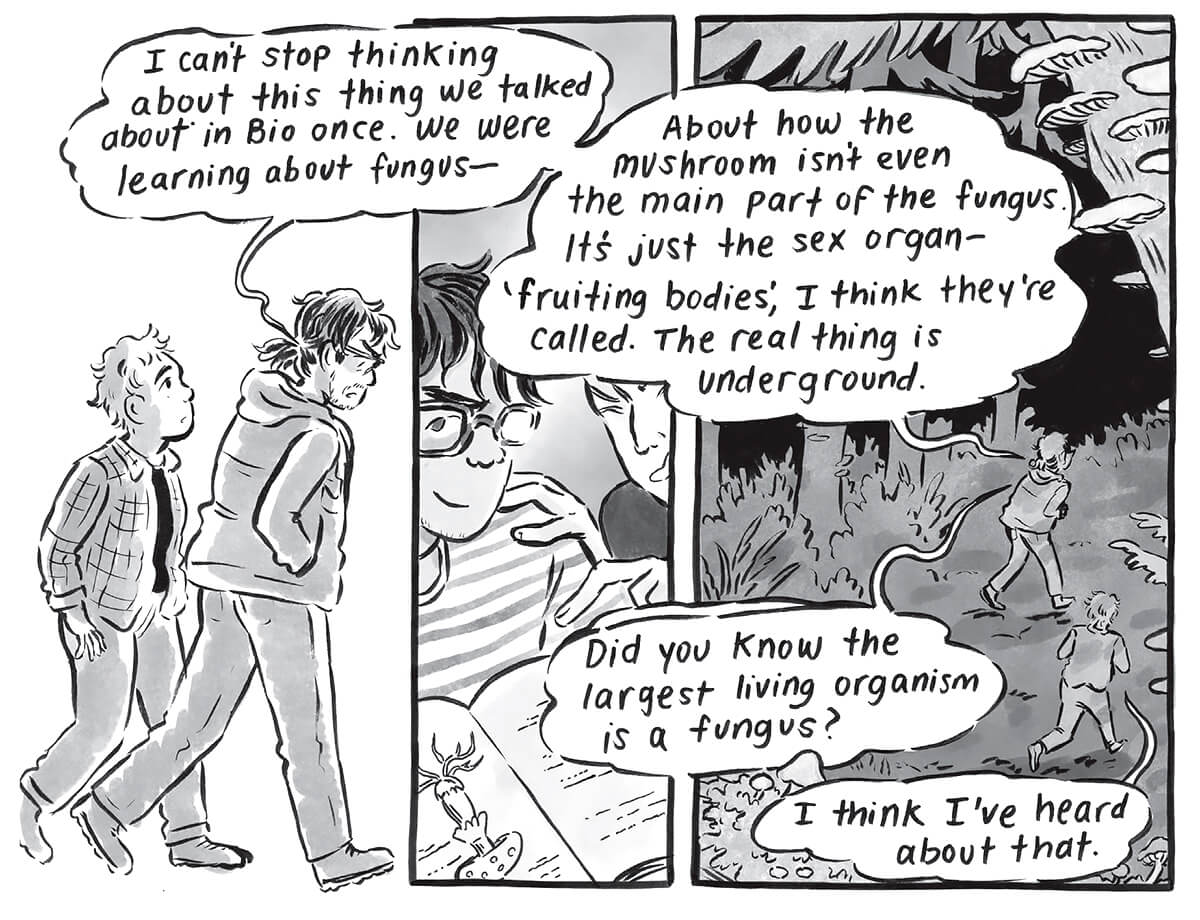
Astute readers will have guessed from the title of Fruiting Bodies that this is a story of mushroom horror. Thanks to various online memes (including the infamous “you cannot kill me in a way that matters” Tumblr post), it’s become a truism that any terrible thing you can imagine about mushrooms actually exists, from Cordyceps fungus infesting the brains of ants to a Honey Mushroom mycelial network in Oregon being more than four miles wide.
Franklin joins Silvia Moreno-Garcia and Jeff Vandermeer in the pantheon of contemporary writers and artists who have celebrated the uncanny invisible world that stretches deep below our feet and proliferates in the warmth of our bodies. Classical botanical horror has its roots in concerns over cultural hybridization, but Fruiting Bodies resists the genre’s Victorian anxieties in favor of a probing exploration of the primal fears surrounding the collapse of bodily autonomy. In the end, Franklin suggests, human social distinctions of gender and sexuality are meaningless to a natural world that devours everyone equally.
