

Women Write About Comics celebrates the 150th anniversary of J. Sheridan Le Fanu’s Carmilla with a series of posts on female vampires in nineteenth-century literature.
At around the same time that Robert Southey’s Thalaba the Destroyer was published, Samuel Taylor Coleridge – one of Southey’s fellow Lakes Poets – was at work on a ballad entitled Christabel. This would not see publication until 1816, however, and even then in unfinished form.
The poem’s narrative begins with Christabel, daughter of the ailing Sir Leoline, walking outside at night when she encounters a mysterious young woman:
There she sees a damsel bright,
Drest in a silken robe of white,
That shadowy in the moonlight shone:
The neck that made that white robe wan,
Her stately neck, and arms were bare;
Her blue-veined feet unsandl’d were,
And wildly glittered here and there
The gems entangled in her hair.
I guess, ’twas frightful there to see
A lady so richly clad as she—
Beautiful exceedingly!
The stranger, Geraldine, explains that she is an aristocrat who has escaped a band of kidnappers. Christabel takes Geraldine back home but fails to notice an ill omen when the household dog moans upon the newcomer’s arrival. Geraldine subsequently collapses on the floor and begins acting strangely: when Christabel speaks of her dead mother, Geraldine reacts negatively, almost as though trying to chase away the dead woman’s ghost. “Alas! what ails poor Geraldine?/Why stares she with unsettled eye?/Can she the bodiless dead espy?”
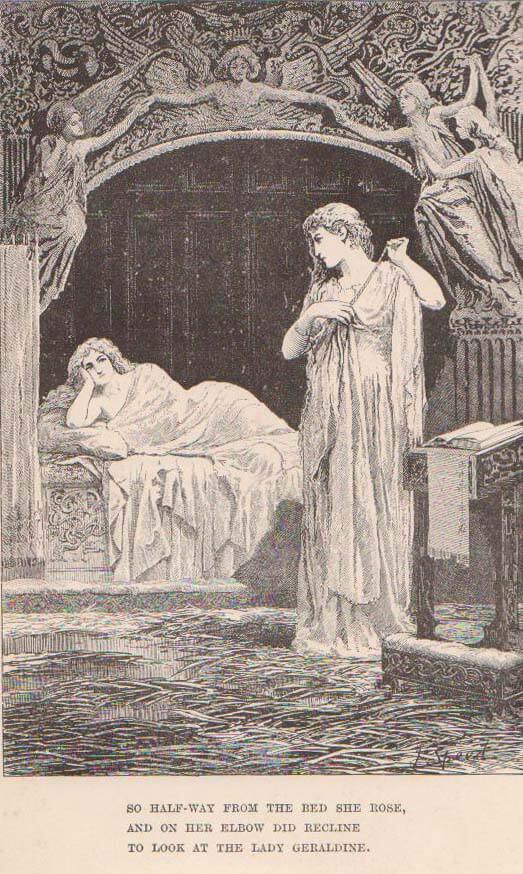
Later comes a strikingly erotic moment in which Christabel witnesses Geraldine in a state of undress:
Then drawing in her breath aloud,
Like one that shuddered, she unbound
The cincture from beneath her breast:
Her silken robe, and inner vest,
Dropt to her feet, and full in view,
Behold! her bosom and half her side—
A sight to dream of, not to tell!
O shield her! shield sweet Christabel!
From here, the poem begins to meander as Coleridge sets up narrative strands that he would never continue. The unfinished tale ends with Geraldine showing a sinister, perhaps even supernatural aspect as Christabel looks at her and sees the eyes of a snake: “Each shrunk up to a serpent’s eye/And with somewhat of malice, and more of dread,/At Christabel she looked askance!”
Even though it lacks a vampire, Christabel is one of the clearest literary antecedents to Carmilla there is. The partial narrative that exists, with the heroine taking a mysterious stranger to her vast home and finding her to have a (presumably) dark secret, has a considerable overlap with J. Sheridan Le Fanu’s tale – in a sense, Le Fanu can be credited with completing Coleridge’s story by adding a vampire.
Three years after the publication of Christabel, the vampire genre began in earnest with John Polidori’s short story “The Vampyre”. Polidori told the tale of a Byronic male bloodsucker preying upon a woman; his contemporary John Keats, meanwhile, opted to explore the opposite scenario.
The motif of a hapless man falling for an otherworldly lover is found in two influential poems by Keats, both written in 1819 and published the following year: the short “La Belle Dame sans Merci” and the longer “Lamia”.
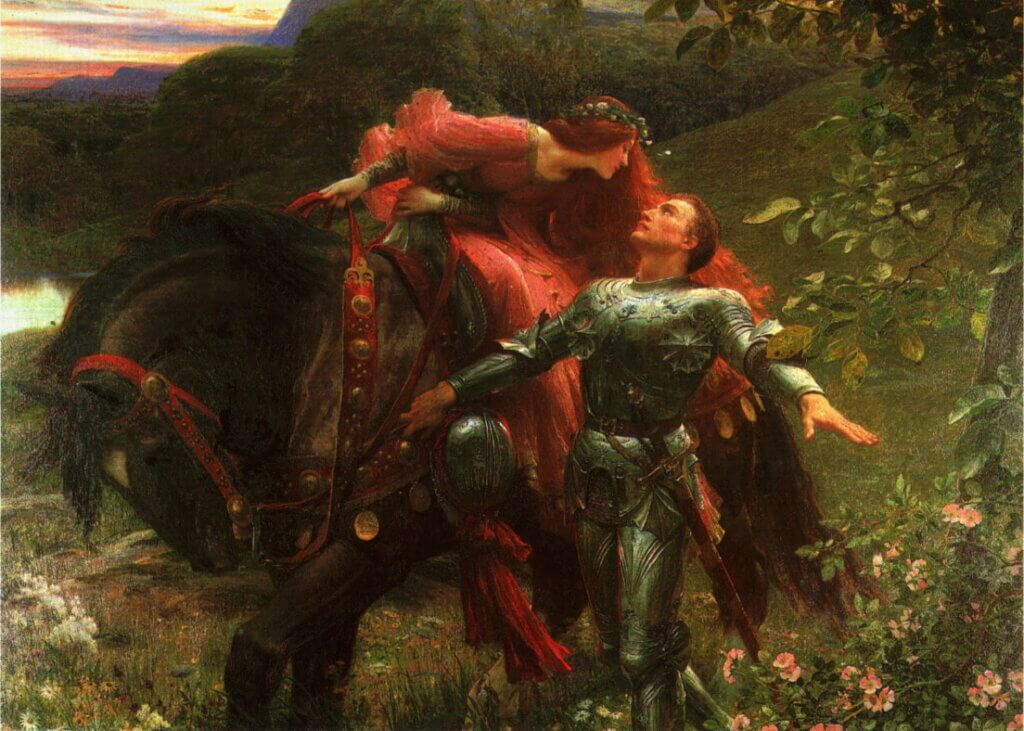
“La Belle Dame sans Merci” opens with its main character (a “knight-at-arms” in the 1819 original, but demoted to a “wretched wight” in the 1820 revision) loiters by a desolate, melancholy lakeside. He tells a tale of having met a mysterious woman – “Full beautiful, a fairy’s child” – who takes him to her “elfin grot” where she kisses him and lulls him to sleep. There, he has a disturbing dream:
I saw pale kings and princes too,
Pale warriors, death-pale were they all;
They cried—‘La Belle Dame sans Merci
Thee hath in thrall!’I saw their starved lips in the gloam,
With horrid warning gapèd wide,
And I awoke and found me here,
On the cold hill’s side.And this is why I sojourn here,
Alone and palely loitering,
Though the sedge is withered from the lake,
And no birds sing.
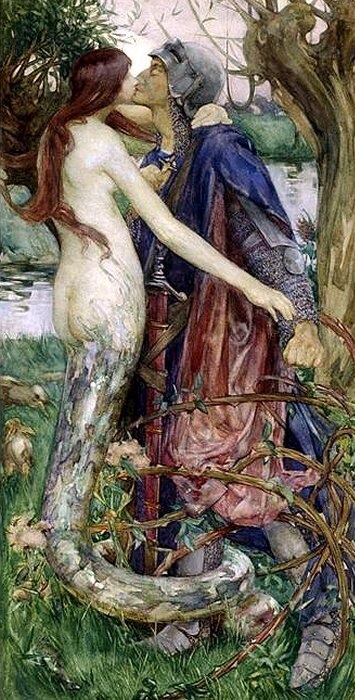
“Lamia”, meanwhile, takes place in a time “before the faery broods/Drove Nymph and Satyr from the prosperous woods”, the poem begins with Hermes looking for a certain nymph. Along the way, he hears a mournful voice:
“When from this wreathed tomb shall I awake!
When move in a sweet body fit for life,
And love, and pleasure, and the ruddy strife
Of hearts and lips! Ah, miserable me!”
Travelling further, Hermes eventually comes across a beautiful and strangely anthropomorphised serpent:
She seem’d, at once, some penanced lady elf,
Some demon’s mistress, or the demon’s self.
Upon her crest she wore a wannish fire
Sprinkled with stars, like Ariadne’s tiar:
Her head was serpent, but ah, bitter-sweet!
She had a woman’s mouth with all its pearls complete:
And for her eyes: what could such eyes do there
But weep, and weep, that they were born so fair?
The serpent, Lamia, reveals that she is keeping the nymph hidden from amorous males, and offers to allow Hermes to see her in exchange for a favour. She explains that she was once a woman, and asks Hermes to change her back to her original form. He obliges, and Lamia becomes “now a lady bright,/A full-born beauty new and exquisite”. The narrative then leaves Hermes and follows Lamia as she sets off to Corinth to pursue a romance with a young scholar, Lycius.
The poem proceeds to chart the tumultuous relationship between Lamia and Lycius (“And knowing surely she could never win/His foolish heart from its mad pompousness,/She set herself, high-thoughted how to dress/The misery in fit magnificence”) and climaxes as the two attend a lavish banquet. The celebration is gatecrashed by Lycius’ mentor, Apollonius, who recognises Lamia: “Begone, foul dream!” he proclaims. Lycius sees her true nature as a serpent – and dies of fright.
Keats’ tale of Lycius and Lamia is clearly borrowed from Philostratus’ narrative of Menippus and the Empusa, both concluding with Apollonius turning up to expose the supernatural bride (as an aside, the story recorded by Philostratus may have influenced another significant poem, Goethe’s “Bride of Corinth”).
As with Christabel, neither “La Belle Dame sans Merci” nor “Lamia” depict vampires – not according to the tightest definitions, in any case. But with their narratives of supernatural lovers, they nonetheless contributed to an area of the literary imagination that would soon play host to a variety of undead lovers.
Next: Here come the vampire brides…
