
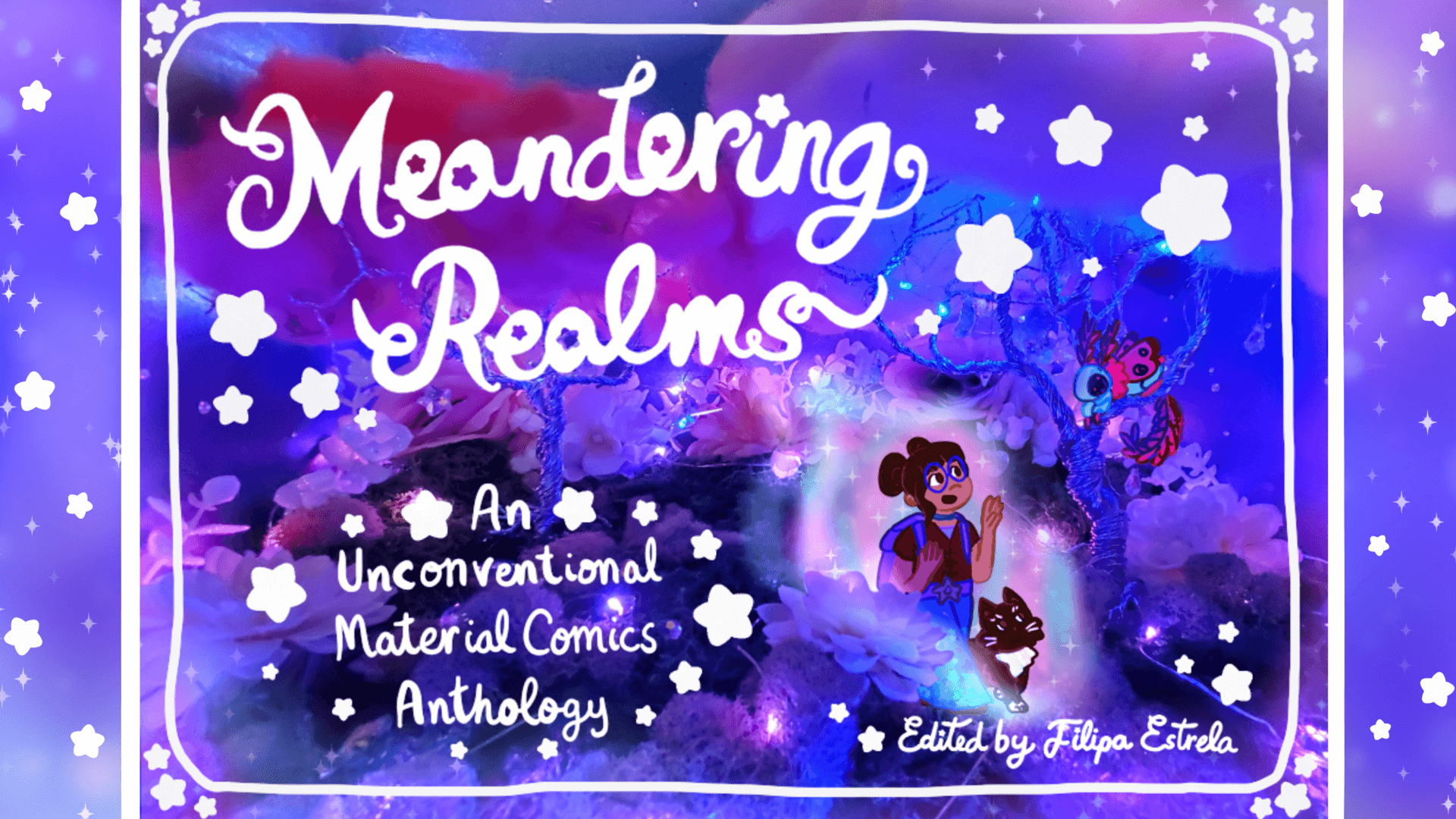
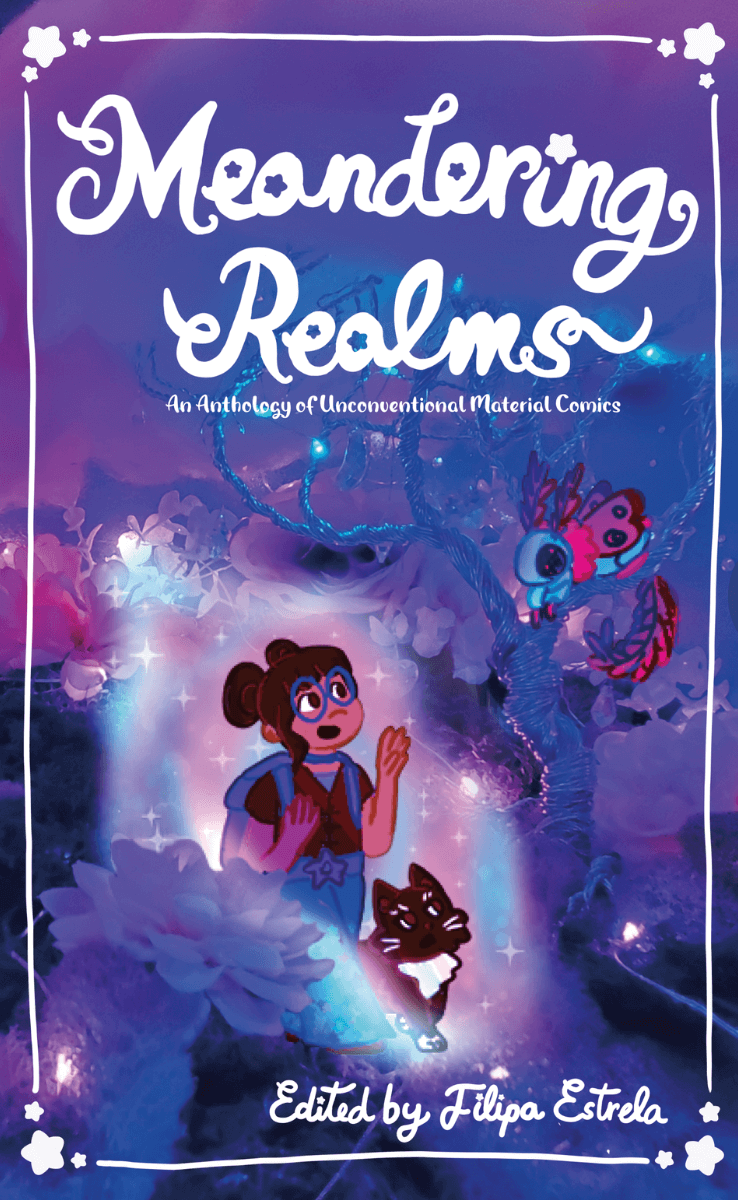
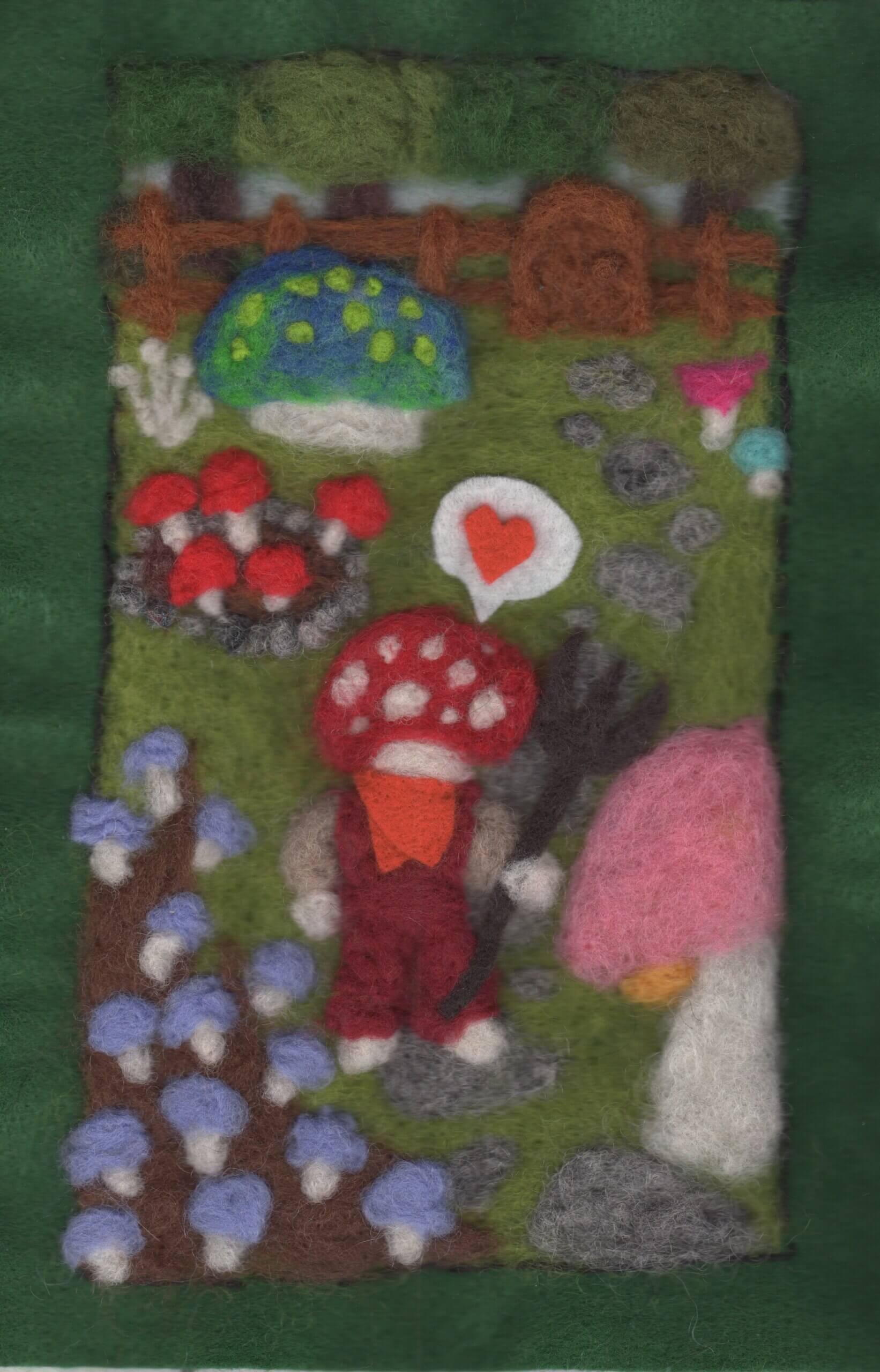
Filipa Estrela is currently crowdfunding the book Meandering Realms: An Anthology of Unconventional Materials Comics, which features short comics by a number of creators in a dizzying array of materials: everything from needlefelting to black and white photographs of facepaint. The stories told are similarly diverse, with some quiet slice of life and some alien exploration.
Filipa answered my questions about this unique collaborative work.
Hi, Filipa! I read your crowdfunding page and this is an exciting project! I love the title Meandering Realms, and the rationale that these comics look like they are from other realms. Why “meandering?”
You’re totally spot on with the rationale that each comic looks like it is from other realms, that’s definitely what I was going for. And if the comics are all different “realms”, then the “meandering” is the action the reader is doing as they go from one comic to the next.
Also, I just love the vibe of the word “meandering”, it evokes movement and action but it’s not a harsh or fast action.
When you meander you are taking your time, you don’t have a specific or urgent destination, so you’re likely more carefully observing your surroundings and you’re more open to possibility and exploration and discovering something new! I hope that when readers are reading these comics they are letting themselves meander through them.
Your funding page talks about the combination of craft and comics – how do you think unconventional materials serve comics?
Unconventional materials serve comics in a lot of different ways!
One of the most obvious ways is that they push the boundaries of what visually comics can look like and what they can be made from.
Comics to most folks just means drawn sequential art, which has a huge pool of visual possibilities because everyone has different drawing styles and approaches, but the introduction of unconventional materials I think really deepens that pool in unexpected ways.
Unconventional materials are also a great way to get around artist drawing blocks. When you’re crafting your comics you’re engaging a different set of skills and brain space. You’re often problem-solving and engaging with the limits of your materials… sometimes those limits make creative decisions for you (like you might only have certain colors of a material or there are only so many ways you can manipulate it) which can be freeing… or frustrating, but I prefer to embrace and say it’s freeing haha. And some crafts can be really therapeutic– needlefelting in particular has great little stabbing motions that are great for releasing tension.
But most importantly, I think unconventional materials can be a fun gateway into comics! Something I hear a lot when talking to folks who are new to comics is the notion that they could never make them because they can’t draw. My go-to answer is that you don’t really need to know how to draw and for a long time all that meant was that you could made comics and draw “badly” or just make stick figures and that would be fine… but something here’s the thing I’ve discovered — you don’t need to draw at all to make comics!
More often than not, folks who haven’t spent time honing their drawing skills have in fact been working on some entirely different skill or interest, and I am really interested in challenging those folks to bring whatever that skill or interest into comics. Like, maybe you’re a woodworker, I’d love to see some carved comics or like… a comic where all the characters are chairs? Or what if the comic is carved into a chair and reading it leads your eye all around the chair? Or maybe you collect fridge magnets, what would it look like if you arranged those magnets in a way that tells a story? Or maybe you’re just really great at formatting excel sheets, what would an excel sheet comic look like? I don’t have the answers to these questions but someone out there does and that’s very exciting to me and is what I believe to be at the core of what unconventional materials can do for comics.
Did any of the contributions to Meandering Realms surprise you?
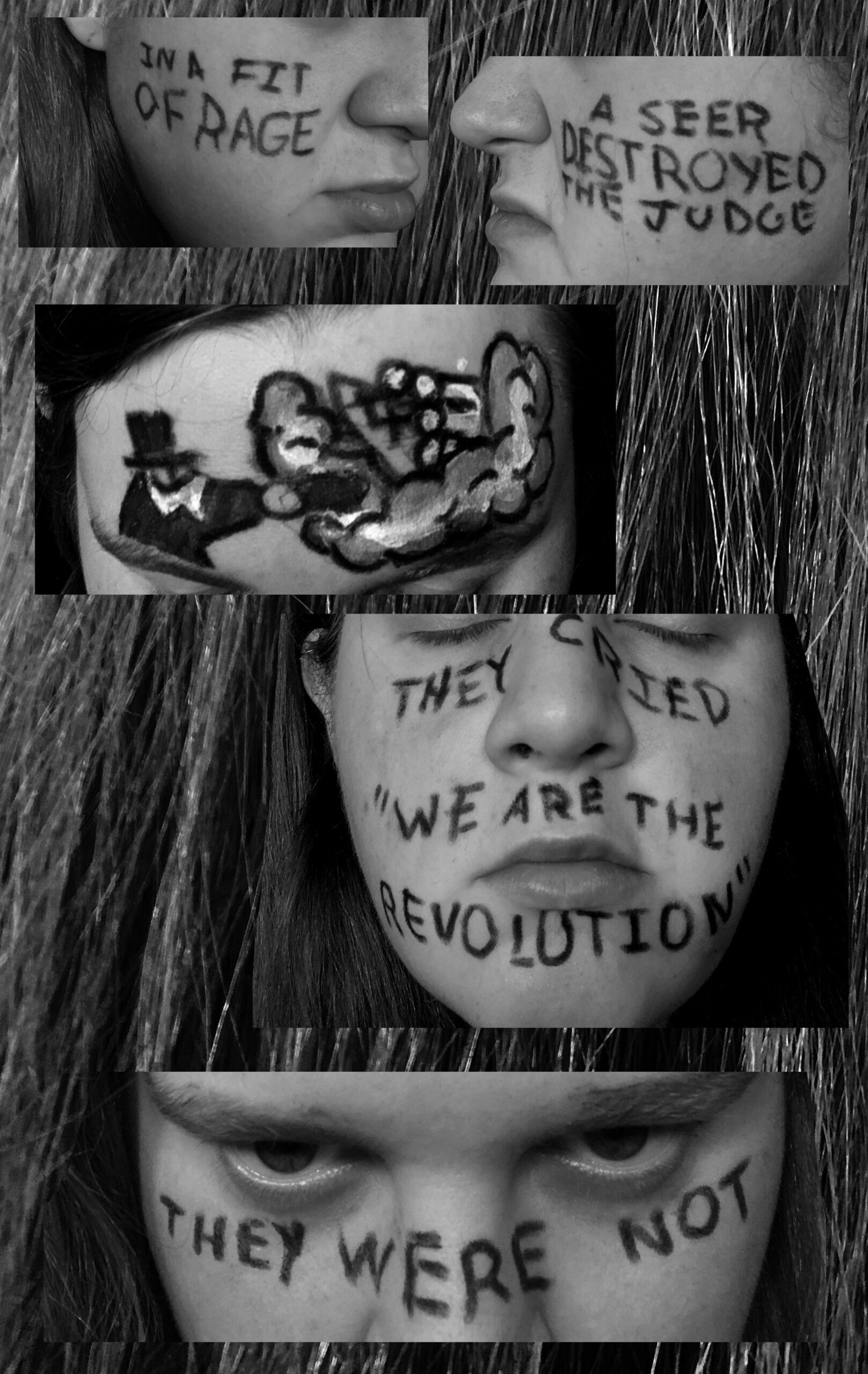
Bread Tarleton’s face paint comic. I would have never expected someone to propose a face paint comic and the execution is beyond anything I could have come up with myself. Everyone else’s comics are wonderful and exciting in their own ways, but Bread’s is the one I still can’t believe is real.

What other cartoonists do you find inspire your work?
There are a lot of folks whose work I am obsessed with and all for different reasons.
But for unconventional materials, in particular, I have to shout out Maelle Doliveaux’s work. Encountering one of her cut-paper comics was what lead me from “oh this needlefelted comic idea I have is nothing special” to “oh not only do I want to make that needlefelted comic but I also want to make cut-paper ones and also… and also….”, her work was on one hand beautiful but it also was greatly enhanced by the material she’d chosen. The cut paper style she works in has so much depth and shadow and it really invites you in.
I also want to shout out Eunsoo Jeong who makes the Koreangry clay comics. She makes full sets and wardrobes for her clay persona, the level of detail is so fun. And her comics are another great example of an unconventional material enhancing the work. You get very quickly drawn in by the colors, fun little clay props, and kind of goofy looking clay character that might make you think this is a comic for kids or jokes but her comics are actually really raw and deal with tough issues like sexism, racism, and xenophobia in real and unapologetic ways.
It seems to me that photography and/or scanning is a necessary component of making these unconventional materials comics distributable. How do you think about this recording process as part of the art process? Like, the materials are generally three-dimensional, and then get recorded in a way that makes them 2D.
The recording process is definitely an interesting challenge, especially with the very 3-dimensional works, and it can actually be quite difficult. At some points scanners are just either totally incompatible or sometimes just can’t capture the level of detail you want. Some materials are hard to photograph — I have a comic that is made of sequins and cotton balls which was a nightmare to photograph because the sequins reflected light, the cotton balls absorbed it, everything looked both too sharp and too fuzzy at the same time… But it can be something that adds to the art process. Manipulating lighting and shadows adds depth, capturing texture is tricky but really rewarding when you hand someone a page and they touch it thinking they might feel it. Ultimately if you’re able to capture that 3D feel on a 2D page in a way that shocks and awes all the trouble is worth it.
Thank you, Filipa! Meandering Realms: An Anthology of Unconventional Materials Comics is currently crowdfunding through early October.
