
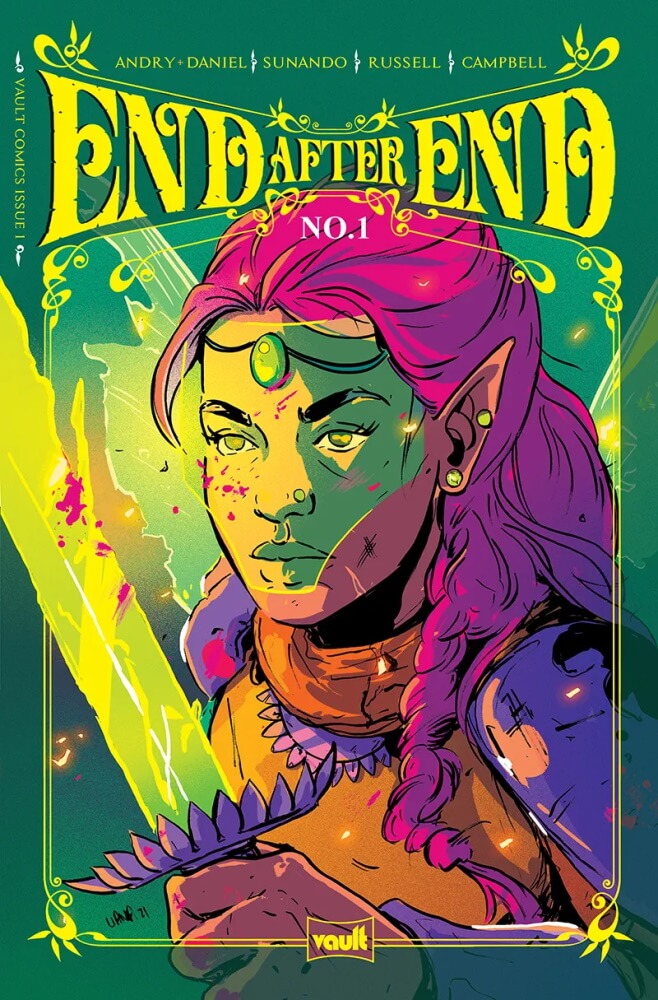
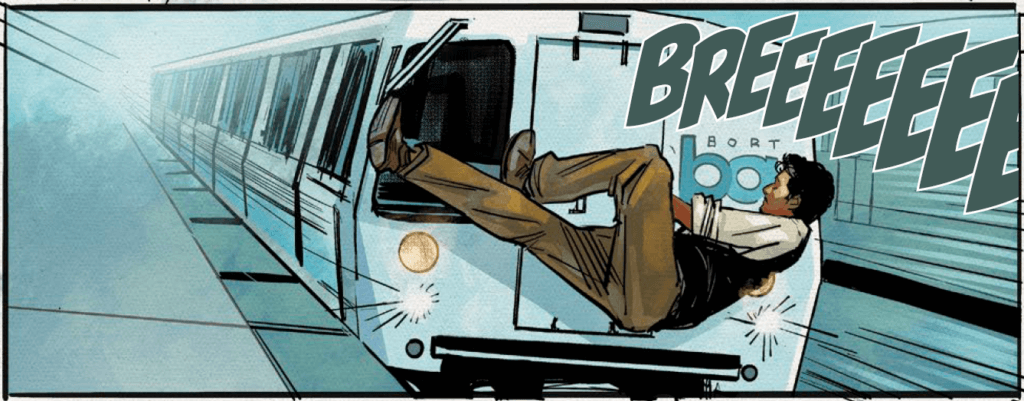
End After End introduces readers to Walter Willem, a man who doesn’t have long to live—seconds, in fact. Those crucial seconds are actually the start of his adventure, as he slips off the edge of a subway platform and into a world of winged faerie warriors fighting an unending battle against implacable darkness.
End After End #1
David Andry (Writer), Sunando C (Artist, Cover Artist), Jim Campbell (Letterer), Tim Daniel (Writer), Liana Kangas (Cover Artist), Kurt Michael Russell (Colorist)
Vault Comics
August 24, 2022
I love a good comic about death.
There’s a tendency in modern fantasy comics to lore-dump; that is, to throw an overwhelming cascade of new concepts and terminology at readers in their first issues, to make the general shape of their fantastic worlds easily discernible. The trouble with that approach is that it rarely works. Most potential new readers are turned off the book because they’re so busy trying to process and internalize a story’s made-up words that they’re not paying attention to the flow of the story itself (if there even is one underneath a given story’s gobbledygook). To its credit, End After End manages to avoid that pitfall, although it seems to stumble into another one.
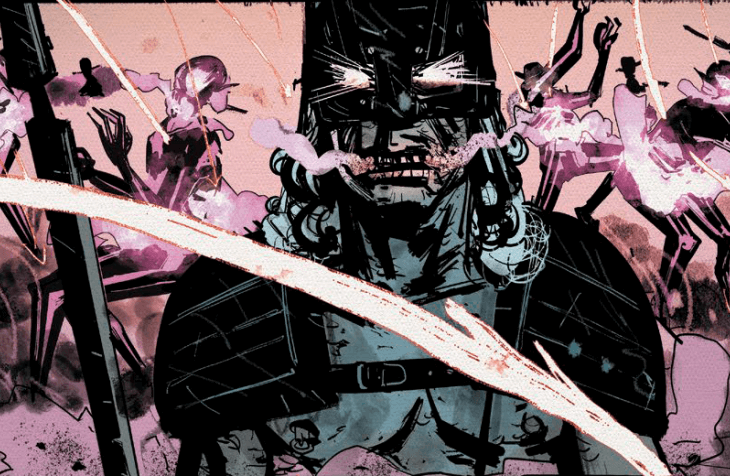
The story element I truly enjoy here is Willem’s confusion and outright rejection of the battle raging around him. He doesn’t understand the logic of the seeming fiction he’s been plunged into, and in that, he becomes relatable to the reader, who too often encounters the problem outlined above. It’s a smart choice from a writing perspective because I found myself instantly sold on his personality and confusion. When writers Andry and Daniel do dole out information about the world, they’re sparing with it, only giving what is necessary for the moment. Willem is on a battlefield. He’s given a shield and told it works best when pointed at the enemies. The enemies are easily identifiable, hollowed out, dead-looking things with bat ears and glowing with an unnatural light.
After the battle, Willem gets a little more information by the light of a fire. In the “real” world, he’s dead, or soon enough to be that it doesn’t matter. This world is the End After End, where the battle rages eternal, and each warrior fights until they die (for real this time). The character imparting this is one of only three named characters in the story, each on the opening credits page. Grink is his name, and he’s a shorter, bearded fairy-like being one might liken to a gnome. Grink tells him his only duty is to fight in the service and protection of the Catha, a beautiful, bewinged, and unstoppable warrior. The Catha says a whole of three words in the entire issue, but I don’t take issue with that fact here. She’s a general of a sort, far removed from Willem’s position as a rookie grunt, and given the issue’s centering on him as a viewpoint character, it makes sense he might not be speaking directly to her from the start.
No, the issue I take here is that, for all of this world’s accessibility to readers, it features such a heavy focus on the battle itself, the breathless pace of it, that the sparse details given about the world are too sparse. I ended the issue feeling like I was at a midway point. That’s not an entirely bad thing, as an issue focused on battle should feel breathlessly paced, but it does leave one feeling frustrated and hungry for the next issue. That also isn’t an entirely bad thing, but there’s a fine line between being excited about the next issue and annoyed you have to wait because you don’t feel like you got enough information. End After End teetered juuuuust slightly onto the latter half of that line.
Art for the series is handled by Sunando C, whom I’ve not encountered before. He employs an impressionistic style here, which worked for me; first, because his sketchy, detailed linework aids the sort of fuzzy reality of the series, and second because it allows him to do some truly interesting work with the confusion of battle. His panel borders are as rough as his figure work, but it’s clear in both cases that the choice is intentional, with hatching lines that bleed past those same borders, giving the layout of the comic itself a kind of kineticism. He’s aided with colors by Kurt Michael Russell (good choice on including the middle name, there), who brings a painterly quality to the landscapes and figures Sunando lays down. As early as the second page of the story, Willem’s trying to peer his way through foggy terrain, something that’s enhanced by color-distorting bands of fog intercepting the page between the reader and Willem himself. It’s a considered choice, and one I found myself flipping back to admire more than once.
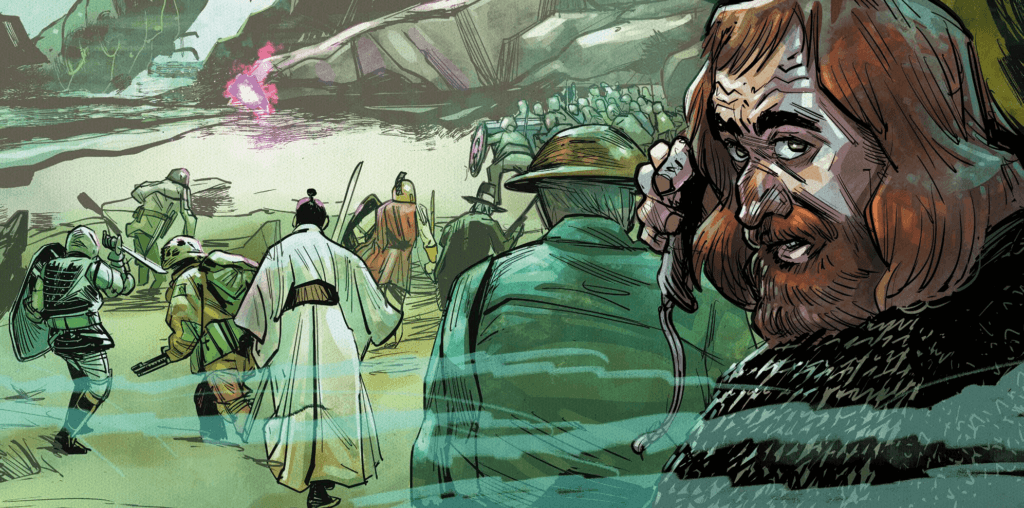
Rounding out the creative team is Jim Campbell on letters. Campbell makes a subtle choice here that I enjoyed! Only the first page of the story takes place outside of the End After End itself and features Willem on the subway platform. While there’s no dialogue here, the sound effects are nonetheless cleaner and more precise typeface choices, as opposed to the bloody raggedness of the sound effects featured in the battles later on. That and Russell’s color palate shifts anchor the differences between the two worlds in an attractive—and more importantly, useful–way for the reader. His dialogue balloons are similarly edged and sharp, with a typeface that has the varying line thickness inkwork, whether or not the font is itself a digital one. The whole thing adds up to a heightened reality that feels immersive, even as Willem’s situation is explained to him and he realizes he’s been taken out of the world and life he knows.
As a whole, I found that despite my minor frustrations with the first issue’s confusion and sense of pacing, I legitimately enjoyed this book, both in concept and execution. I’m interested in following the series as it continues toward whatever End may await it.
