


Alec Longstreth, creator of the Eisner-nominated webcomic Isle of Elsi, longrunning minicomic series Phase 7, and graphic novel Basewood, sat down with WWAC to talk about making comics for children, the challenges of serialization online, and Carl Barks.
Responses have been edited for length and clarity.
What inspired you to make Isle of Elsi a webcomic instead of the print minicomics you’d been doing prior?
Some of it was just financial. I wanted it to be full-color because it’s a comic for kids, so doing it as a webcomic is sort of an inexpensive way to have full color so people can read it without having to do the upfront cost of printing it. So that was one of the original intentions, but also just the time when I was starting to work on the comic (which was about six years before it actually launched) was this weird time where — I sort of hate the term “graphic novel”, I see it as an extension of the distancing of comics — like, comics are for kids, and I’ve had students at CCS say “I don’t read comics, I read graphic novels”, and sort of this thing, and it was at a point where a graphic novel for kids costs 10 dollars, but when I was a kid I could get a comic book for 75 cents. And so it was in that vein of like, “what if instead of working on something that comes out as like (which it eventually did become) a twenty-dollar book, what if it was free and accessible to anybody that wanted to read it, and so that’s been the mission from the first day. So I launched it in 2016, all the archives are up, and everyone can read every comic for free. I don’t know if a lot of kids do read it online [laughs]. One of the things I’ve struggled with is just parents being like “oh I don’t really want my kid reading it on the computer.” So they just wait for the book to come out and then read it with them. But I’ve stuck with it. I don’t regret it. It’s a nice way to have a new update, and I’ve really loved the weekly deadlines. Lots of reasons, I guess. There’s a messy answer for you. [laughs]
I’ve also had that experience, where like, I was teaching a comics class to middle schoolers, and I asked them if any of them read comics, and one of them said, “Well, I read graphic novels,” and I was like, “that’s also comics!”
Yeah! It’s a weird thing. I think when Will Eisner — and you took the comics history class, so you know, there’s a lot of debate on “what is the first graphic novel” and I think we could say maybe Will Eisner popularized it even if he wasn’t the first one to use it, but it feels like an intentional thing to distance himself from the comics burnings that were happening in America in the 1950s and stuff, this idea that it was corrupting children’s minds and the Senate hearings and all that kinda stuff. I try to be very upfront about it. I don’t really like the term “All Ages,” which again feels sort of like a cowardly way to say “it’s for kids but I don’t want to say it’s for kids” because comics for kids carries this negative connotation, so for me it’s like, I proudly say “It’s a comic. I want kids to read it.” That is the intended audience. And it allows me to have bad jokes and visual gags and stuff. I’m unabashed about who I want to read it. And yeah, if you’re an adult, just have the confidence to know it’s a comic book, it’s a webcomic, and it’s meant for kids. I read all sorts of kids media. I read picture books with my daughters, and I have picture books I enjoy that I read as an adult. You just have to have the confidence. I’m not going to pander to an adult audience and say “well actually it’s an all-ages graphic novel so it’s okay for you to read it,” just have the confidence to know that you can read a kid’s comic.
Yeah! And that leads me to my next question. How does your writing process differ when you’re writing for kids versus when you’re writing for adults like in your older work?
I think it’s less stressful. I have a quote over my writing desk that’s from Matilda, where she’s talking to I think the librarian early on in the book when the librarian is like “Oh, what books do you like, Matilda?” and she’s like “I think all children’s books should have funny parts in them because kids like to laugh.” And so I try to make sure every story has some humor in it that’s going on. There’s also just less pressure of… sometimes I like to wear my influences on my sleeve and like, I have a scene where the guy that we think is the bad guy reports back to a guy that’s an even bigger bad guy, and it’s very Darth Vader reporting to the Emperor, and I think if you were working for adults you’d be like “Oh I can do that, because it’s kinda cliche,” but if you’re writing for kids, they might not have seen The Empire Strikes Back from 1980 yet so to them it’s a new idea. Sometimes you read something and think “Wow, this is a classic scene!” and then you find out later that it’s an homage to something else, or you hear a song and you’re like “I love this song!” and then later find out it’s a cover and you hear the original version of the song and realize “oh my gosh, that person was covering it 20 years later.” I just don’t worry about that stuff as much. And it allows me to put silly stuff in there that I really like. Sometimes writers talk about their “internal age.” I feel like I’m about nine, which is the age of the main character, Rex, so he’s sort of a stand-in for me. It’s just looking for any little part where I can make it more interesting. I have a scene where the adults are having a meeting and it’s like, well what if one character falls asleep and their snoring sound balloon gets bigger and bigger and bigger and then someone pokes him and wakes him up and he goes “HUH?” So it’s a running gag going in the background while normal comics stuff is going on on the surface level. I try for visual gags and verbal humor in every story no matter what else is going on.

Can you talk a little more about your influences that you reference?
The big thing for me is Carl Barks. Those are the comics that I read growing up. I read Carl Barks two times — once as a kid in the 80s and 90s, that’s what made me want to draw comics, and it’s like air to me, just breathing it, reading it, that was my whole world. And then when I started working on Isle of Elsi in earnest, that’s when I was finishing up my graphic novel Basewood at the Center for Cartoon Studies as a fellow, which, if you’ve read it, it’s very sad and depressing and I was working on these huge 18 by 24 inch pages with lots of crosshatching and it was not a pleasant process, and I just had this feeling like I wasn’t gonna make it as a cartoonist if this was what I’m doing. If I make books like this, I’ll only make 3 more books and that’ll be my career. So I was trying to say “how could I have fun?” Because I wasn’t having fun. I was depressed and having an awful time at the drawing board. So I was like “what do I love about comics? What could I do that would really make me want to sit down and draw and have fun?” So I tracked down the complete Carl Barks library which is 30 volumes in a slipcase, and I reread his entire body of work — 6,241 pages of comics, while I was starting to write Isle of Elsi, and it was just an amazing experience. Because when I was a kid, I was like, “These are great! There’s adventures and gags and stuff,” but I didn’t appreciate the craftsmanship behind it, and then coming back to it in my early thirties after I’d been drawing comics for about ten years, it was like “Wow!” There’s this amazing efficiency with Barks. He was on a monthly deadline for 25 years so there’s never any unnecessary detail, it’s just incredibly efficient, really tight plots you just move through, they can go around the world in 10 pages. He can just get a ton of storytelling done very quickly. That’s the main one. It was just like “I want to make comics like this.”
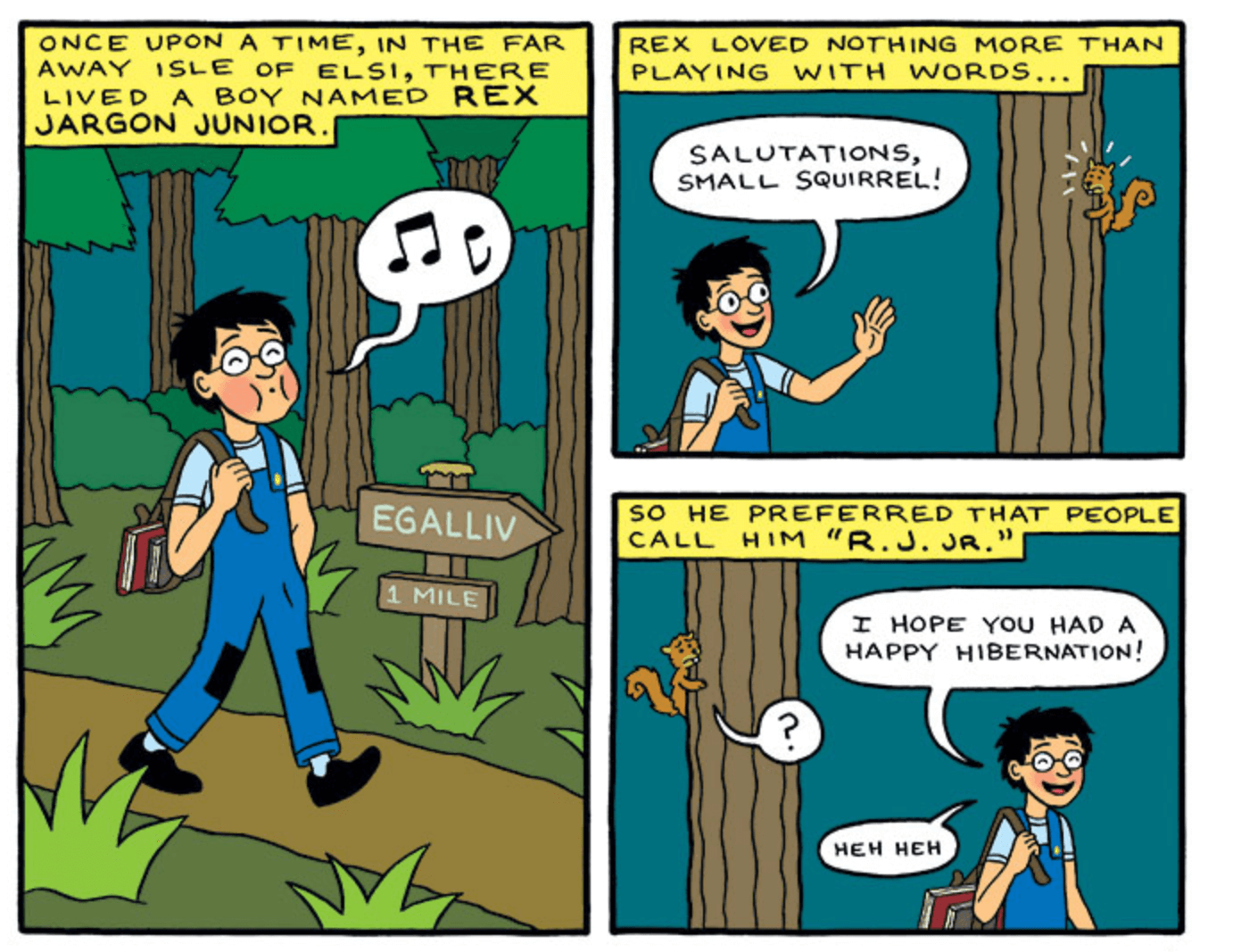
And there were stylistic choices: I got rid of all my crosshatching that I still do in my personal work and that was in Basewood, switching to full color, the four-tier page layout is directly inspired by Barks. So all those things, and trying to get some of that storytelling energy that he had of the kids running the show and the adults coming along, and adventures and making sure it was fast-paced and stuff like that. The density. And then some of the other ones are stories, like Kenneth Grahame’s The Reluctant Dragon is a short story that’s just wonderful about a little boy and a dragon becoming friends, The Sword in the Stone that was storyboarded by Bill Peet and written by T. H. White, the interrelationships between wizards and dragons and… Harry Potter was a big influence for me too, I was a reluctant reader growing up so I read the Harry Potter books in my twenties and that was another big influence. When I was younger I felt like I couldn’t show my influences and I had to be totally unique, and then I made Basewood which I thought was totally original and later realized it was influenced by all these things. So it’s like, “it’s okay, everyone does this, because it’s still being processed through my life experiences and stuff.” When I first started Elsi, I did a crit at CCS, and the students were like “this little character looks exactly like Harry Potter! You can’t do that!” And I was like, “Why not?” [Laughs] He doesn’t have a scar on his head. He’s got glasses and scraggly hair or whatever. And it’s like, I’m just going to do it, because that’s who he is. Harry Potter wearing overalls.
I mean, it’s not like you can copyright glasses and scraggly hair, right?
Yeah, my daughter will sometimes sit on my lap while I’m drawing, and she says, “Rex has untidy hair just like Harry Potter.” That’s what she says.
Aww! Do your daughters give you ideas for the story?
They’re a little bit younger than the protagonist. My daughters are currently four and six. I will read it with them, that’s really fun. I’ll read drafts with them and pay attention to where they’re laughing and is the humor connecting. I’m working on a bit right now with stalagmites and stalactites and my daughters just love those, and it’s like, “mission accomplished!” But yeah, I think some of the stuff, Rex and Sally are between nine and eleven, so they’re a little bit older. In an early draft of one story, I showed it to James Sturm, and his daughters are now in college, but they have the same age difference as Sally and her brother, and I’d made a scene just a little too saccharine, like, “oh, I’m going to do the dishes!” “Oh, thank you sister! And why don’t I dry them off?” And he was like “kids don’t act like this, this is not realistic, they should be bickering, like ‘I did the dishes last night, you have to do the dishes!’ ‘Fine, then you dry!’ ‘I dried them last night, too!’ They have to threaten each other. That’s how siblings are.” So that was good advice, and I’m starting to pick up on some of that watching my daughters get into arguments now. I suspect they’ll influence it more as they reach that age and then they’ll age out and I’ll just have to rely on memories or whatever. I also grew up with two sisters so I draw on those conflicts to make the relationships more realistic.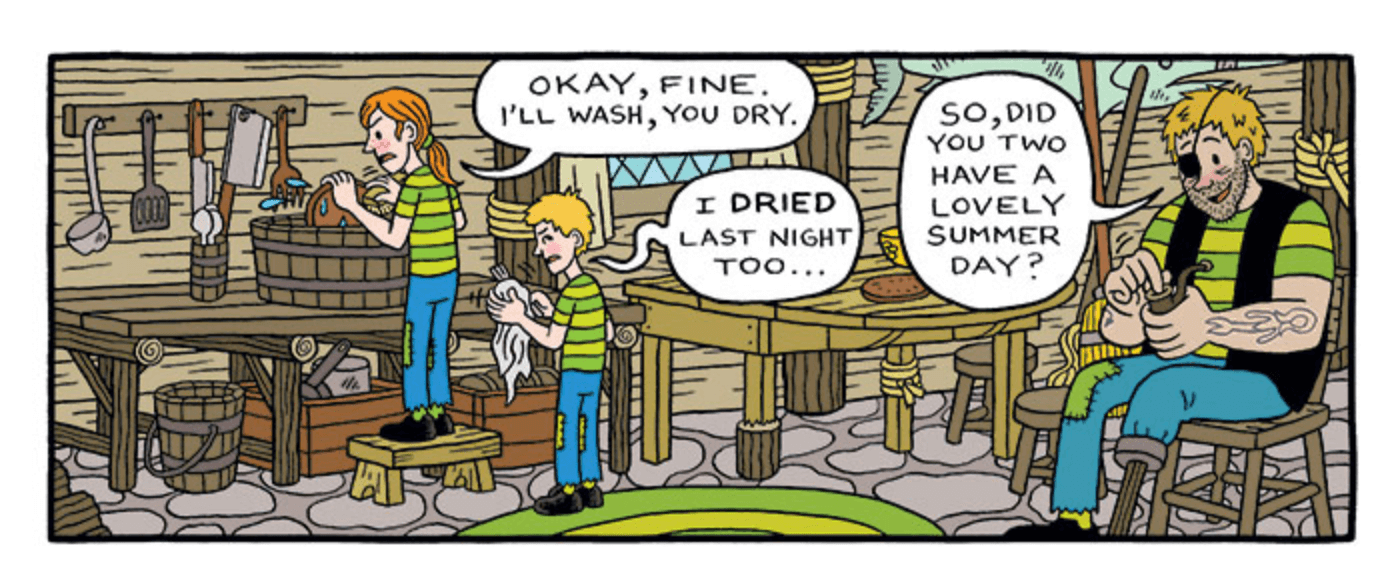
I’ve noticed that the stories in Isle of Elsi are very different lengths, like one is 100 pages, one is 20 pages, one is 10 pages, do you outline first, or decide how long each story is going to be before you write it?
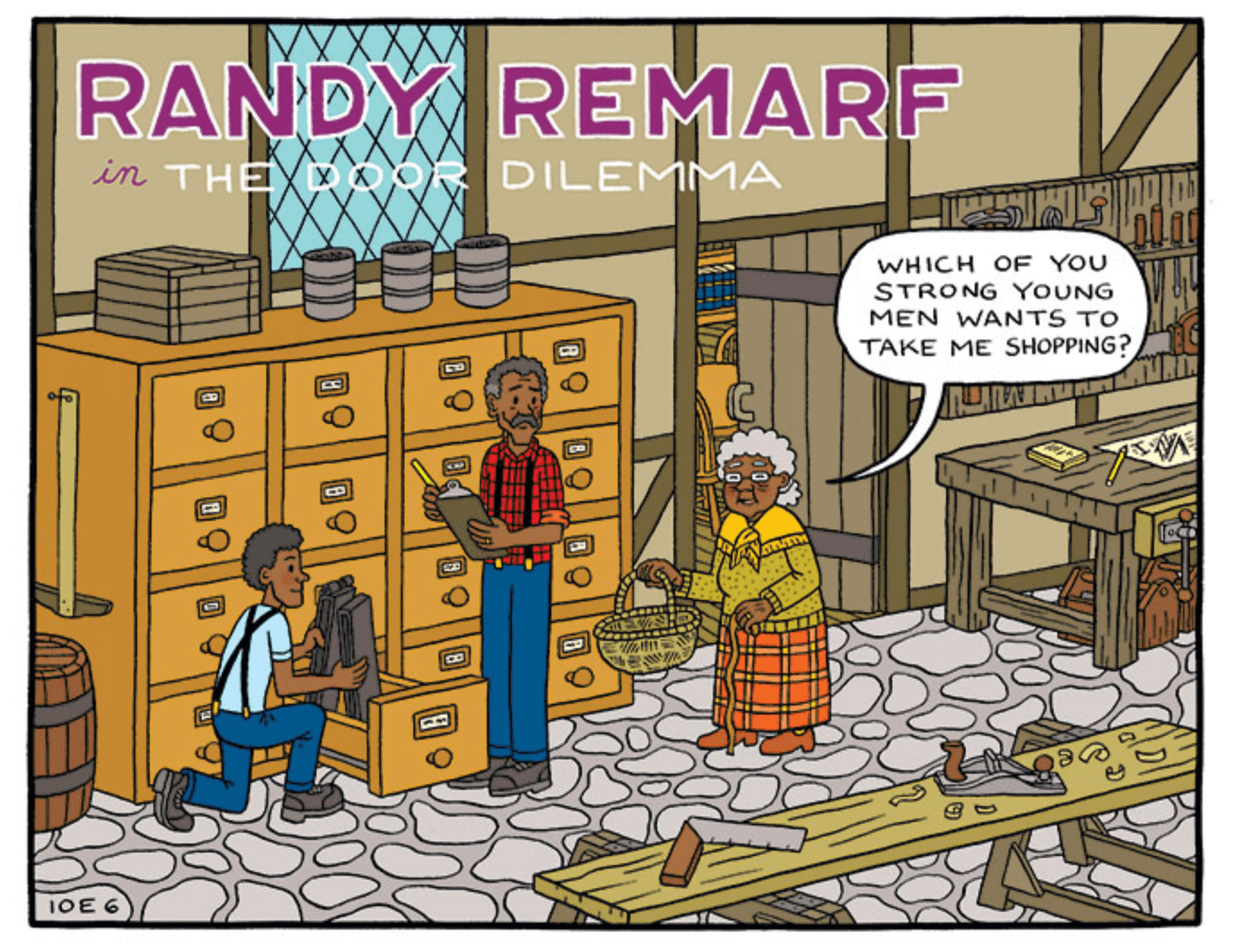
So one of the other things that came out of Basewood, Basewood is 216 pages and it was just hell for me. You know when you’re on page 175 of a 200-page book, that’s a very unhappy place to be. I think it’s actually unhealthy. [Laughs] I’m not a fan of the graphic novel model of spending all this time on just one thing. So one of the ideas I had was to never make a story longer than 100 pages, so that’s the length I want the big stories to be. My idea, some of it is just because I was doing anthology pieces, and then later I had to tie them together when I launched the webcomic to button up all the transitions, but even after that was then it was just nice — I post a page a week, so a hundred-page story is two years — it was just nice to knock off a ten-pager and tell a whole story, push some plot elements forward, get a couple jokes off your chest, and then do that once or twice. I think it’s healthy, helps clear my mind a little bit. Even though I sort of stumbled into that format, I think I will keep it. The other thing it allows me to do, which is really nice, is that the last two stories I posted, I’m on a writing hiatus right now writing the next big 100-page story, but the last two ones featured side characters but it allowed me to make them the main protagonists, which is fun, and Rex and Sally who are usually the main characters are in the background. You might only see them in passing for a couple of panels. So that’s another thing that’s fun about a shorter story. You can grab someone and say “What if this was their story?” and we get a glimpse of their life and how they’re interacting with this town and all the other people.
It makes the world feel fuller.
Totally! And that’s another thing I learned at CCS. I think it was a Steve Bissette lecture about The Spirit — Will Eisner again. I think there was a stretch there where he got bored of the main characters and just featured side characters and do whole stories where the Spirit is only in one panel to introduce it or happens to go by in passing, but it’s taking place in the same world. In my mind, at least, each book would be one big chunky story of 100 pages, and then one or two shorter stories in the back. So you open with a big story for each book and then add flavor with the background characters.
I think it works really well!
Thanks! It’s just nice, when you have like a — the last 2 stories I did were 20 pages and that’s six months, it doesn’t feel insurmountable. So it’s like I’ll just plug through this by the end of the year and then go into the next story. And it’s less intimidating.
Yeah!
I know you also do web design and animation and other tech stuff, and the web design for Isle of Elsi is really pretty! Is that also a fun part of the webcomic process for you?
I do some web design, but I did not do the Isle of Elsi website. I hand-drew all the elements, but my friend Nate Beaty actually coded it. He has a company called Clixel and is a great cartoonist in his own right. One of the best web designers out there. Stuff that I wouldn’t know how to do — if you look at the Phase Seven website where my minicomics are, I coded all that, that’s the limit of my abilities. He was doing stuff like, “What if we click on Archive and the bookcase slides in and each story is on a different shelf?” and he was like, “Yeah, I can do that!” And I was like, wow! I don’t even know. There are also little easter eggs that are hidden — if you look at the stalactites very carefully, one of them wakes up and looks around. He was able to do that with secret gifs that appear. There’s lots of little fun stuff. And that was with the idea that kids might be on here. We tried to design it so there’s no links to other sites, no ads, you just come here to read the comic and that’s all. But most of the credit goes to Nate Beaty.
That is super cool. And have you had difficulty reaching out and getting kids to read it?
It’s been an interesting challenge. For my Patreon supporters, I do a podcast, and I interviewed Drew Weing, who’s done webcomics for decades, and it’s something I’ve struggled with, so I remember I asked him “how do you connect?” because he’s doing a series for grade schoolers called Margo Maloo that’s also published by First Second. And he said “it’s just two different audiences.” It was great. He wasn’t really bothered by it. It was just sort of “oh, teenagers and adults are looking at the website and kids need to read it in print.” The hardest part was the first two years, three years, when I was building up the backlog of pages but I had not made any print collections.
There were some very awkward shows where I was like standing at SPX with a binder of printed-out pages and adults with their kids are going “this looks great, we’d love to read this!” and I’m like “it’s not in a book yet, but you can read it online!” and they’re looking at me like, “I’m not going to go online with my kid!” or whatever. But then once I had the book it was like, “Oh cool!” and some parents have said that they read the book and loved it and then went online to continue reading the story. I do have some very gung-ho parents who load the page and read it with their kid every Thursday and talk about the story as it’s developing.
It’s hard! The pace of comics that I’m drawing, I like a sustainable, achievable, human amount of comics, which is like a page a week, which I know is sustainable because there are newspaper cartoonists who did that for fifty years, it’s slow! It’s 50 pages a year. It might take 3 years. Say a kid picks up Isle of Elsi and they’re 9. They’re 12 by the time book 2 comes out, and by the time book 3 comes out, they’re 15! They’re not going to read that anymore, probably. So, I don’t know. That’s a challenging thing. And I’ve talked to other cartoonists about that as well, where you like build an audience but then they age out because it’s so slow drawing comics and you sort of have to catch the next generation of kids coming up. I’ve kind of let go of that. I can’t really control that. Hopefully, when I’m dead there’ll be a nice shelf of books and someone can come along and sit down and read the whole thing.
What’s next for the comic and also for you? Any other projects you’re working on?
Right now I’m writing the seventh Isle of Elsi story. It’s called R. J. Jr in the Underground Underground, and it’s the first story that blows the lid off everything. We’re gonna meet the dwarves and get into some high fantasy stuff. I’m about halfway through writing that right now, but it does mean the webcomic is on hiatus. I’m not posting pages right now. So that’s the main thing I’m working on. I hope to be building up a little buffer by the end of the year and then posting next year. I’m always working on the next issue of Phase Seven, my minicomic that I’ve been publishing since 2002. So it’s the 20th anniversary this year. I’m working on issue 25 of that.
Congratulations!
Thanks! And then the main thing, since the pandemic began, as you’ve mentioned, I’ve been animating late at night after my kids go to sleep, so that’s been fun. I’ve been trying to teach myself, and I have an animation workshop coming up this summer at CCS so that’s the other place where I get to hang out with other people who are interested in animation and stuff. And those are my projects!
Do you have any recommendations for kids’ comics similar to Isle of Elsi?
A big one is Hilda by Luke Pearson, my kids love that series. Bone by Jeff Smith is the big one for fantasy, he’s also a huge Carl Barks fan so that felt very familiar to me, my kids love reading that. The Island books by Evan Dahm is another fantasy one that’s really good. It’s not quite as scary and adult as some of his other stuff like Vattu, it leans a little bit more towards a younger audience, so my daughter really enjoys reading that. Raina Telgemeier, Babysitter’s Club, all that stuff. Trying to think if I have any other “deep cuts” that people might not know… Those are the main ones I guess. Margo Maloo is another one that’s really great, I like that one a lot.
Thank you for talking with me today!
Thank you for reaching out!
