
Firuz’s family has escaped the slaughter of their people, the Sassanians, arriving at Qilwa as refugees seeking a new way of life. While Firuz dedicates themself to saving people at a free clinic, a new disease emerges with powerful political ramifications for Firuz’s people and their new home.
The Bruising of Qilwa
Naseem Jamnia (Writer)
Tachyon Publications
August 9, 2022
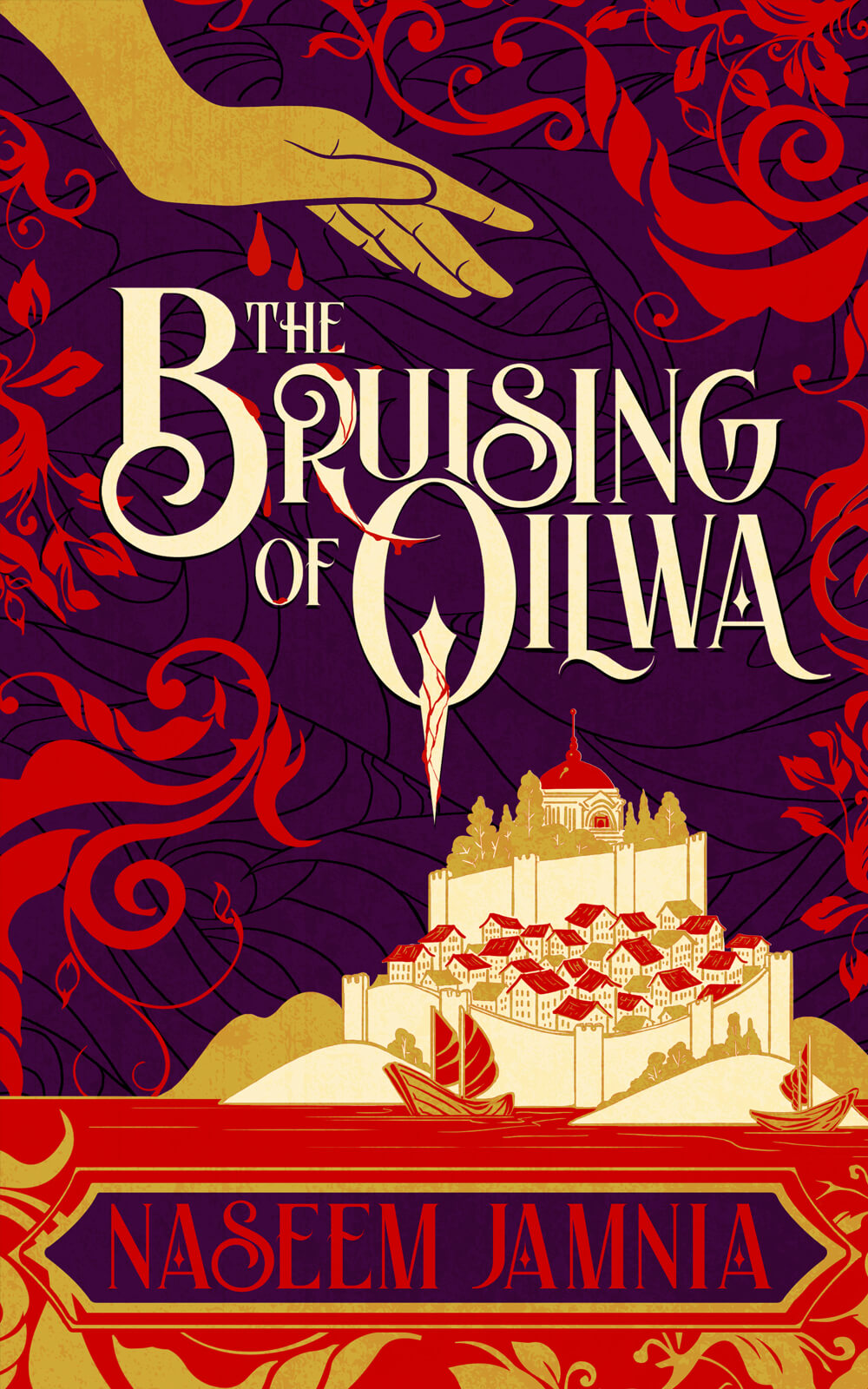
We see refugees and immigrants on the news regularly enough and while there are memoirs about these marginalized groups, for some reason, genre fiction hasn’t been as welcoming. When I saw that The Bruising of Qilwa had a nonbinary refugee as a protagonist, I knew I had to read this book. I now have a completely new set of expectations for the world of literature. We need more books like The Bruising of Qilwa.
Writer Naseem Jamnia (former managing editor of WWAC’s sister site, Sidequest!) has effortlessly built a world that speaks to their Persian heritage and the migrant experience. The world-building in The Bruising of Qilwa is so natural, it absorbs you from the first page. One of the aspects of sci-fi and fantasy that often gets in the way of my enjoyment are the long preambles about a concept, a group of people, or the workings of a world. The descriptions in The Bruising of Qilwa of the various groups of people—the Sassanians, the Dilmunis, the Qilwans—are interwoven into the story without halting the plot. There are mentions of foods, of gods, of past and present monarchs, as well as the spectrum of gender identity—these are all dropped into the story without much explanation because the context exists within the world of the book. The reader is along for the ride. And this made reading this book so much more enjoyable and engaging for me.
I also adore how queer this book is. Queer people exist in The Bruising of Qilwa and they have complete lives beyond their queerness. Firuz is nonbinary and uses they/them pronouns. They clarify their pronouns with their employer, Kofi, when the two first meet, and from then on, Kofi refers to Firuz by their correct pronouns. Firuz’s brother, Parviz, is trans and though part of his arc does revolve around aligning his body with his identity, there’s also a lot more that happens with and around Parviz in the book. Another character has two mothers, each with their own personality. I picked up The Bruising of Qilwa to read a migrant story and I also got a queer story. My expectations were high and Jamnia managed to surpass even those.
But what really caught be my surprise about The Bruising of Qilwa was that it’s a whole different kind of fantasy fiction that I’ve never encountered before—it’s a medical fantasy, as Jamnia describes it in their afterword. I didn’t know this was a subgenre that existed or that it could be so engrossing. The way Jamnia describes the magical medical examinations is so realistic that it made sense even to a non-scientific reader like me. That Jamnia’s background is in the sciences is very clear—the language they use is simple but effective, advancing the story and adding more texture to this rich world without trying too hard. It felt like reading a crime procedural except with magic.
The politics of the world of The Bruising of Qilwa becomes personal fairly quickly. Firuz and Kofi are both magical medical practitioners, except Firuz, being Sassanian, is also a blood magic adept. But in Qilwa, blood magic is a strict no-no, so Firuz can’t really heal people to the best of their abilities. This becomes a point of contention for Firuz when the new disease makes itself known—it’s got properties that are based on blood magic principles. As much as Firuz wants to find out who is behind this disease, they also can’t let on how they know what’s causing it without exposing their secret. The Sassanian refugees are treated badly enough in Qilwa—arousing suspicions about Sassanians using blood magic could be a death sentence. Reading Firuz’s concerns was a lot like feeling that prick of anxiety every time one lapses into their mother tongue in their new adopted country—you want to hang on to what you have but you don’t want to stand out. Like I said, Jamnia makes it all seem effortless.
I do feel like The Bruising of Qilwa was a bit harsher on Firuz than it should have been. From the start of the book, Firuz takes on so much—working at the clinic for extremely long hours, taking care of Parviz since their mother is pretty much absent, and then mentoring Afsoneh, a Sassanian orphan they rescue. Plus, there’s the mystery around the new disease. Firuz is the sole-earning member and the hardest working person in the family (and the whole of Qilwa, as far as I’m concerned) but they’re constantly berating themself for not saving more people, not being there enough for Parviz, not spending enough time mentoring Afsoneh. Firuz can’t catch a break in this book, and they aren’t kind to themself about it. I would have liked if people had been a bit more sympathetic towards Firuz.
I think the only place where The Bruising of Qilwa didn’t completely blow me away was the ending. It felt too rushed, and not just because I wanted to spend at least 100 more pages in this world. Within the span of a few pages, everything comes to light and is resolved. For the majority of the book, we had all this excellent build-up around the mystery, and I would have liked for Firuz to have found more clues and come to their own conclusions. The ending was also a bit gorier than I thought it would be, but that’s a personal preference.
Reading The Bruising of Qilwa was an incredible experience. I didn’t know world-building in a fantasy story could feel so seamless. That scenes around medical magic could make sense to me and increase my enjoyment of the story is still blowing my mind. The queerness in this book is so natural—no explanations, no phobias, just queer people living their lives. The politics and world-building feel relatable even if I’m not Persian. When people from marginalized groups talk about creating stories based on their lived experience, this is what they mean. Jamnia brings all the various intersections of their life into The Bruising of Qilwa and the book is so much more significant because of it. This story has set the bar for fantasy fiction so high now. Who’s going to meet it?
