

Storm versus Storm, disco revival, an austere castle, a name change — this first issue of X-Men Red has it all. Most importantly, it has a strong theme, with this issue examining the power and malleability of names, and how those names create identites. Names for people, their titles, and the names we give things — are they mutant powers or mutant weapons?
X-Men Red #1
Al Ewing (writer), Stefano Caselli (artist), Federico Blee (color artist), VC’s Ariana Maher (letterer and production), Tom Muller w/ Jay Bowen (design), Russell Dauterman & Matthew Wilson (cover)
April 6, 2022

Al Ewing makes this reviewing stuff easy in the first issue of X-Men Red — named for the red planet of Arakko, and the blood spilled that gives you a place in the broken land. He has a new character straight-up express surprise at the many names of Magneto, who came to Arakko to leave behind his scattered and fractured identities. Who is the real Erik/Max/Magneto?
While he creates a metallic castle to dramatically die in, Storm is faced with different questions of identity as she rules from the Great Ring. Storm is called many things here: the Regent of Arakko, the Queen of Mars, and the Voice of Sol, though she only claims Regent. Stefano Caselli and Federico Blee deliciously literalize this battle of identities in an astonishing opening sequence of Storm battling Nameless in the form of her younger self, wearing a familiar costume and crown, what Nameless calls her “Prime.” Blee’s lighting is gorgeous, the blue crackle of lightning and the way it gives Storm’s visions a haunting blue pallor. Similarly, the reveal of the last page had me quietly hooting and hollering (I was in public), just a perfectly delivered vision.
Storm emphatically refuses her former title of Queen, pushing away the false reverence given to her by some of her Arakkii peers, like Isca the Unbeatable. But her inner conflict is also an interesting meta-analysis of Ororo Munroe the character, who is beloved but lately, rarely given the meat of a story, or a spotlight. Her air of austere wisdom, her reverent presence, her importance in terms of representation — this can lead to a Storm who is unchanging: still, sure, and static. Here she must push forward, ahead; she must change now that she has changed lands.
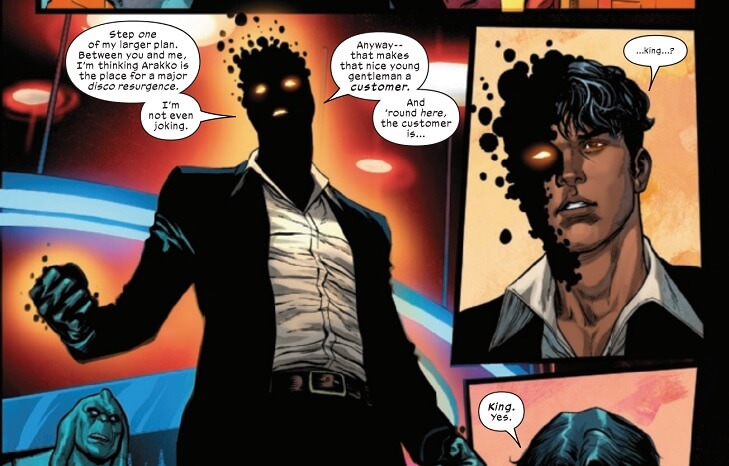
I wasn’t sure what to expect with Vulcan, and his continuing lust for his crown was unexpected but fascinating. His eagerness to reclaim the title of king is a clever use of his character and slides easily into the story to mirror Storm’s wariness over her power on Arakko. Caselli does a good job illustrating Vulcan’s fracturing, his facial expressions flipping from glowing eyed anger to slight confusion, compared to Storm’s always-solid footing. She is the deciding vote, she is called a queen, but she doesn’t want to be a conqueror — or a colonizer — in her new home.
While Storm must choose a title, Magneto is there to shed them. His humiliation at the Quiet Council has broken him down, and he’s retreated to Arakko in defeat. Ewing has a deft hand with Magneto’s character voice here; even in his brooding, he’s perfectly arch with quiet desperation bleeding through the page.
In a satisfying ending, the story is tied up with a bow. Rather than wholly reject the self embodied by Nameless, or be defined by her royalty, Storm embraces her first self. Not an X-Men or a queen but a thief, returning to the subaltern with a brand new look. Storm cannot protect Arakko by becoming a tyrant.
Something I hope this title touches on in the future — and it’s not for lack of good lore here — is an examination of Krakoan and Arraki naming conventions. Arraki names have similar descriptive uses as mutant names do. Kobak Never-Held is a more descriptive name than Gabriel Summers, yet Krakoans often use their legal names and mutant names interchangeably.
I’m also curious to see how much leeway Ewing, a champion of queer Marvel characters, has been given to a team made up entirely of characters who have been queer-coded so hard it makes you wanna scream. Storm, Roberto da Costa, and Magneto (in that order, from most canon to some heterosexual explanation for this) all have multiple storylines spanning decades with plausible queer reads — Storm’s relationship with Yukio, Roberto’s with Sam Guthrie, and of course the tumultuous affair of Magneto and Xavier. Having them together under these creative hands has gotten my hopes up.
Lastly, I know I’m not the only person with this thought, but I’d be remiss if I didn’t mention it — this is a book that NEEDS some editorial boxes telling me what issues to read to catch up. I think I read a pretty fair amount of X-Men, but even I miss titles or, you know, forget who Genesis is because X of Swords was a while ago! X-Corp had an editorial box referencing X-Men Red, couldn’t this return the favor? Especially now when back issues are easier to read (and buy!) than ever digitally, there’s no good reason to not at least give the reader a hand in trying to figure out when Vulcan was partying with Petra and Sway (X-Men #8 (2019) or what have you. Give me the citations, please!

