

Continuing the series that celebrates the centenary of Nosferatu with an overview of German vampire literature.
Karl von Wachsmann’s short story “Der Fremde” (literally, “The Stranger”) is another work that, like Ernst Raupach’s “Laßt die Todten ruhen” (“Wake Not the Dead”), has had much confusion surrounding its publication in the English-speaking world. An English translation was published in Chambers’s Repository of Instructive and Amusing Tracts in 1854, but the author was uncredited – the story was presented simply as having been “translated from the German” with no further clue as to its origin. When Montague Summers included the tale in his 1933 anthology Victorian Ghost Stories, he was unable to shed light on its background save for his claim that the translation was reprinted in an 1860 edition of Odds and Ends magazine.
Well into the twenty-first century, various publications have cited “The Mysterious Stranger” merely as an anonymous story that came out in 1860. However, when the story was included in Mike Ashley’s 2013 anthology Vampires: Classic Tales, the editor was able to reveal its origin, crediting Douglas A. Anderson and Thomas Honegger with the necessary research: the original German version of the story appeared in 1844 and was written by Karl von Wachsmann. This prolific author was born in what is now the Polish city of Zielona Góra, which, at the time, was part of Prussia.
Despite all of this confusion, one detail has led to the story attracting attention as a significant part of the vampire genre: considering that it was written decades before Dracula, it bears remarkable similarities to Bram Stoker’s novel – arguably more than any other pre-Dracula work of vampire fiction.
The story introduces us to the Knight of Fahnenberg, who has inherited property in the Austrian portion of the Carpathian mountains. He travels there with members of his extended family: his daughter Franziska, his niece Bertha, and his nephew Baron Franz von Kronstein. The party is attacked by wolves along the way, and the knight decides to shelter in the nearby ruined castle of Klatka, “dismantled because the possessor in those days had iniquitous dealings with some Turkish-Sclavonian hordes” and now reputedly haunted.
They have no need to shelter, however: a stranger with sword and broad-brimmed hat appears from behind a tree and, with a wave of his hand, turns the wolves away before departing. Bewildered by the occurrence, the party carries on to the Knight of Fahnenberg’s estate. There, the knight mentions the incident to a steward of the estate, who tells him a local ghost story regarding the Fiend of Klatka:
“What do you say? Whom do you call by that name?” inquired Franziska, whose love of adventure and romance was strongly awakened.
“Why, people call by that name the ghost or spirit who is supposed to haunt the ruins,” replied the steward. “They say he only shows himself on moonlight nights —”
“That is quite natural,” interrupted Franz smiling. “Ghosts can never bear the light of day; and if the moon did not shine, how could the ghost be seen? for it is not supposed that any one for a mere freak would visit the ruins by torch-light.”
The knight and his companions decide to pay the ruin another visit. Examining the adjacent churchyard, they find a gravestone bearing the epitaph “Ezzelin von Klatka fell like a knight at the storming of the castle”. Below lies the family vault, where lies the coffin of Ezzelinus de Klatka, Eques.
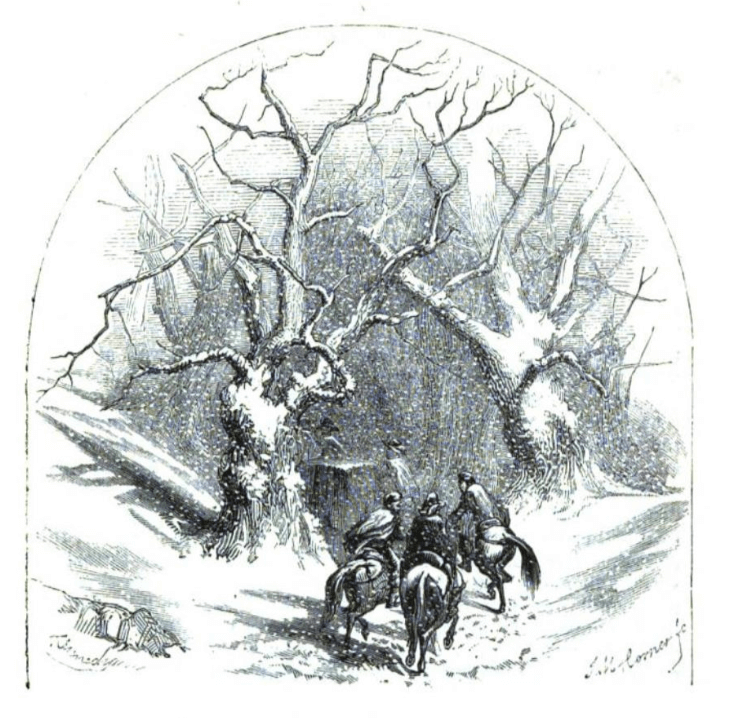
They are then startled by the reappearance of the stranger who had saved them from the wolves earlier on. He explains that beasts fear him, and Franz asks if he is a huntsman. “Who is not either the pursuer or the pursued?” replies the stranger. “All persecute or are persecuted, and Fate persecutes all”. The stranger – who states that he is a knight of a family as ancient as the Knight of Fahnenberg’s line, and gives his name as Azzo von Klatka – has a striking appearance:
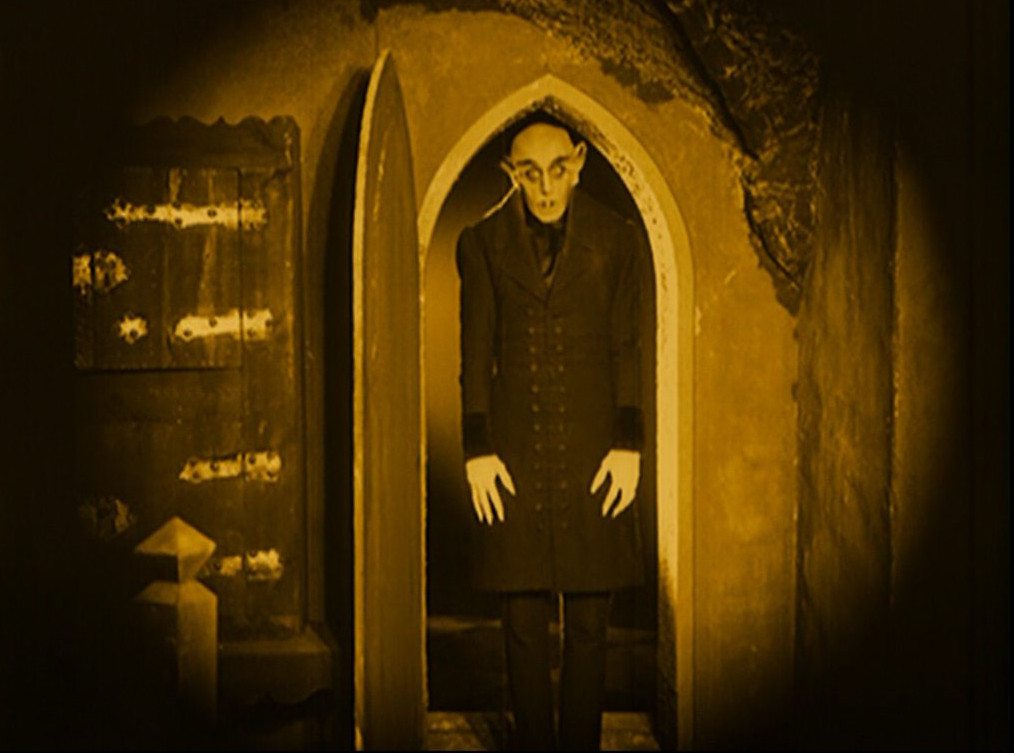
The brilliantly lighted chamber gave a full view of the stranger. He was a man about forty, tall, and extremely thin. His features could not be termed uninteresting — there lay in them something bold and daring; but the expression was on the whole anything but benevolent. There was contempt and sarcasm in the cold grey eyes, whose glance, however, was at times so piercing, that no one could endure it long. His complexion was even more peculiar than the features: it could neither be called pale nor yellow; it was a sort of grey, or, so to speak, dirty white, like that of an Indian who has been suffering long from fever; and was rendered still more remarkable by the intense blackness of his beard and short cropped hair. The dress of the unknown was knightly, but old-fashioned and neglected; there were great spots of rust on the collar and breastplate of his armour; and his dagger and the hilt of his finely-worked sword were marked in some places with mildew.
Azzo turns out to live alone in the ruined castle, without even a single servant. “You perhaps consider me rather touched a little in my mind, for taking up my abode with the bat and the owl”, he says; “but if so, why not consider every hermit and recluse insane? You will tell me that those are holy men. I certainly have no pretension that way; but as they find pleasure in praying and singing psalms, so I amuse myself with hunting.”
While the image of the vampire living alone in a crumbling old castle is familiar today, this is largely because of Bram Stoker. Pre-Dracula stories like “The Vampyre”, Carmilla and Varney the Vampire typically depicted vampires not as recluses, but as wanderers who inserted themselves into their victims’ families. Another noticeable connection is that both Azzo and Dracula make their homes in the Carpathian mountains, not noticeably a popular setting for vampire stories in this period.
In private, the two women discuss their new acquaintance. Bertha calls him “repulsive”, but Franziska disagrees, comparing Azzo favourably to her cousin Franz, the man she is lined up to marry: “the thin, corpse-like, dried-up, whimsical stranger is far more interesting to me than the rosy-cheeked, well-dressed, polite, and prosy cousin.”
The two women’s conflicting tastes in men form a recurring theme throughout the story. Even before the vampire has been introduced, Franziska is dismissing Franz as “effeminate” and expressing her preference for men who are “[b]old, aspiring, even despotic”. She does, however, approve of Bertha’s fiancé Woislaw, a knight with a facial scar and an elaborate mechanical hand made of gold (replacing the hand he lost in battle): “Franziska at last saucily declared that a rather ugly man was infinitely more attractive to her than a handsome one, for as a general rule handsome men were conceited and effeminate.”
Again, we can see Karl von Wachsmann’s story prefiguring Stoker, the characters of Franziska and Bertha acting as antecedents to Lucy and Mina in Dracula. Just as Dracula began feeding upon Lucy, Azzo begins feeding upon Franziska:
“…I saw a number of pictures before me, as I used to do in childish sicknesses. I do not know whether I was asleep or half awake. Then I dreamed, but as dearly as if I had been wide awake, that a sort of mist filled the room, and out of it stepped the knight Azzo. He gazed at me for a time, and then letting himself slowly down on one knee, imprinted a kiss on my throat. Long did his lips rest there; and I felt a slight pain, which always went on increasing, until I could bear it no more. With all my strength I tried to force the vision from me, but succeeded only after a long struggle. No doubt I uttered a scream, for that awoke me from my trance. when I came a little to my senses, I felt a sort of superstitious fear creeping over me — how great you may imagine when I tell you that, with my eyes open and awake, it appeared to me as if Azzo’s figure were still by my bed, and then disappearing gradually into the mist, vanished at the door!”
Over the coming weeks, Franziska grows pale and thin (and bears a wound on her neck that refuses to heal). Azzo also transforms, but in the opposite direction: “The skin, before so shriveled and stretched, seemed smooth and soft, while a slight tinge of red appeared in his cheeks, which began to look round and plump.”
Finally, Bertha’s fiancé Woislaw arrives on the scene, having returned from the war against Turkey; he turns out to be the only person who can stand up to Azzo, and in one scene apprehends the vampire using his mechanical hand (“into the springs of which he threw all his strength”) to rescue Franz. Woislaw turns out to be familiar with the workings of vampires, and pursues Azzo to his coffin:
In the coffin lay Azzo as he lived and breathed, and as Woislaw had seen him at the supper-table only the evening before. His appearance, dress and all were the same; besides, he had more the semblance of sleep than of death — no trace of decay was visible — there was even a rosy tint on his cheeks. Only the circumstance that the breast did not heave, distinguished him from one who slept. For a few moments Woislaw did not move; he could only stare into the coffin.
The similarity to Stoker becomes so striking in this scene that it is worth quoting from the fourth chapter of Dracula for comparison:
I knew I must reach the body for the key, so I raised the lid, and laid it back against the wall; and then I saw something which filled my very soul with horror. There lay the Count, but looking as if his youth had been half renewed, for the white hair and moustache were changed to dark iron-grey; the cheeks were fuller, and the white skin seemed ruby-red underneath; the mouth was redder than ever, for on the lips were gouts of fresh blood, which trickled from the corners of the mouth and ran over the chin and neck. Even the deep, burning eyes seemed set amongst swollen flesh, for the lids and pouches underneath were bloated. It seemed as if the whole awful creature were simply gorged with blood. He lay like a filthy leech, exhausted with his repletion.
But while Woislaw finds the vampire’s resting-place, the job of slaying Azzo falls upon Franziska – as Woislaw explains, she can use blood from the vampire’s body to heal her wounds. In a small variation upon tradition, Azzo is destroyed not by a stake through a heart, but by three long nails driven through the lid of his coffin.
After Azzo has been slain and Franziska healed, Woislaw reveals how he knew about the existence of vampires. During his first military campaign in Hungary, he encountered a strange man who behaved in a similar manner to Azzo. Another man, a Sclavonian, explained to Woislaw that the stranger was a vampire:
“…As in my country vampires had never been heard of, I questioned the Sclavonian minutely. He said that in Hungary, Croatia, Dalmatia, and Bosnia, these hellish guests were not uncommon. They were deceased persons, who had either once served as nourishment to vampires, or
who had died in deadly sin, or under excommunication; and that whenever the moon shone, they rose from their graves, and sucked the blood of the living.”
“Horrible! ” cried Franziska. “If you had told me all this beforehand, I should never have accomplished the work.”
“So I thought; and yet it must be executed by the sufferers themselves, while some one else performs the devotions,” replied Woislaw.
We may never know for sure if Bram Stoker was influenced by “Der Fremde” or if he merely arranged stock Gothic elements into a coincidentally similar pattern, but it is nonetheless intriguing how – even when the stories depart in plot – they remain close in spirit. For example, Azzo is unlike Dracula in that he never escapes his hazy, out-of-time Carpathian surroundings to terrorise modern society; yet the conflict between superstition and science is symbolised by the vampire-hunting Woislaw and his mechanical hand.
Another interesting detail is that, because of its shorter length and more rightly-confined action, Karl von Wachsmann’s story sometimes resembles the film versions of Dracula even more than it does the original novel. A particularly amusing instance of this comes when Azzo prefigures a much-loved line of dialogue from the 1931 Bela Lugosi film:
“For a long time past, I have accustomed myself never to eat at night,” he replied with a strange smile. “My digestion is quite unused to solids, and indeed would scarcely confront them. I live entirely on liquids.”
“Oh, then, we can empty a bumper of Rhine-wine together,” cried the host.
“Thanks; but I neither drink wine nor any cold beverage,” replied the other; and his tone was full of mockery. It appeared as if there was some amusing association connected with the idea.
Or, as Lugosi put it: “I never drink… wine.”
Next: How did German vampire poetry fare a century after Heinrich August Ossenfelder?

