


There’s been no small amount of curiosity about the next stage of Krakoa after the departure of Jonathan Hickman from the line. With Immortal X-Men, it’s safe to say that the future is…Sinister.
Immortal X-Men #1
Mark Brooks (Cover Artist), VC’s Clayton Cowles (Letterer), David Curiel (Color Artist), Kieron Gillen (Writer), Tom Muller (Design), Lucas Werneck (Artist)
Marvel Comics
March 30, 2022
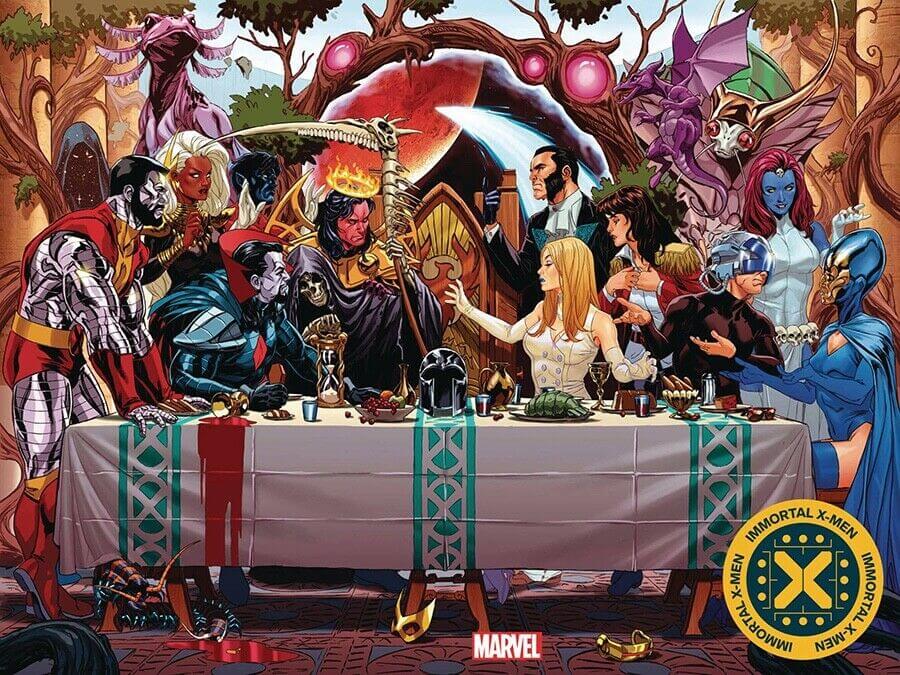
I have some strong opinions about the version of Mister Sinister that debuted under Kieron Gillen when he helmed Uncanny X-Men from 2011 through the close of Avengers vs. X-Men and its epilogue, AvX: Consequences, in 2013. It was at the time a character renaissance, breathing life and direction into a villain who had been up to that point inconsistent and self-contradictory. Gillen’s version evoked wonder and curiosity; Mister Sinister was an unquestionably villainous character, but he was playfully so, stopping just shy of a fourth-wall awareness as he played the ever-jocular host to the X-Men in San Francisco.
He had every reason to gloat. After all, he had the heroes right where he wanted them! He’d remodeled the Palace of Fine Arts in his own image, declaring it the site of the inaugural Sinister World’s Fair. His plan was complex—a heaping of eugenics, a dash of pooled and applied resources, a smattering of colonialist thinking, resulting in Sinister as a system, an entire host of connected lifeforms possessed of the same genetic structure, host to a hivemind with the collective psionic power to overwhelm nearly every mutant present.
The heroes prevailed, as heroes do, but the statement was evident; this new Sinister, this Gillen version, was a planner once more, in the way he’d been during the events of Inferno twenty-ish years prior. He wasn’t just another implausible super-scientist: he was the bleeding edge of that ilk, constantly refining his data streams, his plans, himself to be what was required. He was funny, yes, because he carried the smug arrogance of superiority,. But he was menacing in a fresh (if not new) way for the X-Men, one step ahead of them and doing his best to assail their then-island home, Utopia.
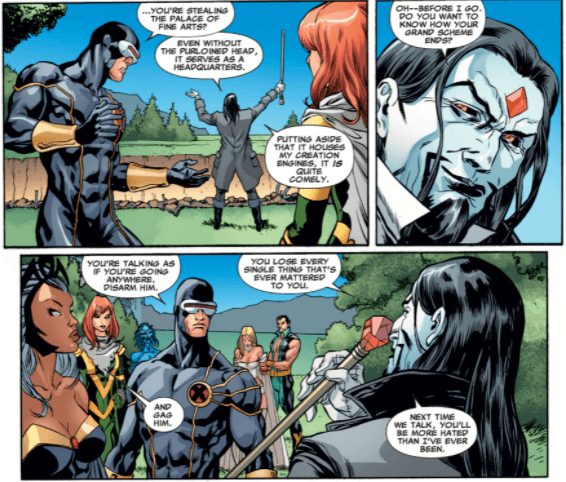
Of course, Utopia fell, and Gillen moved on, leading to Brian Bendis’ run, where Sinister’s prediction above would prove true. Sinister would appear over the next decade, but did not return to prominence until the events of House of X and Powers of X, where it was revealed that he was recruited by Xavier, Magneto, and Moira in secret, for his repositories of mutant genetic code. In exchange for this, they gave Sinister a seat on the newly formed Quiet Council, the governing body of Krakoa. Since then, while his machinations have been consistent, he’s lacked the…menace of Gillen’s Utopia-era iteration. He certainly manipulated Kwannon in the poorly-conceived Fallen Angels miniseries and was further embroiled with mutant shenanigans throughout the entirety of Hellions. But his presence there was more comedic than anything, often the butt of jokes rather than a devastating architect only desperately outdone. The only evidence of the Sinister we saw a decade ago was the “Sinister Secrets” data pages found scattered through X-Books, codifying the prophetic streak demonstrated in San Francisco before AvX, with the further hint that Sinister keeps finding things out that no one is supposed to know.
I’ve made a point of explicating Gillen’s iteration of Sinister for a reason; this is not a case of “only this writer is correct in his depiction of a given character.” What it is is an analysis of what made that particular depiction work, what made it the template for versions of the character going forward. Post AvX, Sinister quite often carried the camp of Gillen’s take, but rarely, if ever, that menace. Now, here we are. Reign of X gives way to Destiny of X, the third phase of the Grand Krakoan Era, and Kieron Gillen returns, a decade later, to write Immortal X-Men, a series specifically about the machinations of the Quiet Council post-Inferno (the second one). There is synchronicity in that, a cycle is repeated.
He is, of course, not here alone. Lucas Werneck has been present for the duration of this era of X-Comics, contributing interior pencils on Marauders and covers (his variant of X-Factor #4 is a favorite of mine). Werneck’s art is beautiful; he’s a capable and canny renderer, giving each character he draws an expressive personality. There’s perhaps one flaw evident here, and that’s the way the majority of the issue is framed as static poses; a great deal of standing around and talking, with few depictions of movement and existence within the characters’ environments. Whether this is a failing of Werneck’s or a demand of the script for this particular issue is hard to say; future issues will give us more context. As it is, his art also feels like the next iteration of a cycle; his figure work is evocative of Terry Dodson, who prominently worked on those earlier Gillen issues while still very much being its own thing. I’m excited to see what he does as a regular artist.
Werneck is assisted by David Curiel (no, not that one, unless this is another bit of Sinister machination?). Curiel’s been coloring Marvel issues for about a decade now, and his skill shows here partly in what doesn’t; his colors feel natural, and he has a deft hand with lighting and shadow both. The real mark of his craft is the way, for a single panel, he uses an entirely different mode of coloring. We see Sinister on the outside of a glass tube, looking in; Werneck’s art distorts Sinister’s shape, but it’s Curiel who seals the deal with a color palette that’s muted and more limited than elsewhere in the same scene, selling that distortion as something refracted through glass. It’s the kind of careful work that excites me as a comic reader.
I will not assign Gillen the writer’s arrogance of returning to see a thing done right. As I said, this is not that piece! Nonetheless, I do hope that, through analysis of both his prior run and his current one, we can develop an understanding of what makes the villainous eugenicist work as a character and what does not. This undercurrent of menace is a key factor, and so I’m glad to see it return in force here. Additionally, Gillen manages to take the story hooks laid down thus far in Dawn and Reign both and advance them in such a way as to educate the reader on The Plan this time around. The revelation of how Sinister is getting his secrets is juicy, diabolical, and absolutely thrilling in the context of what’s been revealed in the two years up until now.
Also thrilling is the evident self-deception in Sinister’s narration: Gillen’s Sinister is so biased by his own presumed superiority that he does not see his failings, no matter how evident they are. This is cleverly displayed on a couple of fronts; the first is during the surprise election of a new Quiet Council member, when the votes do not go as he anticipates, but the second is more subtle. Sinister claims that he has “surgically excised” the racist part of his personality (most infamously demonstrated when he was an active part of the Nazi eugenics front during World War II), but of course, that is a convenient fiction of the oppressor. Wouldn’t it be nice if such a thing could be so easily controlled? Wouldn’t it be tidy if one could sidestep the moral dilemma of eugenics by simply experimenting on oneself?
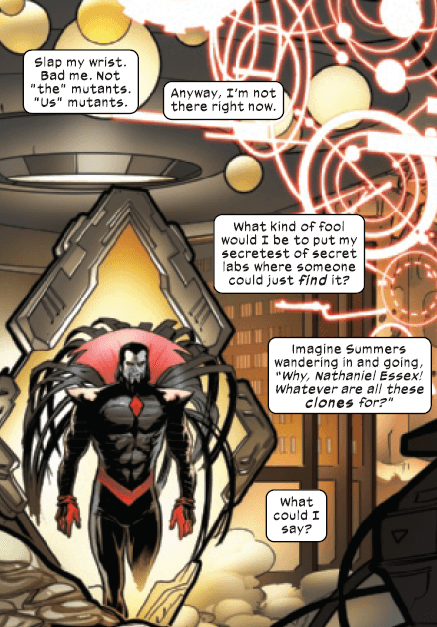
Of course, Nathaniel Essex did not merely experiment on himself, did he? He has used mutant DNA time and time again, the DNA of others, to achieve his goals. He has stolen that DNA, created clones with it, spliced it into his own code, all with a complete absence of ethical rigor, a thing to which he gives no credence. It’s a neat little lie to think that he is now above prejudice, but he betrays the existence of that lie with his very stance, regarding mutants as not people but resources for his experiments, revealing that he still thinks of himself as separate from mutantkind (above), despite the technicality of his inclusion in Krakoa.
We cannot trust Sinister as a narrator of this tale. Not only because of the imperfection of his prediction methods but because of the demonstrable bias he exhibits toward his presumed self-superiority, the demonstrable bigotry he possesses regarding mutants. He is the bleeding edge of genetic science, true. But he forgets that new is not always better. The question in Immortal X-Men is not only what his plans are for the council’s new member, but whether he will, at long last, learn this about himself. My money’s on “no.” After all, what fun would that be?


