

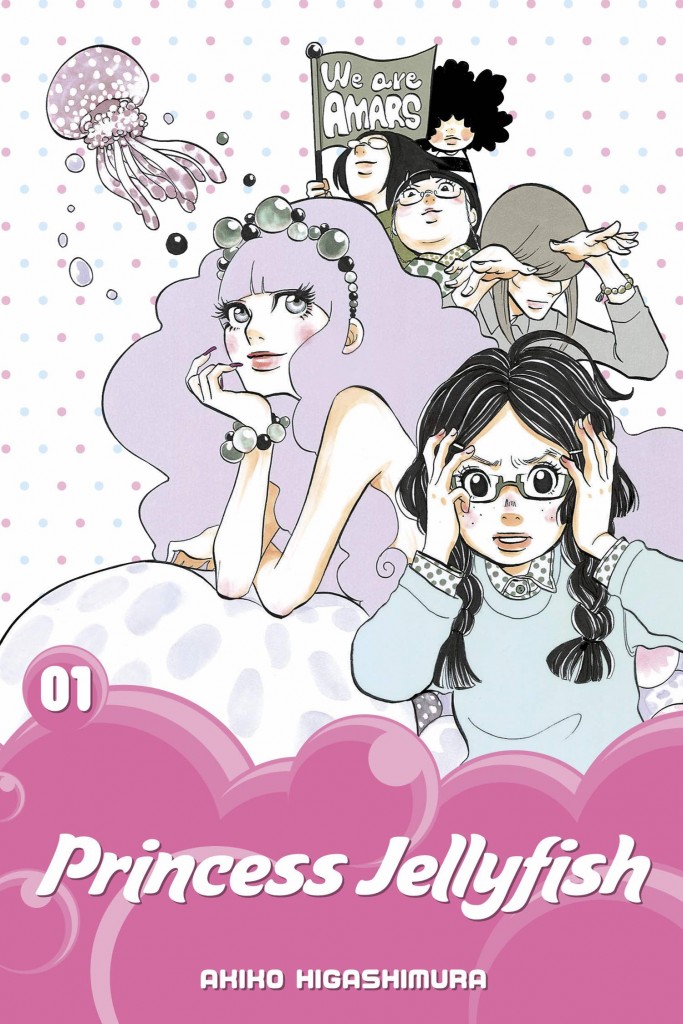
Akiko Higashimura is a manga legend. Since her debut in 1999, she’s been publishing award-winning hit comic after award-winning hit comic (including Princess Jellyfish, Blank Canvas, and Tokyo Tarareba Girls) and has now branched out to Webtoons in addition to serialized print manga. Paulina Przystupa got the WWAC crew together to discuss her long and storied career.
How did you get hooked on Higashimura?
Masha Zhdanova: I watched the anime for Princess Jellyfish on I think Netflix back in high school, and I liked it enough to pick up the manga when I saw it…somewhere, I can’t remember if it was an anime convention or a bookstore. I liked her well enough, but I wasn’t hooked until Blank Canvas, which really resonated with me as a cartoonist and an art student myself.
Kathryn Hemmann: Princess Jellyfish was my Higashimura starter series too! I picked up the first two volumes of the manga during a research trip to Japan in 2009, and I was so charmed by Tsukimi that I ended up spending a not-insignificant amount of my research grant money on aquarium visits.
Paulina Przystupa: Fellow WWAC writer Carrie got me hooked on Higashimura. I wanted to support local bookstores and get back into manga, specifically josei, and Carrie wrote this amazing recommendation list that I keep plugging because it’s just so great. She recommended both Princess Jellyfish and Tokyo Tarareba Girls and I decided to start with TTG. And once I started TTG I’ve just been looking for more and more of her work.
Carrie McClain: Princess Jellyfish for sure! I can remember seeing many of my nerd spaces hyping up the manga way before its official publication here in the states and I just fell in love with Higashimura’s stylish art. I also loved that narrative centering around young women and their fight to save themselves. That series has paved a way for me wanting to read, own and share any work with hers to those who I know will appreciate her!
What is your favorite book or series of hers?
Carrie: Princess Jellyfish was and forever remains a game changer! As the gateway to Higashumura’s work for many English reading manga readers, the manga and the short anime adaptation remains favorites for many folks simply for the wild story and lovable characters. PJ came to me at a time as a manga reader when I felt overwhelmed by the shonen machine and wanted more Shoujo and Josei in my life. To this day, it remains a near perfect series that I love rereading.
Masha: Blank Canvas is a masterpiece of autobiography. It’s funny and moving and made me cry. I also went to a classical arts atelier when I was in high school so I could relate to that part but, also, just, like, her relationship to drawing and comics and making art and the way that’s depicted was so powerful.
Paulina: While TTG will always have a place in my heart, I second Masha’s fave of Blank Canvas. I love the candor that she uses to talk about her experiences, her reflections on her younger self, and the discussions about the artistic process that go into that book. It gives the readers a peek behind the scenes of manga creation without it feeling like a documentary. Furthermore, I love the way the series is an ode to good teachers. Sometimes our best teachers show up when we least expect them and we don’t always recognize their value until its too late. It’s a powerful story and reminder of how important genuinely caring relationships are to maintaining our sanity.
Which of Higashimura’s untranslated works might you want to read next?
Paulina: There’s a historical fiction series she’s been writing that reimagines Uesugi Kenshin, a historical figure, as a woman that I’d be interested in reading. I have no idea how likely it is to be translated any time soon but I love historical fiction and I’d love to see how her style translates to a historical manga rather than a modern one.
Carrie: YES! Paulina and I have talked about Yukibana no Tora, the historical reimagined series of hers as we both are history buffs yet I’m here with the (possibly) controversial pick: Himozairu, a suspended series. According to this piece it “involved a group of unemployed young men looking to better their romantic prospects by teaching themselves domestic skills that would make them more attractive partners to professional women.” It was suspended after complaints that the series was derogatory to men–word? I can’t help but be curious about this short-lived series that was apparently semi-autobiographical and based on some of the experiences of the manga creator’s male friends and assistant.
I’m sure she brought the funny and the heat, which isn’t a bad way to bring up gender dynamics in society and the workplace. Although I found out about the series way after it left the manga magazine it was being published in, (Thanks to my good friend Paulina reminding me of its existence in here as she pondered why certain series get the green light and other don’t) it made me think about how often manga series are suspended or are forced to end earlier than expected–how much does reader feedback and criticism play a part in the modern world of manga as well? (As a second most wanted from her: the manga she’s created about her young son. I am a sucker for manga with child protagonists!)
Masha: Oh my god, I never heard about that but that sounds so fascinating and I’d love to read it. Higashimura writes a lot from the point of view of young women and the dynamics between groups of female friends, but rarely focuses on young men in the same way. I actually haven’t read all that much Higashimura, but I enjoyed A Fake Affair and I’m interested in seeing more from her in the Webtoon format, so Do You Remember Me? piqued my interest as well.

Kathryn: I’m a sucker for the “they were childhood friends” romantic trope, so I’ve been tempted to pick up her romance comedy that’s currently in serialization, Do You Remember Me? (Watashi no koto o oboete imasu ka). It’s interesting to approach a story like this from the perspective of a thirty-something writer suffering from creative burnout, if only to see how Higashimura tackles the subject of how your childhood expectations of your dream career differ from the reality. I’m also curious about the one-volume Rose and Tulip (Bara to chuurippu), which is about a temperamental artist who asks a look-alike to impersonate him. The trailer for the 2019 live-action adaptation is very silly and sweet.
Has your relationship to her work changed and if so, how? And what do you want to see her do now that more of her work is being translated and accessible to fans outside of Japan?
Carrie: While, it may not be super evident to fans outside of Japan just yet–Akiko Higashumra’s work is defined by her ability to turn life stories, mostly hers, into the auto-biographical work we know and love into pure gold. When I think of auto-bio comics and manga enters the conversation, I immediately think of her. On another note: I don’t think I’ve seen too many other (translated into English and published) female manga artists in this more modern age speak about motherhood and what it means to be a working mother in the manga industry which is both refreshing and illuminating.
I’d love to stand on the sidelines as a fan and see Higashimura continue to create manga and have a storied career as long and amazing as legends like Rumiko Takahashi, to be honest. At my big age, I still very much want to see the work of women in the manga industry shine just as bright and be global hits with staying power as the male creators we read and talk about.
If you have time, look up this interview of hers on an episode of a show with manga creator Naoki Urasawa, (a brilliant show where he interviews other manga artists?!) that does go in depth on her creative process and her drawing speed. Catch the highlights and a 15-minute short version of the episode here. She’s a mangaka with one of the highest page counts in manga, effortlessly moving between genres from coming of age to josei. I wish her well and will always, always want to read more of her work!
Paulina: One of the things I cherish about Higashimura’s work is how different series can speak to different needs. While they are all definitely her work, I’ve been able to reach for different series (first TTG, then PJ, etc) and have them speak to what I was experiencing at the time. Currently, I have the last volume of Blank Canvas sitting next to my bed, waiting for the right time. As others have touched on, the series is a great combo of autobio and self-reflection that, as a graduate student, has really touched my life.

And I agree with Carrie. I would love to see Higashimura just keep creating in general and have a great long career. I also would love to see more stories about/inspired by her life, as she ages. As I’ve gotten older, I am increasingly drawn to stories about people who are my age and older because we so rarely get to see older folks, particularly gender minoritized people, in manga. When I was a kid I wanted stories with older protags so I could pretend to be them. As an adult, although society wants me to be nostalgic about my teens, I’m not. I still want stories about older people because that’s who I’ll be some day.
Masha: Agreed with above! I hope she has a long and prolific career and that we continue to see her work on Western shores.
