


Beyond Forgetting is a short memoir by Frank A. De La Rosa. The memoir combines short historical summaries with personal stories to illustrate the experience of growing up in the Philippines under Japanese occupation and just after World War II. Beyond Forgetting captures an imperfect human voice that informs and colors one boy’s understanding of the war.
Beyond Forgetting: Childhood memories of the author during the WWII in the Philippines
Frank A. De La Rosa
Shunduay LLC
March 14, 2021
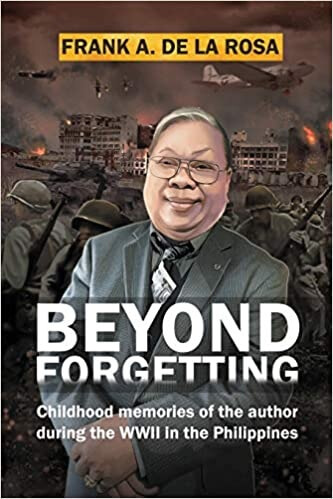
Separated into twelve thematic chapters, Beyond Forgetting is De La Rosa’s story of his childhood in the provincial Philippines. De La Rosa’s stories paint a nostalgic picture of his provincial hometown of Panganiban.
These stories acknowledge the poverty of the region and demonstrate that things were not entirely bad. Throughout, De La Rosa contrasts his childhood with modern amenities available in the west. Although he makes comments such as “we did not have the luxury of the internet,” he colors his childhood as different, not worse, than today. Additionally, he acknowledges that “[p]overty was no stranger,” but doesn’t fetishize it by suggesting that there was something better about how those in Panganiban lived either. He just tells it as it is.
While there are parts that might benefit from minor edits, such as some duplicated words, I liked that the memoir reads like a regular person telling a story. It stops and starts and sometimes uses odd phrases. However, these all reflect the person who lived these stories. Furthermore, I found it refreshing to read a memoir whose stories felt real rather than so polished that the messiness of the person who experienced them is lost.
Additionally, I enjoyed that the personal stories De La Rosa tells are short. Sometimes they’re only a few paragraphs or less than a page. What was cool about this is that it’s how someone tells a story the first time, rather than rehearsing it. Personally, those short stories, such as when he fell out of a palm tree, were more enjoyable than the historical descriptions.
Those chapters felt unnecessary to the memoir because they were often very general, such as “Great Britain, headed by Churchill, firmly stood against Hitler’s conquest.” Or they focused on events removed from the world of De La Rosa’s childhood that have been the subject of intense study and writing, such as the bombing of Hiroshima.
In general, Beyond Forgetting demonstrates how the current publishing landscape allows for the stories of everyday people to be shared. We don’t have to read infinitely vetted histories to get an understanding of the past. Sometimes we can pick up one person’s story and get a peek at how it was to be a child during the second world war.
Whether it was “… buy[ing]…a lot of lemon drops” from the Japanese-run garrison store or making the best of a typhoon by “banana rafting in [the] flood!” life in Panganiban was not all suffering. And that perspective, one of the day-to-day and the mundane, reminds us that even if things are bad there can be small joys we can celebrate and learn from.
