

As his student, Elizabeth is fascinated by the ways of Dr. James Frankenstein, a figure surrounded by controversy due to the conducting of unethical experiments he believes would serve the betterment of humanity. Swayed by what she believes are good intentions and her growing attraction to him, Elizabeth willingly becomes his protégé. She digs herself deeper into his world, and she learns the hard way that there is a cost to life once you start tampering with it.
The Modern Frankenstein
Paul Cornell (writer), Emma Vieceli (writer and artist), Pippa Bowland (colorist), Simon Bowland (letterer)
Magma Comix
October 27, 2021

Content warning: This work contains depictions of a teacher-student relationship, dementia, mind control, references to designer babies, and lobotomy.
The Modern Frankenstein was an idea conceived between Paul Cornell (Elementary, Doctor Who, I Walk With Monsters) and Emma Vieceli (Life Is Strange, The Adventures of Supergirl, Olivia Twist). Together, they used the stagnation and disruption of the COVID-19 pandemic to fulfill an opportunity to collaborate. This publication of The Modern Frankenstein is a compilation of a five-issue series that began earlier in 2021 around spring.
Although The Modern Frankenstein wants to be a perfect binding of both horror and romance, the latter is one of the weaker points in the work that made disbelief difficult to suspend when reading it. Establishing pacing that ensures the reader can empathize with what is going with its characters is challenging for a miniseries, but that is a challenge The Modern Frankenstein fumbles.
In the book’s opening, we quickly get a glimpse into Elizabeth’s illicit infatuation with her professor, Dr. James Frankenstein, and it does not falter even after witnessing him opposing standard protocol in the middle of a surgery. Her crush on him is unwavering against all odds and medical board violations because he’s…hot?
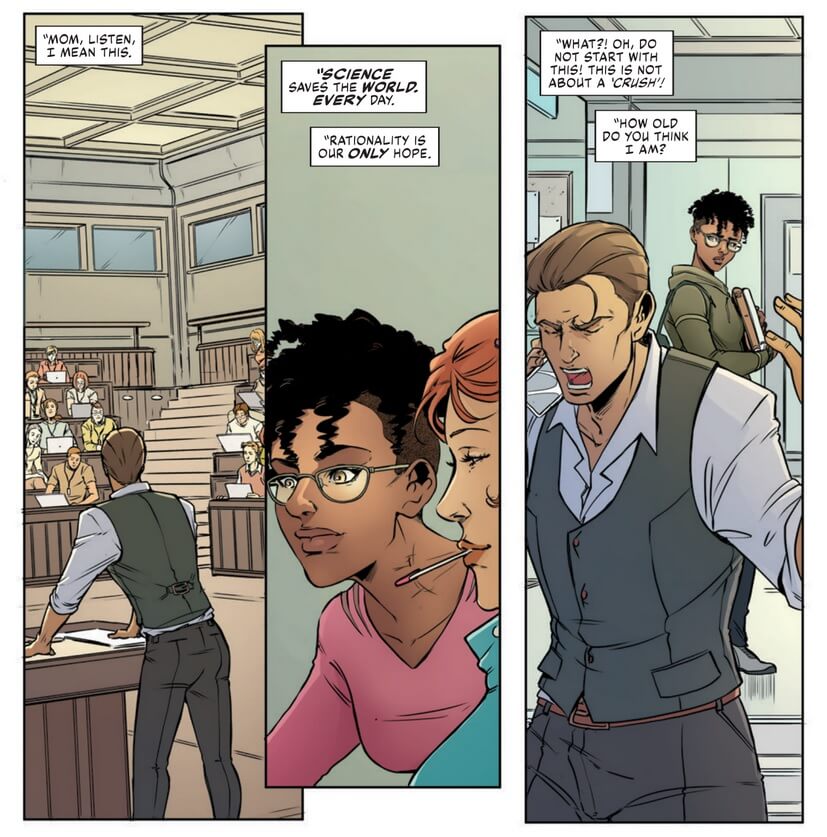
After supposedly curing her mother of dementia thanks to a serum in development, Elizabeth is convinced that James works for righteousness and joins in on his efforts for a secret project he has been working on. As if attempting to emulate an aura like Christian Grey entrancing Anastasia Steele from Fifty Shades of Grey, James reveals to Elizabeth his dark secret: He wants to dissect what makes the “evil” and empathetic parts of the human brain to rid the world of ailments and imperfections. He justifies using criminals as human subjects if it means eradicating issues like those that have been ailing her mother and removing humanity’s tendency to do bad things. He has also further developed a smartphone app to potentially control and discipline these subjects if the need arises. Despite being depicted as a Black woman, Elizabeth’s attraction to James still does not budge despite these particularly dangerous ideas that tiptoe towards racist science.
Elizabeth’s closeness to James has been noticed by Dr. Angela Barnes, who continually warns that James will cross a line and be caught in a legal web soon. Despite the reasonable interventions made, Elizabeth essentially tells Amanda to butt out. But Angela’s warnings come to fruition, and soon enough, James’ arrogance gets the best of him, revealing his true colors. Although Elizabeth tries to give him the benefit of the doubt, James goes too far and she is the only one with enough knowledge of the situation to stop him—coming to question her own ethics, sacrificing her reputation, and risking her life.
The comic ends with a poignant ode to Mary Shelley’s original work, in which one of James’ last surviving subjects escapes the facilities with his newfound intelligence and developed personality, leaving him with both a blessing and a curse.
Although The Modern Frankenstein is largely a work of fiction, it is working on somewhat faulty logic that is difficult to welcome. I can accept that James is so brilliant that he figured out how to quickly eradicate disease and mind control people with an app, but the flights of fantasy are at odds with the characters’ own qualities and systems of belief that function similarly in our own society. How did James keep this “project” under wraps for so long? And why did Elizabeth fall into her own naivete so easily despite very obvious red flags?

An addendum to the book justifies that despite Elizabeth’s brilliance, no one is immune from casting misjudgements especially in believing that it can lead to genuine good—and if one’s logic was also muddled by horniness, I suppose. But this is especially egregious given that Elizabeth is a Black woman who quickly falls into James’ arms, all as he is posting into the sort of rhetoric that would be so obviously associated with eugenics.
As a story overall, The Modern Frankenstein is all over the place. We go from scene to scene without really getting to know the characters as well as we should. Aside from constantly having sex on the laboratory floor (which is gross), our two leads have no real chemistry outside of the test tubes and flasks they use in their experiments.
The Modern Frankenstein uses the framework of many “beauty and the beast” narratives, sharing the shelf of a much larger genre that caters to the attraction of “monstrous”, brooding, misunderstood men. Like the titular Phantom in various incarnations of The Phantom of the Opera and Mads Mikkelsen’s portrayal of Hannibal Lecter of the eponymous television series, saving the tortured-but-sexy-genius-criminal is not a new concept. It is also a concept that does not exist in Mary Shelley’s original text, but it serves as the lede that The Modern Frankenstein uses to differentiate from its source without detracting from its themes. The tensions between Elizabeth and James certainly add another layer of dimensionality to the arguments and ethics of “playing god”, but ultimately, said relationship at the heart of the dynamic did not feel convincing enough. Conceptually, it is a trope that is always compelling, but compared to its counterparts, The Modern Frankenstein falters.
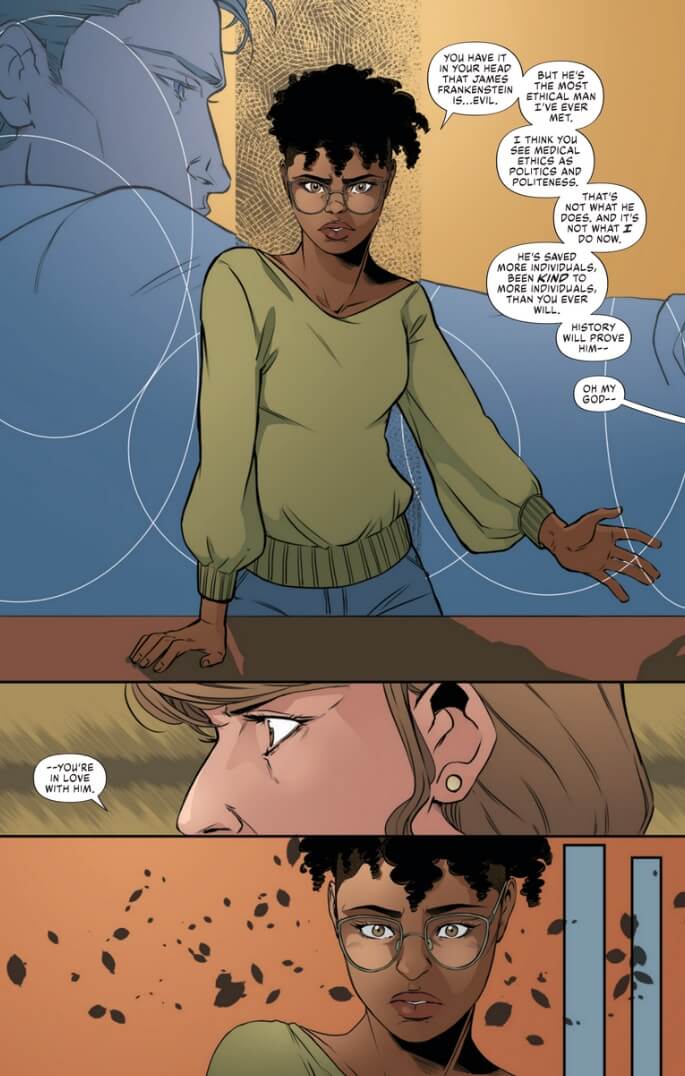
Despite this messy narrative, the comic’s art looks decent. At times, The Modern Frankenstein’s panels have disjointed compositional choices. Sometimes, characters are looking towards a specific direction, while the next panel puts them in different positions jarringly without a proper visual transition. But it was clear that Vieceli put lot of intention and research into accurately portraying a laboratory setting and understanding the grisly risks often put upon those who carry those occupations who work in the field. A lot of heart was also clearly put into its character designs, especially with the execution of James Frankenstein’s archetypal hunkiness. Additional concept art and variant covers were also attached to this edition of the title.
But as per the outcome of Elizabeth’s downward spiral into a world she didn’t want, no good deed goes unpunished. The Modern Frankenstein wants to say something striking while showing something sexy all at once—and the combination simply does not work. Neither saying nothing new and nothing particularly groundbreaking, The Modern Frankenstein, at the very least, owes so much to the original Frankenstein anyway. That said, what it wanted to do has been all done before, and it has been done better.
