

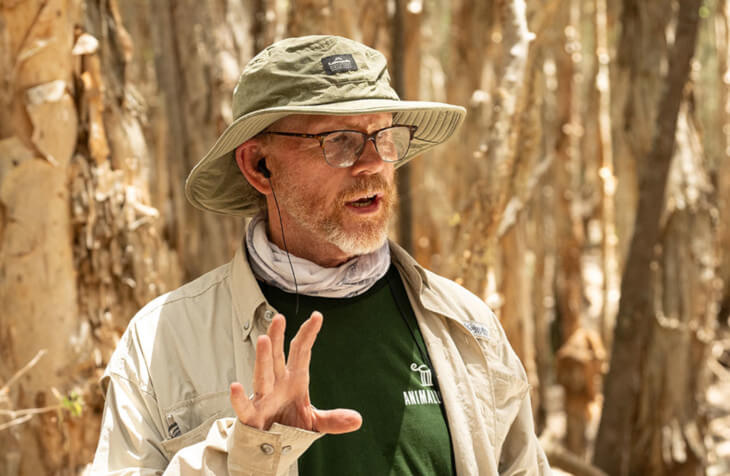
Ron Howard’s Eden is set soon after the First World War, where a doctor and his partner have been living alone on an island in the Galapagos. When new neighbours arrive, the sanctity of their haven is disturbed and all hell breaks loose.
Eden
Ron Howard (director), Noah Pink (writer), Mathias Herndl (cinematography), Matt Villa (editor)
Sydney Sweeney, Ana de Armas, Vanessa Kirby, Jude Law, Daniel Brühl (cast)
September 7, 2024 (TIFF)
One of the things I love about film festivals is that they introduce me to stories and people that I may never have stumbled across in the normal course of things. I say this because had I watched the trailer of a film like Eden or read more thoroughly about it, I would have avoided it. I jest, but Eden is the kind of film that reminds me that whatever faith I have in humanity is totally unfounded.
Eden is based on true events, as told by the survivors of the tale. Are they reliable narrators? The audience will be left wondering this as the truly bizarre events of the film unfold. The film begins in 1929 and takes place on the island of Floreana in the Galapagos. Dr. Friedrich Ritter (Jude Law) and Dore Strauch (Vanessa Kirby) moved there after the First World War. Tales of their adventures have been romanticized in the papers and attract the attention of the Wittmer family— Margaret (Sydney Sweeney), Heinz Wittmer (Daniel Brühl), and Heinz’ son Harry.
But, if one new neighbour wasn’t bad enough, there are more. The Baroness Eloise Bosquet de Wagner Wehrhorn (Ana de Armas) arrives with claims of wanting to build a hotel on the land. But this isn’t an island that welcomes humanity, and Ritter’s protectiveness of “his island” soon sees all the parties at each other’s throats. It’s not long before Eden turns into a power play among all the players with the Wittmer family stuck in the middle.
The film is often tense and tightly told. Barring two scenes, I didn’t feel any of the events dragged on too long. Ron Howard proves again that he’s a good director, bringing out the best in his actors, giving us the lay of the land, and telling a crisp story with shots that encompass a lot of detail in the foreground and background. But, Eden is a steady film to watch, and that’s not what this story needed. We’re watching a bunch of idealists stranded on an island, hoping for miracles while some of them are falling into madness; we should have seen that play out on-screen. We needed to see the desperation, the wheels turning, the tables turning. Oftentimes the film jumped from plot point to plot point, and while the clues to these beats were given, the preamble to ratchet up the stakes was missing.
The cinematography by Mathias Herndl is fantastic. It’s a sweaty, sticky, gross reminder that to survive in nature you need to be made of much sturdier stuff. You won’t catch me camping, let alone relocating to an island with absolutely no people and no infrastructure. Since it’s so immersive, some of the scenes are hard to watch — there’s a whole sequence with a pregnant woman in peril, and it’s harrowingly shot and acted. Also, unbelievable. Who’s to know the truth?
The performances in this film are outstanding — Jude Law’s Dr. Ritter is riveting as the curmudgeonly, snobbish survivor looking down his nose at everyone around him. As a high-minded philosopher with an aim to reorder the world, Ritter can’t help but consider everyone else beneath him. But when his achievements begin to pale in comparison to that of the Wittmers, his sinister side appears. Law perfectly captures these dimensions to the character.
Sydney Sweeney isn’t her usual glamorous self and holds her own as a young woman trying to make the most of the situation she’s found herself in. Ana de Armas is as charming as ever, though I wish she’d added a little more maliciousness to her character. It would have given Eden a much-needed air of terror. Daniel Brühl is always brilliant at playing the everyman with a decent heart. Heinz is battling the morality of the people around him, and Brühl is convincing as a man who must be swayed to take action, for better or for worse. Vanessa Kirby’s character is underbaked. She’s not on screen that much, but when the story focuses on her, she captivates as a woman losing her way.
I usually find myself listening for the score of a film, but I didn’t hear it at all in Eden. The one time I did, I found it too intrusive. At least I could hear the dialogue in this screening. Which is good, because I love that the script is littered with sardonic lines that made me titter while still being on edge over what was about to happen.
Decent performances and an interesting conceit make Eden a film that piques one’s interest. But only watch it if you can stomach survivalist cinema. It’s not an easy watch, but not as gruesome as one would expect.
