
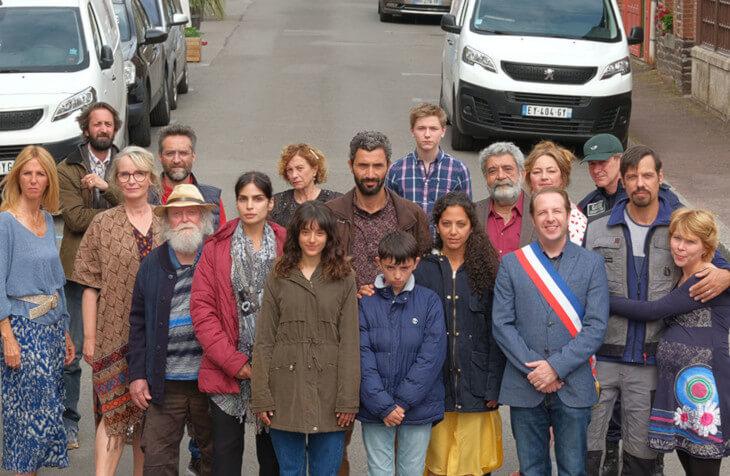
In Meet the Barbarians, a small town in France prepares itself to welcome a family of Ukrainian refugees. But when the refugees turn out to be from Syria instead, the town must reckon with their prejudices and either make peace or war with the new arrivals.
Meet the Barbarians
Julie Delpy (director and writer), Georges Lechaptois (cinematography), Camille Delprat (editor)
Julie Delpy, Sandrine Kiberlain, Laurent Lafitte, Ziad Bakri, Jean-Charles Clichet, India Hair (cast)
September 9, 2024 (TIFF)
When a film is called Meet the Barbarians, you’re allowed to feel some amount of anxiety about how the film will engage with the subject of racism. I was intrigued but definitely concerned — the word barbarian still grates on me even though its use as an epithet towards Black and Brown people is not common parlance as it once was.
But I was in for a welcome and emotional surprise. Writer-director-actor Julie Delpy spotlights the hypocrisy of one of the great injustices of the modern era: the refugee crisis. It’s not bad enough, Meet the Barbarians tells us, that corruption and greed have destroyed and displaced innocent people, but why must we then make a spectacle of their displacement and place more value on some refugees over others?
Set in a small town in France called Paimpont, the townspeople in Meet the Barbarians are sheltered white folk who’ve not really known any Earth-shattering difficulties in their lives. But things are about to change.
As the war breaks out in Ukraine, the town immediately moves to accept refugees from the country, except much to their surprise, it turns out every country in Europe has the same idea. So instead of a family of Ukrainians, who would be welcomed with open arms in the all-white town, Paimpont find themselves preparing to greet the Fayads, a family from war-torn Syria. Their arrival highlights the hypocrisy in the town’s thinking — prejudices surface and threaten to rip apart families and friends and especially the new arrivals.
You’d never know how dark Meet the Barbarians is from how much the audience laughed at my screening, because the film is a very effective satire. There are digs at everyone and everything — early on in the film there’s a joke about France still loving their English neighbours despite the whole Brexit thing. There’s a running theme of the uselessness of politician-speak, and of course, the jabs to and from the townsfolk about how Ukrainian refugees would be treated differently from their Syrian counterparts.
Meet the Barbarians is precise in its portrayal of a town shaken by one family that’s faced immense hardship, loss, and trauma, but the film also shows what the Fayads have to do their part to make Paimpont home, which is heart-breaking to watch. The Fayads soon realize just how much of their former lives they have to give up — if a person was a doctor in Syria but her only evidence literally went up in flames in a bombing, then what is she going to do? And each member of the Fayad family faces their new reality in different ways.
Marwan (Ziad Bakri) can’t handle how much he must compromise to accept this life; his father Hasan (Fares Helou) is quick to temper in these unknown surroundings, while Marwan’s wife Louna (Dalia Naous) is a problem-solver and wants to accept Paimpont as their new home. Their children must tackle pre-conceived notions about Muslims in school from their peers. All while they must get used to a home and town that function like nothing they’ve known before.
The colourful cast of characters makes Meet the Barbarians a lively experience. The townsfolk are all up in each other’s business, and tensions that had been quashed before start breaking through the surface when the only thing people can talk about are the refugees.
The film is powered by measured performances — yes, most of the racists are essentially caricatures, but you believe them as credible threats because, let’s be honest: while most racists and prejudiced people are total jokes, many of them also have a ton of power which is why they’re so scary. In Meet the Barbarians the stakes are ostensibly lower, yet you don’t know when racial tensions can boil over into actual violence.
Bakri’s performance as Marwan is stellar. He’s so infuriatingly stubborn, but you have to feel for him as he tries to come to terms with everything that’s happened. Bakri portrays Marwan, who has essentially been betrayed by life, with a quiet, seething calm instead of going for the easier option of being angrily vocal about his lot in life. I was also enchanted by Naous as Louna Fayad. Her role isn’t huge, but she is magnetic as the only optimistic, nay, realistic person in the family who has to make this move to Paimpont work. Among the townsfolk, all the actors do a credible job. I didn’t find anyone particularly outstanding, but they keep a straight face in a farce, so credit for that.
Meet the Barbarians is tightly written and edited. Delpy injects humour into scenes without undermining heartfelt or heartbreaking moments. And, the story doesn’t live in a fantasy of everyone being perfect, which gives the characters dimension and invests the audience in the story. If you need a stark and intimate look at just how horrible it is that the world keeps turning its back on the plight of people just because they’re not white, and especially because they’re from Arab/Islamic countries, then Meet the Barbarians is a startling reminder for you.
