

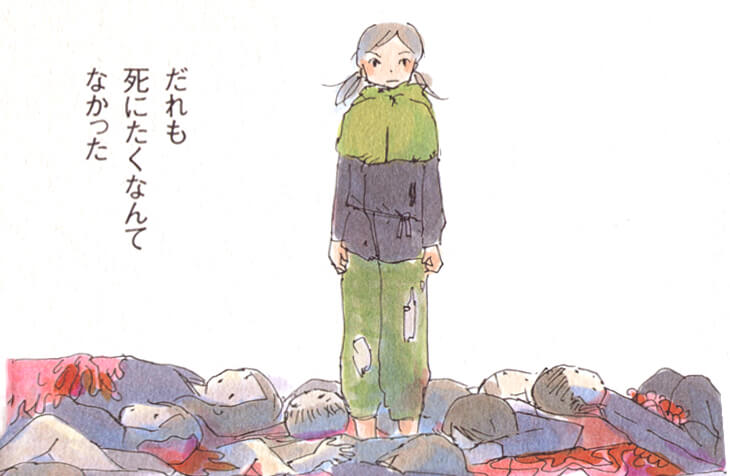
Machiko Kyō’s 2011 graphic novel Cocoon tells a harrowing story based on the historical circumstances of a group of teenage girls who died in Okinawa during the Pacific War. An animated adaptation of Cocoon is scheduled to be released in Summer 2025, bringing this tragic chapter of Japanese history to a new generation. Although Cocoon hasn’t yet been translated into English, its warning concerning the dangerous appeal of militaristic fantasies is universally relevant.
Machiko Kyō, a graduate of Tokyo University of the Arts, won the prestigious Osamu Tezuka New Artist Prize in 2014 and has since published more than a dozen books, while attracting upwards of a hundred thousand followers on her account on Instagram. Kyō’s work is recognizable by her distinctive visual style of digital watercolors applied in light pastel shades. The sketchiness of Kyō’s art style lends itself to impressionistic compositions in which the emotions of simple human figures are projected onto the landscapes and cityscapes that surround them.
In an interview with Matt Hill for The Comics Journal, Kyō explains that translations of her books have been published in Spain, Italy, Taiwan, Vietnam, and Korea, but she has not actively sought English-language publication as, she claims, “I am not a super major author in Japan.” Kyō’s modesty aside, her bibliography is impressive, and her 2010 graphic novel Cocoon was even adapted into a stage play in 2015.
In June 2023, Kyō’s publisher Akita Shoten announced that Cocoon will be adapted into an anime, scheduled to air on the public broadcasting channel NHK during the Summer 2025 season. Hitomi Tateno, who worked as an animator on Studio Ghibli films such as Spirited Away, Whisper of the Heart, and The Wind Rises, has been named as the chief animation producer. The level of care and talent dedicated to this adaptation is fitting, as Cocoon is an intensely upsetting story about an unfortunate chapter of Japanese history that is nevertheless important to remember and pass to future generations.
Cocoon is an intensely upsetting story about an unfortunate chapter of Japanese history that is nevertheless important to remember and pass to future generations.
Cocoon is set on one of the islands of Okinawa at the close of the Pacific War (1941-45), a series of battles between Japan and the United States carried out across the Pacific Ocean during World War II. Many works of mainstream Japanese popular culture decry the crimes of the wartime military dictatorship, from Shigeru Mizuki’s harrowing 1973 graphic novel Onward Towards Our Noble Deaths to Isao Takahata’s heartbreaking 1988 animated film Grave of the Fireflies to Takashi Yamazaki’s sardonic 2023 blockbuster Godzilla Minus One. Nevertheless, the Japan is currently experiencing a populist far-right turn reflected by pop culture glorifications of Japan’s military aggression in which the “gorgeous sacrifice” of military service is presented as a solution to emotional precarity.
Cocoon is a bitter subversion of the patriotic myth of military service as beautiful and uplifting. The story is narrated from the perspective of San, a teenage girl who develops a close friendship with a girl named Mayu. Mayu has been sent to the island to escape the firebombing of the mainland. The Japanese Imperial Army has ordered San, Mayu, and their classmates to care for wounded Japanese soldiers in sea caves until they receive orders to abandon their station and return to base. Unfortunately, the girls are too exhausted and weak from hunger to make rational decisions, and the road home along the beach has become a dangerous battleground. Cocoon closes with Mayu dying in San’s arms on the beach after being mortally injured by gunfire during an American attack.
Cocoon is a bitter subversion of the patriotic myth of military service as beautiful and uplifting.
In her “Afterword,” Kyō writes that the story and characters of Cocoon were inspired by the Himeyuri Gakutai (“lily princess student corps”). The Himeyuri Gakutai was a group of 220 female high school students mobilized as a front-line nursing unit on March 23, 1945, roughly a week prior to the beginning of the American invasion of Okinawa on April 1. The young women of the Himeyuri Gakutai were not provided with adequate medical training, nor were they prepared for the carnage of a full-scale military invasion. When an order was given for the unit to dissolve, the young women left the coastal caves that served as makeshift hospitals for wounded soldiers. Many of the girls had already died from illness and malnutrition, and those who survived attempted to travel along the beach during the American attacks and were caught in the crossfire. Only nine of the 220 students survived.

Cocoon is unflinching in its portrayal of the horrors of war, and its strength as an artistic work lies in the juxtaposition of the carnage of battle against the beauty of Okinawa’s natural environment. The young women of the Himeyuri Gakutai were doomed to almost certain death by the Japanese military state, and Kyō demonstrates how the young women’s compliance with the orders they received was facilitated by a fantasy of the purity of their service.
This fantasy of patriotic purity forms a cocoon that the young women believe will protect them from the evils that befall adult male soldiers. Kyō represents the allure of this fantasy with the visual imagery of the Okinawan tropical paradise, which she uses to convey the seemingly “natural” appeal of patriotism. Unfortunately, the military state that has sacrificed these young women cares as little for them as the flowers and palms that silently witness their deaths when the cocoon of their fantasy is ripped apart.
Kyō suggests that, for younger generations who have no direct experience of war, the real tragedy is not the violence of battle, but the delusional fantasy that enables it. As manga scholar and translator Jocelyn Allen writes of Cocoon: “Kyō deftly captures the conflicting messages these girls get—fight for their country even as their country attacks them mentally and physically—and shows them coping the best they can, escaping from reality into dreams and fantasy only to be yanked ever-so-harshly back to the real world.” In order to critique this fantasy, it is necessary to expose not only its lies but also its allure, especially for teenagers like San who are searching for purpose and meaning in life.
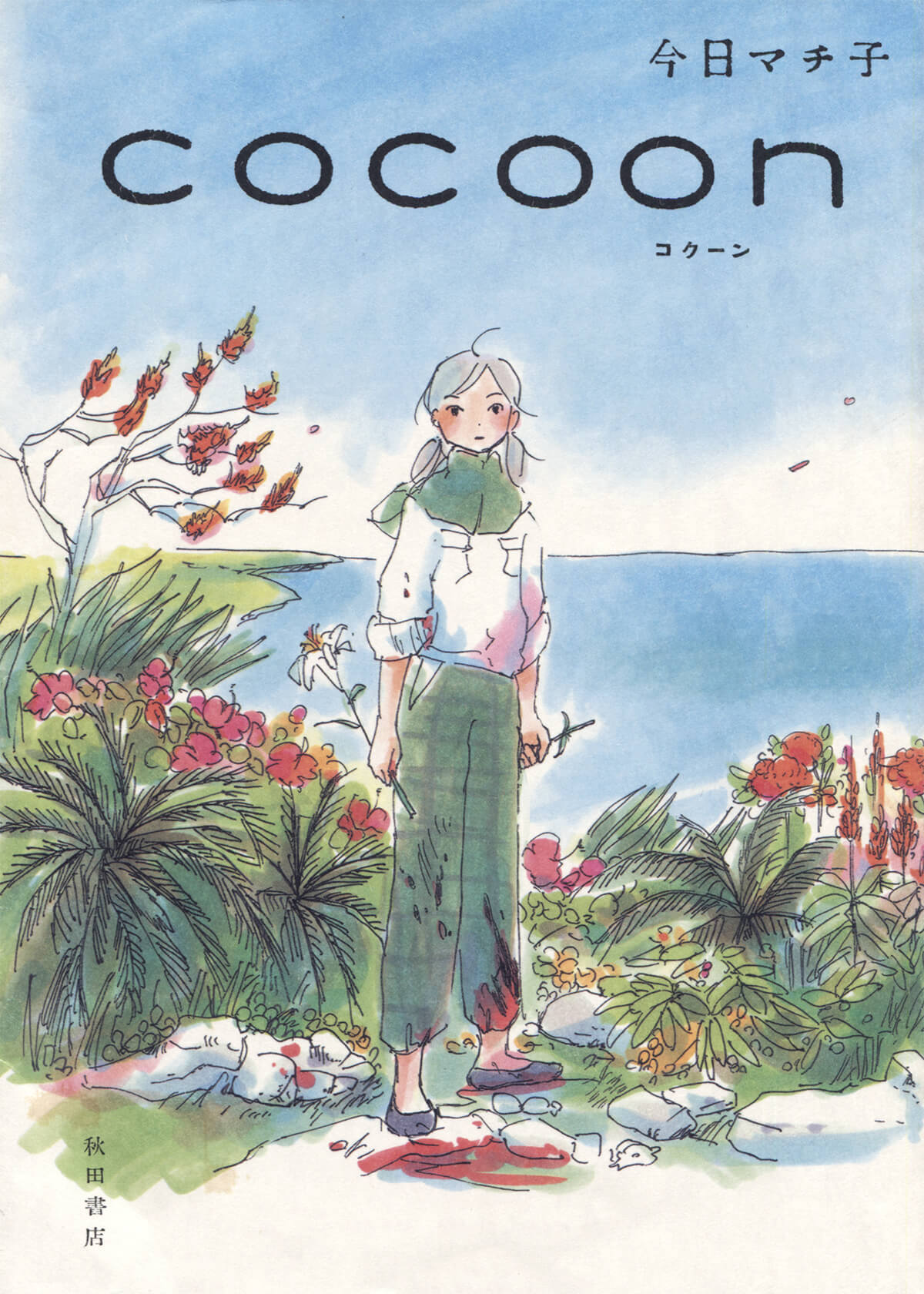
The watercolor painting that adorns the front cover of Cocoon establishes the theme of violence with an arresting contrast of colors. San is framed by a background of the sky and sea, painted in a uniform shade of soft blue offset by the rich greens of the grass and ferns of the foreground. A curved red arc of tropical flowers bends down from both sides of the frame, intersecting at the splash of crimson gore on the hem of San’s trousers. Red flecks of blood rise in a diagonal splash across San’s white shirt, guiding the viewer’s gaze upwards to her blank, traumatized stare. In this world of rich tropical beauty, something is horribly amiss.
Standing in rigid contrast to the visual flow is the white lily in San’s hand, a non-native flower that represents the fantasy “cocoon” of the manga’s title, and echoes the name of the group, the “lily princess student corps.” From the first chapter onward, San repeatedly references the idea of “working for the good of the nation” (o-kuni no yaku ni tatsu), a mantra that encloses her within the fantasy that, as long as the girls maintain their patriotic belief in the value of their work, they will be able to keep moving forward despite the hardships they endure. San and her friends believe that their hearts will be able to remain as pure as the white petals of the lily, which grows steadily upwards on its admirably straight stem.
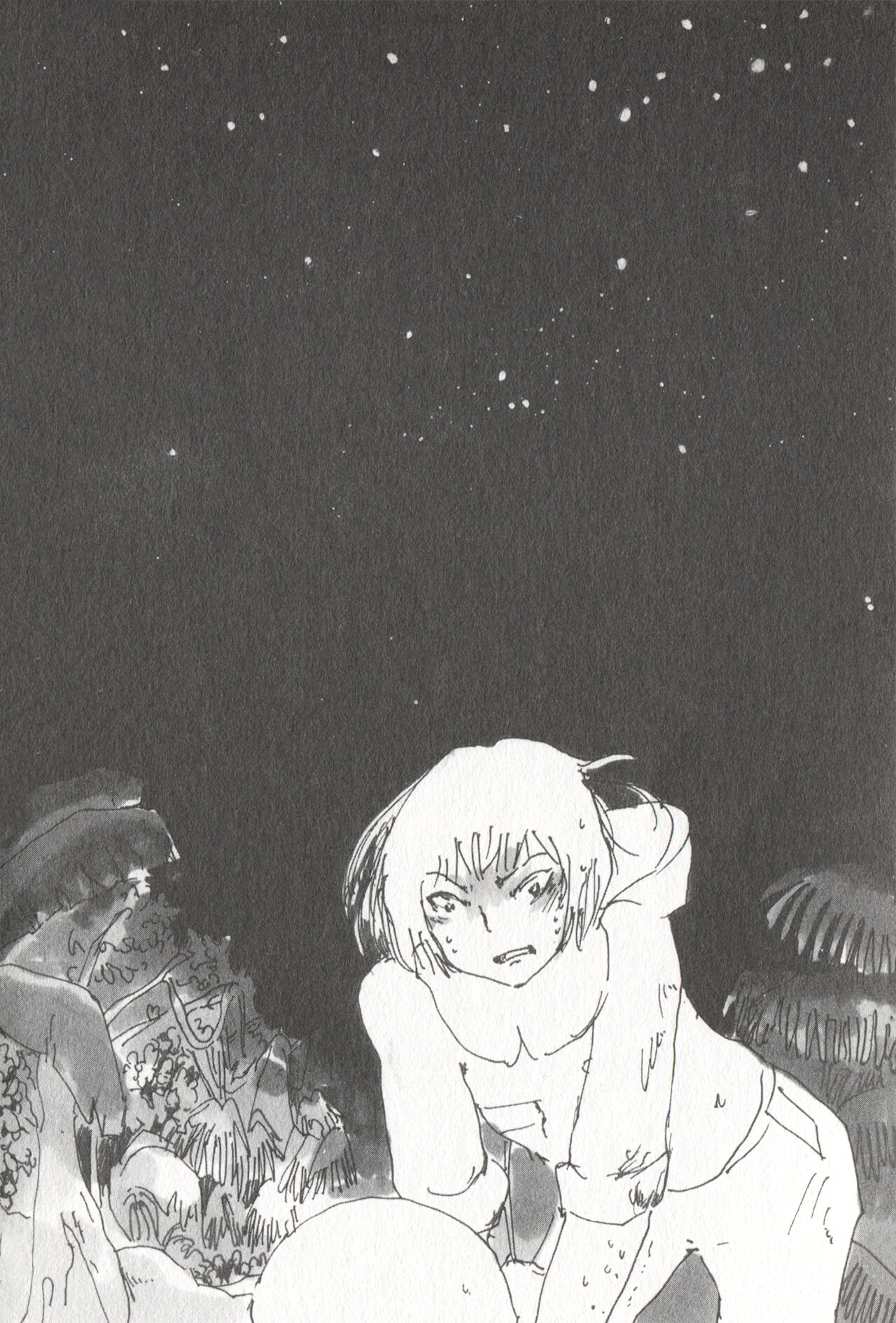
San’s fantasy cocoon unravels in the tenth chapter, “Beneath the Starry Sky,” whose romantic title belies its grisly story. As she crouches on the ground to vomit after eating rotten food, San is sexually assaulted by a wounded soldier who has followed her outside. Kyō juxtaposes a small panel with a close-up of San’s pained face during the assault against several larger panels depicting the night sky over the treetops. This assault becomes a turning point for San, who can no longer justify the idea that it’s “natural” to offer her body in service to the nation.
Although it seems as if only the heavens have witnessed San’s assault, Mayu has noticed San’s absence and runs to the rescue. She attacks the soldier from behind and wrestles him to the ground before strangling him. As he dies, the soldier chokes out: “You’re… not… a girl…”
In the penultimate chapter, after a stray bullet catches Mayu in the abdomen, San drags her friend to a sheltered rocky overhang along the beach. As San removes Mayu’s clothing to treat the wound, she is surprised to discover male genitalia. The story is unclear regarding what Mayu’s “true” gender might be in contemporary terms, but the implication is that Mayu’s family facilitated her assumption of a female identity in order to escape the draft. Nevertheless, various episodes in the story suggest that, despite the horrific circumstances of war, Mayu was happy to live as a girl. As a girl, Mayu loved San, and San loved her in return.
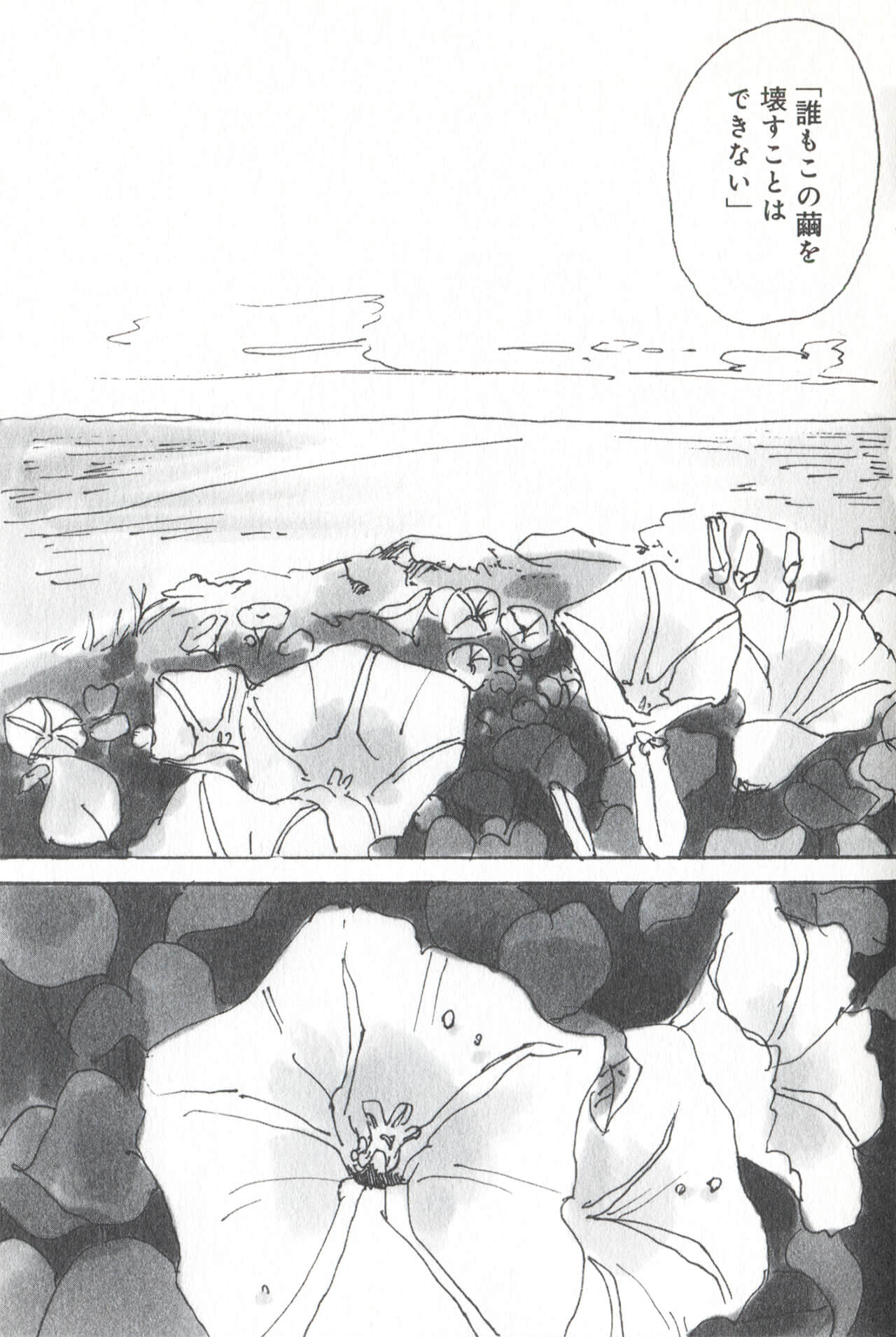
As Mayu dies, she asks San to repeat the magical charm they created to help them withstand the challenges of their duties: “We are protected by an imaginary cocoon, and no one will be able to break it.” The panels framing the text bubbles focus not on the girls, but on the beauty of their environment. The beach is pristine, the seaside rocks are covered in luxuriant moss and grass, and large tropical flowers sprout from bushes higher along the shore. By creating a visual focus on the botanical details of the landscape, Kyō suggests that the love between San and Mayu is beautiful and natural, even if it was supported by an unnatural and unsustainable fantasy.
In the opening chapter of the manga, Mayu describes the experience of watching snow fall as like being inside a cocoon, while San compares the innocent conversations of their classmates to the white threads spun by silkworms. Curious about silkworms, San reads about them in the school library, where she learns that domesticated silk moths cannot fly.
San returns to the analogy of the silk moth in the closing chapter, which shows her life after she’s rescued by American servicemen and reunited with her mother. She appears to have a crush on a boy who lives in the temporary shelter where she happily goes about her daily chores of doing laundry and gathering food. Although San can never forget that she was one of the very few members of her high school class to survive the war, she moves forward with courage while focusing on small tasks that benefit her community. Instead of clinging to the fantasy of pure-hearted girlhood used in war propaganda and imagining herself as a silk moth protected by its cocoon, she says that she has decided to fly.
Much more could be said regarding how the ideology of military imperialism constructs femininity as precious and pure, how the policies of the American empire have shaped postwar Japanese right-wing politics, and how financial precarity has affected the political views of the generations who came of age during Japan’s prolonged economic recession of the 1990s. Kyō has tackled larger social issues in many of her other graphic novels, but her project in Cocoon is to focus on the emotional intimacy of the personal and individual.
Everything beautiful and natural about the characters and their circumstances, from the love that grows between San and Mayu and the tropical flowers that bloom across the manga’s pages, is destroyed by war. Cocoon thereby undermines the emotional appeal of the fantasy of militaristic patriotism by painting its reality in the light of emotional devastation. With any hope, Hitomi Tateno’s upcoming animated adaptation of Cocoon will not only present a grisly wartime drama, but also offer contemporary viewers a wealth of botanical imagery to symbolize the more “natural” beauty of human ambitions and relationships outside the suffocating cocoon of patriotic imperialism.

