

Can you believe it? Spider-Man 2 came out twenty years ago today! It premiered at what was then known as the Mann Village Theater on June 25, 2004, before its nationwide release five days later.
Released four years before Iron Man, in hindsight, Spider-Man 2 feels like one of the last gasps of “old” superhero cinema. No cinematic universes, only one or two tentpole superhero films released in a given year, not a Funko Pop in sight. Increasingly, Spider-Man 2 feels like a relic from a different era, which is not a bad thing in itself.
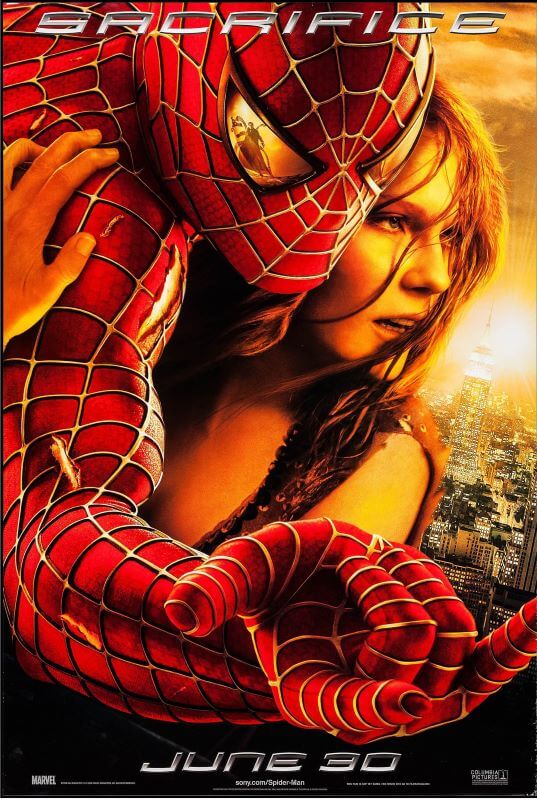
Spider-Man 2 was released to massive success, both commercially and critically. It made over $700 million during an era when movies that weren’t Titanic didn’t make over a billion dollars, becoming the third highest-grossing film of 2004. It’s hard to imagine something like this happening now, but Spider-Man 2 was well-received by critics, and was not viewed as a harbinger of culture’s demise, but rather as a brilliantly-crafted blockbuster with real weight and substance.
Around the time of Spider-Man 2’s release, a consensus was quickly reached that Spider-Man 2 was the best superhero movie. That consensus went mostly unchallenged for the next few years, but twenty years later I think it’s safe to say there isn’t really a consensus at all, and if Spider-Man 2 is still considered the best, it’s a plurality (won with less than 50% of votes) rather than a majority win. But on this anniversary, I want to ask this question: if there’s a better superhero film than Spider-Man 2, which movie could it possibly be?
It’s time I put my cards on the table; Spider-Man 2 is possibly my favorite movie. I don’t mean that Spider-Man 2 is possibly my favorite superhero movie, but rather my favorite movie, period. It’s a deeply uncool opinion for a cinephile to have, but I stand by it. I enjoyed Spider-Man 2 enough when I first saw it fairly close to its release, but it was only a few years later, watching it on TV while staying home sick from school, that it became one of my all-time favorites. It’s a bit hard to remember over a decade since that fateful day, but Spider-Man 2 may have been the film that turned me into a cinephile.

I didn’t just enjoy Spider-Man 2 the movie, but I also loved the Treyarch Xbox game. As a Spider-Man fan in general, it feels safe to say that watching Spider-Man 2, and replaying the Xbox game, are the crown jewels of my occasional Spider-Man hyperfixation periods. I’m admittedly “nostalgic” about Spider-Man (2002) and Spider-Man 2. I say nostalgic in quotes because I don’t feel blindly nostalgic. Whenever I return to Spider-Man 2, I convince myself that I’m not going to like it as much as I used to, something I’m going to touch on in more detail later. This is to say that I’m not the kind of person who yells over dissenting opinions relating to Spider-Man 2, at least as long as they aren’t too egregious.
As you get further into this piece, you might start to notice that I often take a defensive position when talking about Spider-Man 2. The film’s diehard cult has grown over the last 20 years, but so has its league of detractors. As a cinephile, it always feels like a rejection of good taste when someone claims the latest superhero film that was shadow-directed by fifteen different VFX houses is better than Spider-Man 2, a film existing somewhere near the peak of classical Hollywood blockbuster filmmaking. So I’m going to apologize in advance.
Now let’s get into it. I’m going to emulate the earnest, heart-on-sleeve tone of Raimi’s Spider-Man films; yes, this is how I’ll describe my highly opinionated nature.
What’s to Love?
There’s a reason that the ’60s are called the “Marvel Age of Comics” in some circles. The ’60s were the era when superhero comics gained more emotional substance. The Fantastic Four bickered, the Hulk’s powers were a curse, and the X-Men were persecuted minorities. Spider-Man was not actually a man, but rather a poor kid wracked with guilt trying to do the right thing.
I’m not sure if there’s a single issue that embodies the Marvel Age more than Spider-Man No More, a story arc that started in The Amazing Spider-Man #50, published in 1967. It’s a classic story from Stan Lee and John Romita Sr. that has been adapted numerous times; after being a superhero disrupts Peter Parker’s personal life one-too-many times, he decides to give up on being Spider-Man. The story defined an era, and it’s one of the four most important Spider-Man stories, next to other classics such as The Night Gwen Stacey Died and The Master Planner Saga (the origin is, obviously, the most important).
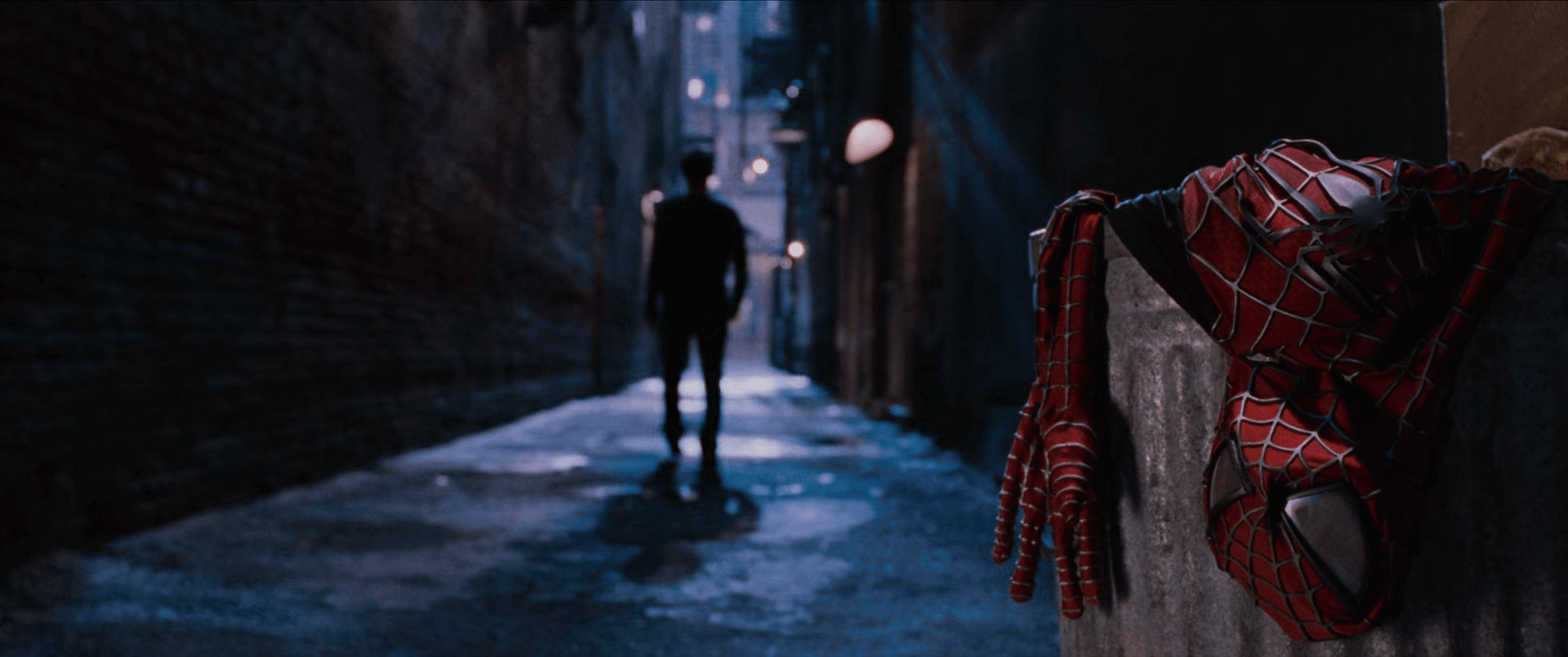
Had Batman ever thrown in the towel? Had Superman ever decided to live exclusively as Clark Kent? Considering the ’60s was also the era of Superdickery, the answer to both of those is probably “yes,” but there’s a reason it mattered when Spider-Man did it.
It was the added psychological depth of stories like Spider-Man No More that changed superhero comics forever. By the time Spider-Man 2 was made, film had already become a mature medium, but Spider-Man 2 was the most emotionally real and complex — the most human — superhero film yet. 1992’s Batman Returns was a complex film, yes, but its characters were more symbols and archetypes than human beings. In Spider-Man 2, Peter Parker is a normal guy, with a lot of normal problems. Mostly.
The 2002 Spider-Man, with its dynamic David Koepp screenplay, is kinetic and fast. Sam Raimi’s direction and Don Burgess’ cinematography are filled with shots where Spider-Man is posed to emulate the imagery of comic books. It’s a movie filled with an exuberant approach to filmmaking, a certain kind of showmanship. Spider-Man 2 also has shots that emulate comic book imagery, but it dials back the kinetic energy of its predecessor and trades that in for something more down-to-earth, with cinematography from Bill Pope (all 3 Matrix films and previous Raimi collaborator on Army of Darkness) and with a brilliant screenplay from Alvin Sargent (and story credits for Alfred Gough, Miles Millar, and Michael Chabon).
Spider-Man 2 is, once again, a film about responsibility. But it’s also a film about impotence; about being unable to accomplish things; about being crushed by life with little reprieve. Peter Parker knows how important saving people is, but he also is flunking his college classes. He’s losing Mary Jane, the love of his life. Because he’s Spider-Man he’s losing Harry Osborn, his best friend, who blames him for the death of his father. The Daily Bugle has made people distrustful of Spider-Man, but Peter Parker needs to do freelance work for The Bugle in order to make rent. It doesn’t help when Peter Parker’s mentor turns into a supervillain.
It’s not surprising that all of this would cause Spider-Man to “lose” his powers. I said this was a film about impotence earlier, but the flipside of that is that it’s also about perseverance. It’s about continuing to fight an endless fight, because it’s the right thing to do. I frequently hear people complain about Peter Parker losing his powers and then getting them back, usually because it’s seen as being arbitrary. This is troubling, because it’s clear Parker’s powers are tied to his emotional state, and if Mary Jane being kidnapped is not clear enough motivation, I don’t know how else this could’ve been communicated.

Something that I find ironic is that a lot of people complain about the lack of levity in Spider-Man 2, but people also complain about the sentimentality. These are odd complaints because, to some degree, they’re diametrically opposed. But they also just don’t hold water as criticisms. It’s true that Spider-Man doesn’t quip in Spider-Man 2 like he does in the comics, but all of the Raimi Spider-Man films are hilarious. The pizza delivery sequence, Peter Parker jumping over that car, the scene where Peter tries reciting poetry to Mary Jane? I understand that jokes occurring in a film are not the same thing as jokes coming out of a particular character’s mouth, but there is still the larger macro criticism that this is not a “fun” movie because Peter Parker’s life still basically sucks when it ends. Which is true, but that’s a complaint that basically says an ending is only good when the protagonist doesn’t have to worry about money anymore.
And the sentimentality: what made our culture so hungry for cynicism? The best parts of the Raimi Spider-Man films are the sentimental parts: Peter Parker talking to Mary Jane about getting married on a hilltop, Aunt May telling Peter about the importance of heroes, Spider-Man crawling towards Mary Jane on his web after saving her. All enhanced by Danny Elfman’s lush, romantic score. Would this scene be better if Peter Parker said something like “Gee, it’s pretty dumb how we’re sitting around up here, like we’re in some kind of superhero movie?”
I’ve been talking about the emotional substance of the film, but the formalism is also very important. Sam Raimi directed Spider-Man 2 with an incredibly sure hand, and it features some of Pope’s best cinematography. The action scenes are dynamic while still having clarity, and the colors are beautiful. I still remember the exact moment I stopped caring about the MCU, and it was the fight between Spider-Man and The Vulture at the end of Homecoming. It was such a gray, incomprehensible, and shaky mess. It was shocking to see how unambiguously worse filmmaking had gotten in thirteen years.
Spider-Man 2 is not a film that pushed the envelope for film formalism. There’s no non-linear narrative; no experimentation with non-diegetic sound. This isn’t Nashville, Point Blank, or THX-1138. But it’s hard for me to think of other Hollywood blockbusters that represent the pinnacle of a certain kind of tentpole classicism the way Spider-Man 2 does. The only film that comes to mind as being more impressive in this respect at the moment is maybe Minority Report.
Spider-Man 2 is not only a well-lensed film, but also a brilliantly acted one. The performance on which the film lives or dies is its Peter Parker, portrayed here by Tobey Maguire. Maguire’s portrayal of Parker as an awkward, well-meaning nerd is flawless. While Maguire doesn’t really “do” wisecracking, snarking Spider-Man, he shines during dramatic scenes. Maguire’s experience in films like The Ice Storm, Pleasantville, and Wonder Boys is utilized to great effect during scenes with Mary Jane or Aunt May.
Some people feel Maguire is a mediocre Spider-Man. Unlike a lot of depictions of the character, Maguire’s Parker is not someone it’s enjoyable to fantasize about being, because of how awkward and dorky he is. Maguire’s Parker is something of a middle ground between the nerdy, anti-social, and acrid Steve Ditko!Peter, and the cool and lovable John Romita Sr.!Peter. Maguire’s Peter is nerdy and awkward, but also nice.
People have many criticisms about the Raimi trilogy, but I think it’s safe to say that its portrayal of Mary Jane is by far its most often criticized aspect. Kirsten Dunst’s performance as Mary Jane is not as brilliant or essential as Maguire’s performance. That being said, the character and portrayal are unfairly maligned. The reception of Dunst’s Mary Jane clearly has roots in misogyny; there’s a widespread refusal to empathize with the character that would be comical if it didn’t represent a stunning lack of media literacy. People often complain about how acrid Mary Jane is, but her behavior makes perfect sense when one considers the information the character knows, or rather, doesn’t know. Mary Jane doesn’t know Peter Parker is Spider-Man, and so from her perspective, she understandably views Parker as being a massive flake who enjoys playing emotionally draining mind games with her.
I understand that this portrayal of Mary Jane is distinct from the more vivacious one found in the comics, but the gradual maturation of Mary Jane found in the source material makes sense in a serialized medium like comics; the screenwriters of the Raimi trilogy made choices when adapting Mary Jane that make sense when you consider the ultimately short amount of time a film series has relative to an ongoing monthly comic. Mary Jane in the Raimi trilogy is ultimately one of the more complex and three-dimensional love interests in the superhero film genre. Across all three Raimi films, things never become simple for Mary Jane and Peter Parker (something that maybe was pushed a little too far in Spider-Man 3). But in a genre filled with wish-fulfillment love interests who mostly exist to provide uncomplicated emotional support for protagonists and otherwise very simple romances, there’s something laudable about the complexity Raimi’s screenwriters brought to the table. This isn’t to suggest that the Raimi trilogy’s portrayal of Mary Jane is without flaws. In all three films, she’s used as a damsel in distress; while it makes sense in the first two installments, relating thematically to Peter’s anxieties around putting the people closest to him in danger, by Spider-Man 3 it was played out.
Then there’s James Franco, who is something of a blemish on the entire Raimi trilogy. Even before Franco’s extensive history of sexual misconduct was made public, nobody was calling Franco a highlight of the Spider-Man films. I have to admit that his weird, off-putting energy works in a strange way when playing vindictive fail-son Harry Osborn, and because his character is meant to be unlikeable it’s easier for me to overlook Franco’s wrongdoings than it would be if he was playing the lead role. Maybe you don’t feel the same way, and it’s totally fine if you don’t.
Of course, there’s also Alfred Molina and Rosemary Harris, not to mention all of the other brilliant supporting players like J. K. Simmons, Cliff Robertson, and Elizabeth Banks. Lynn Kressel and Francine Maisler, casting directors of the first film, as well as Dianne Crittenden, casting director of this sequel, deserve major credit for making every small role so memorable, from Joel McHale’s smarmy turn as a bank employee, to that guy on the train (played by Joey Diaz).

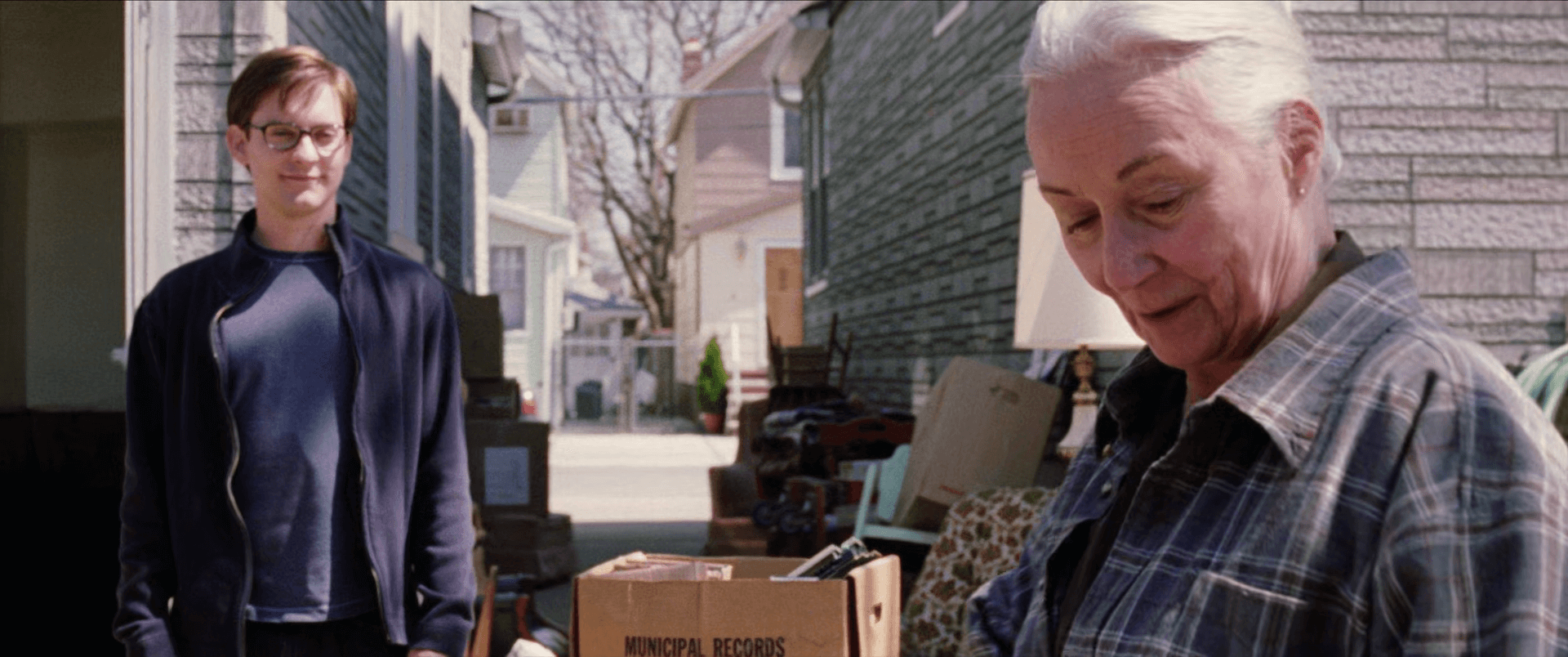
But Molina and Harris do deserve extra acknowledgement. Molina’s portrayal of Doc Ock as a warm, friendly, and cultured man of science with an ambitious streak is a lot different than the less sympathetic mad scientist Ock of the comics. But it’s difficult for me to care about the lack of fidelity to the source material in this instance, because Molina is so . . . sublime. And Harris as Aunt May plays off Maguire during Peter Parker’s confession to incredible effect. Later in the film when Aunt May gives her speech about heroes I always tear up, because she sounds so pure of heart.
And I need to make the observation that everybody makes, that J. K. Simmons is the perfect J. Jonah Jameson. It helps that J. Jonah Jameson is a simple character, but I can’t think of a more perfect 1-to-1 translation from comic page to screen.
Three years after Spider-Man 2’s release the world would be exposed to Spider-Man 3. Spider-Man 3 is not an awful film. It’s probably the funniest film in the Raimi trilogy, and while it is a bit overstuffed, the biggest problem is that it ended a trilogy instead of acting as an Empire Strikes Back-type dark middle chapter. But Spider-Man 3 does still highlight a bunch of things that were great about its predecessor. Spider-Man 3’s entire vibe reflects its rushed and tumultuous production, from the deeply flawed structure of the narrative on a macro level to more localized problems (i.e. the butler-glider scene, misused musical themes from the prior films). The special effects sometimes look worse (remember that oddly terrible composite shot involving the construction site?), and even Bill Pope’s cinematography feels too oversaturated and unfocused, figuratively speaking.
I also need to say this here, since I’m probably never going to talk at length about Spider-Man 3: Sam Raimi fucked up Spider-Man 3, and nobody else. It’s true that Avi Arad, former head of Marvel Studios, forced Raimi to put Venom into the movie, but it’s Raimi’s fault he didn’t roll with the punches and take out Sandman during pre-production. An artist shouldn’t need to make compromises, but Raimi was making a big Hollywood tentpole and he should’ve adapted instead of setting himself up for failure. Spider-Man 3 highlights a lot of what made Spider-Man 2 so great; 2 just feels so assured of itself in comparison to its sequel. But it obviously shines without needing favorable comparisons to other movies.
The ’80s, ’90s, and ’00s were a great period for genre filmmaking. There are certainly nightmare stories from this period about executives ruining movies, but in hindsight, it feels like a period where trust in filmmakers intersected with huge advancements in filmmaking technology to create many classics. Spider-Man 2 feels like one of the last masterpieces of this era. It’s strange how weird Spider-Man 2 feels; I can’t imagine a studio releasing a massive tentpole this earnest, uncynical, and beautiful ever again. At the same time, I almost can’t understand why every movie isn’t like this.
What Didn’t Age Well
In almost every cinematic respect Spider-Man 2 is a movie that’s aged well. The visual effects still look incredible, and if anything the formal elements of the filmmaking represent a higher standard than a lot of modern blockbusters do. But if there’s anything that really makes Spider-Man 2 feel like a movie from 20 years ago, it’s how predominantly white the cast is. In the year 2000, only 35% of New York’s population was white, and that doesn’t exactly manifest in the primary cast of the film.
An effort was clearly made to make tertiary characters as diverse as possible. The kids who see Peter Parker backflip over the car and the woman who yells “Go Spidey go!” are Black. Mr. Aziz (Aasif Mandvi) is Indian. The toddler Peter Parker saves from the fire is from an East Asian family, as is the street performer who makes an obligatory reference to the 60s Spider-Man theme song. But these are, Mr. Aziz aside, nameless characters who ultimately exist to either be saved and/or remark upon things.
As a transgender viewer, it’s also pretty hard to ignore that there isn’t even an implied gay character in the entire Raimi trilogy. Not even during any of the Broadway-related scenes!
I mentioned towards the beginning of this retrospective I often expect to like Spider-Man 2 less each time I revisit it. Spider-Man 2 resonated with me as a queer teenager who was closeted even to themself. It’s a story about someone who hides a major, vital part of themself from everyone they know. All superheroes are kind of gay, and secret identities are one of the gayest things about them. But, as someone who no longer has a secret identity, I felt I would not find as much to enjoy about Spider-Man 2 because I didn’t think it would intersect with who I am now. Not every piece of art needs to be for everyone, and that’s totally fine, but I didn’t expect to enjoy Spider-Man 2 for the same reasons I now enjoy movies like Elvira: Mistress of the Dark, The Craft, and Showgirls.
I discovered upon revisiting Spider-Man 2 that I do still enjoy it immensely. It’s still a well-made movie, and its themes relating to responsibility and obligation are universal. That being said, I’m glad things have changed over the last 20 years. In 2004, making changes when adapting source material to reflect a more diverse society was something that was very rarely done. Things have changed very fast when it comes to expectations relating to diversity. I’m glad that we now have the Spider-Verse films, which have made racial diversity a focus. They have even included some subtextual trans rep with Spider-Gwen, which is unfortunately the most we can hope for from an all-ages studio film.
Spider-Man 2 vs Other Movies
Now that you’ve listened to my gushing for a few thousand words, it’s about time we return to the central question of this piece: is Spider-Man 2 still the greatest superhero film?
The big irony here is that many of the superhero films that I consider Spider-Man 2’s competition are films older than Spider-Man 2. Purely because of its influence, the 1978 Superman film is a candidate. While the earnest bright and optimistic tone feels like a panacea in 2024, it’s mostly a hard film to revisit. Does anyone remember that oddly long and excruciatingly boring scene where Lex Luthor steals those missiles? Superman II, on the other hand, is still a really fun watch, but only the 2006 Richard Donner Cut. It’s just a shame that it ends, like its predecessor, with Superman reversing time and making the film un-happen.
RoboCop is also a contender. While RoboCop was not based off of a comic, it’s structurally similar to every superhero film that includes an origin story. RoboCop also is very much a Marvel-style tragic science-origin hero, like the Hulk, or, more superficially, Iron Man. Edward Neumeier and Michael Miner’s screenplay is flawless, and Paul Verhoeven’s gleefully violent and sardonic direction is perfect. RoboCop is probably the greatest superhero movie that happens to contain an origin story.
Then there’s Tim Burton’s Batman Returns (the 1989 Batman is a firm 6.5/10 movie). I think this film is held in higher regard by cinephiles than comic fans, but I also think most comic fans have moved past strict adherence to lore as being mandatory. It’s a little weird that Batman murders a bunch of people, and Catwoman and the Penguin are nothing like how they are in the comics. But it’s a movie filled with dynamic images, great humor, and it has one of Elfman’s greatest scores. It’s also an extremely horny movie, and if there’s anything modern superhero movies are lacking it’s horniness.
X2, also known as X-Men 2, is also a contender. It’s the only superhero film I can think of that approaches saying ACAB on a textual level. It feels more politically astute than 90% of superhero films. But the direction is pretty indistinct relative to all the other movies I just mentioned, and many people would argue, not necessarily incorrectly, that later X-Men movies like First Class are better overall. I’ve always had a soft spot for X2, but it’s definitely dated in a way that none of these other movies are due to how it tries to distance itself from the more comicbook-y elements of its source material. Much like another movie I can think of . . .
Many people love Nolan’s The Dark Knight, a movie I will never love for two reasons. The first is that I’ve seen Batman Begins, and I found it to be deeply ashamed of itself and excruciating to watch. The second is that I associate hardcore Dark Knight fans with guys who yelled homophobic slurs on Xbox Live. You’re allowed to think that’s an unfair association, but I was alive in 2008 and I went to school with those people.
Those are all the heavy-hitters from the “old” era of superhero films, before the current MCU era. I mentioned being nostalgic about Spider-Man 2 at the beginning of this piece, and I think it’s worth mentioning that I saw most of these movies for the first time when I was between 7 – 15 years old, and the same can be said for some of the earlier MCU movies. But they don’t invite the same feelings for me. Many people will find this controversial, but I don’t think there are more than a small handful of post-Iron Man superhero movies that can compete with the ones I just mentioned.
There are some newer superhero films that I do enjoy. Most of the films leading up to The Avengers were pretty good, because at that stage MCU movies still had to succeed by traditional metrics of storytelling and filmmaking. Black Panther is a much more politically astute film than most of its detractors realize. Venom: Let There Be Carnage is a welcome throwback to when a superhero film could just be a fun 90-minute thing. The Spider-Verse films are great, but the character assassination stuff in the sequel rubs me the wrong way. Do you really expect me to believe all those Spider-People would form a massive conspiracy devoted to making sure certain people die? Don’t do Spectacular Spider-Man dirty like that.
I also must mention Doctor Strange in the Multiverse of Madness, Sam Raimi’s return to superhero film directing after Spider-Man 3 (and a return to Ditko-ish characters). There are a lot of fun Raimi-isms in Multiverse of Madness, like some of the extremely dissolve-heavy montages and some of the horror-adjacent sequences in the film. But the filmmaking is pretty much the only thing the film has going for it, because it has no emotional core. Doctor Strange has some feelings about his ex getting married to someone else, which isn’t much. Scarlet Witch has the emotional maturity of a 5 year old; she nakedly wants to live in a fantasy and lies to herself about how fulfilling it would be. Of course, lying to oneself is a very human impulse, but only to a certain degree.
It doesn’t help that Elizabeth Olsen isn’t that great here. She puts a lot of effort into portraying Scarlet Witch as straight as possible when the logical choice would’ve been to chew the scenery and go full camp. It’s easy to imagine Fairuza Balk being handed the same screenplay and turning in a performance that would’ve single-handedly made Multiverse of Madness essential viewing. I could say the same thing about Rachel McAdams, who also demonstrated a great gift for playing villains in Mean Girls and Passion.
To be fair to Olsen, if she’d tried to go camp, I’m sure a Disney exec would’ve told her to stop. Multiverse of Madness is ultimately two hours of non-stop spectacle, and it really demonstrates what made Spider-Man 2’s grounded approach so special. Sam Raimi says he wants to direct a Secret Wars movie, and I wish I could get excited about that.
On the whole, it feels like most of these newer movies exist on a different, much lower, playing field, where studio executives are exerting a lot more creative control than they used to. Hollywood is a lot more risk-averse than it used to be, and it feels most obvious when comparing new superhero films to older ones. There are a lot of things people can say about Steve Ditko, a lot of bad and unfavorable things that are totally justified, but his comics weren’t risk-averse. Putting Spider-Man into a costume that covered his entire body was a risk. Making Peter Parker into an acrid asshole was a risk. Making a teenage superhero was a risk, and creating weirdos like Dr. Strange, and for DC Creeper, The Question, and Shade the Changing Man, was a risk.
Spider-Man 2’s legacy (and memes)
It’s safe to say there are a handful of superhero movies out there that are, arguably, as good or better than Spider-Man 2.
As I worked on this piece, I consciously noticed something for the first time; modern superhero movies aren’t trying to be like Spider-Man 2. Spider-Man 2 does have a legacy, but it’s not in the superhero movies that followed, at least on an ethos level. Spider-Man 2, along with the other Raimi films and the X-Men trilogy, showed Hollywood that superhero movies could make a lot of money. The success of Donner’s Superman could be attributed to how widely known the character was, and Burton’s Batman to cultural osmosis from the Adam West show. In the eyes of film studio executives, Marvel characters didn’t have the same obvious bankability behind them, which explains why Spider-Man was in development hell for decades before eventually being produced.
Would Nick Fury have appeared at the end of Iron Man without the success of Spider-Man? Probably not. Iron Man itself probably wouldn’t have been made, considering the words “Iron Man” used to be more associated with an old Black Sabbath song than a superhero.
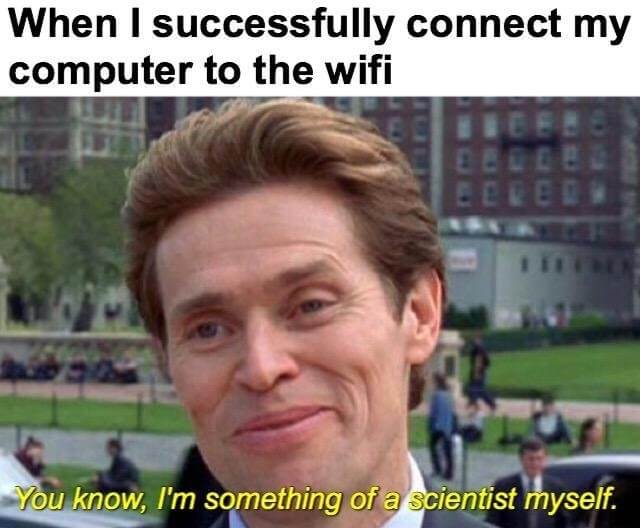
Spider-Man 2’s legacy can also be felt in countless memes. A visit to /r/raimimemes reveals that the Raimi trilogy is only second to the Star Wars prequel trilogy when it comes to a certain school of memeing; it’s not just a handful of common macros, but rather a complete dissemination and recontextualization of every single quotable line of dialogue from the films. Of which there are surprisingly many.
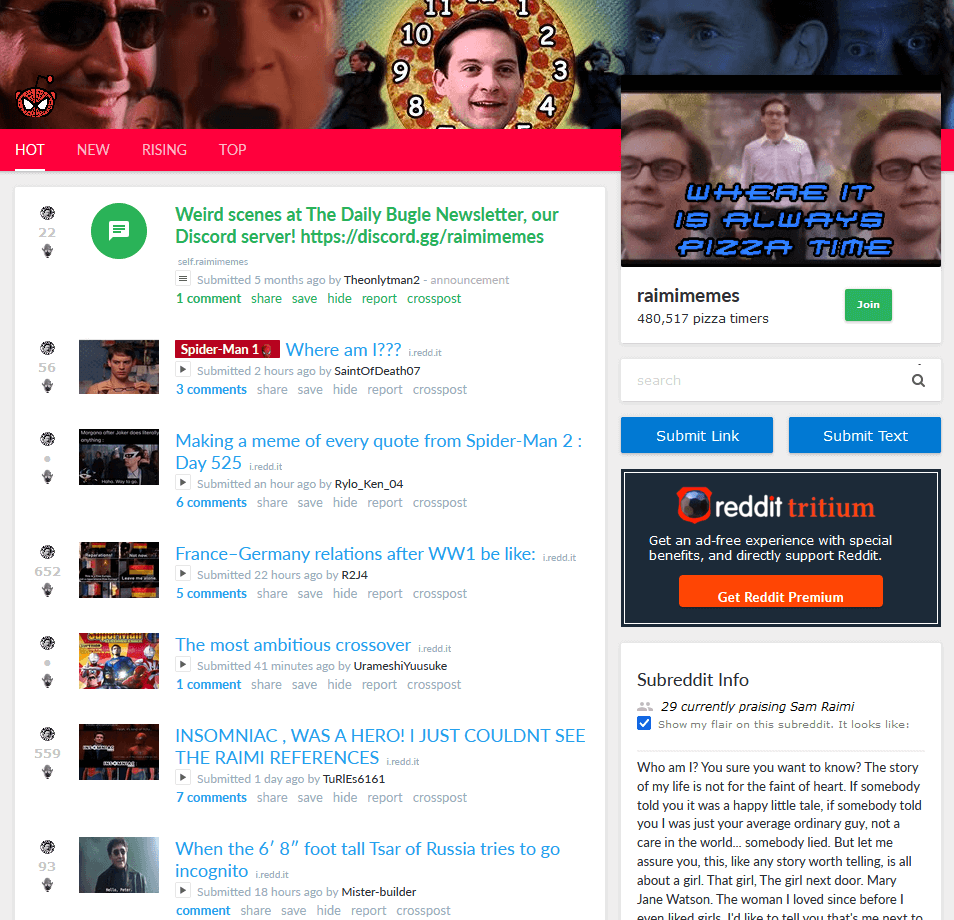
Whereas the Star Wars prequel meme phenomenon seems to have been born out of an ironic unappreciation that gradually turned into an unironic love, the Raimi memes seem to have always come from a positive place. Whether or not the bright and occasionally goofy tone of the films is good in an unqualified way, or endearingly hokey, is not universally agreed upon, but I don’t think anyone making Raimi memes dislikes the movies themselves. There are also some rumors that there might be a fourth Raimi Spider-Man film. I usually have a dislike of nostalgia fanservice movies like Ghostbusters: Afterlife and The Force Awakens, but Spider-Man 4 is a movie I could get really excited about. I just hope that it acts as a solid coda to the original films instead of trying to be anything else.
Webbing Things Up
There are now dozens of big-budget superhero movies, the majority of them from the post-Iron Man era. It’s an era that seems to be ending. As of this writing, Madame Web has bombed in theaters, critically and commercially. Multiple upcoming superhero films are on the horizon, but the prognosis for all of them is unclear; people are getting tired of superhero movies, and the bloated, slapdash school of Hollywood filmmaking they’ve come to represent.
Spider-Man 2 feels alien when compared to modern superhero films, where people stand in front of greenscreens and shoot lasers at each other. If every superhero film was made with the same craftsmanship and quality as Spider-Man 2, I don’t think the superhero film genre would currently be declining. The past few times I’ve revisited Spider-Man 2, I’ve told myself I would be disappointed by it, but that has never come to pass. It’s a movie I still love just as much as I did a decade ago, if not more. It’s not only a film that captures what made Spider-Man a special and memorable character, but also a great human story in general.
Is it the greatest superhero film? Yeah, probably. At least for me.

