


Hello, hello! Have you been watching that hot new anime on Netflix lately? Yes you have. Delicious in Dungeon is all over everyone’s social media feeds like it’s the last season of Succession. And it looks like a lot of people were inspired by Studio Trigger’s tasty adaptation to check out the manga by Ryoko Kui, currently published in English by Yen Press. But if you’ve finished the manga, caught up on the anime, and are still hungry, what should you read next?
Fortunately for you, WWAC has a list!
Golden Kamuy
Satoru Noda
VIZ Media, 2016-2024

At 314 chapters and 31 volumes, this is not a quick read. But if you like unusual recipes, offbeat adventuring parties, and learning about the effects of the 1905 Russo-Japanese War and Japanese imperialism on the Ainu of Hokkaido, this is the manga for you!
This historical manga is more violent and explicit than Dungeon Meshi is, but it’s just as funny and full of heart. My usual quick pitch of the story is, “True Grit, but set in 1900s Hokkaido.” War veteran Sugimoto is on the search for a rumored treasure trove of gold, when he runs into a 13-year-old Ainu girl named Asirpa who helps him survive in the wintry wilderness, teaching him how to hunt and prepare the native animals of her home while also helping to unravel the mystery of the lost treasure. Along the way, they make allies and enemies and discover a lot of other factions also searching for that gold, and learn the shocking truth about Asirpa’s father. If you like the adventuring part of Delicious in Dungeon more than the cooking (but still like the cooking) and don’t mind a historical setting, you really need to check this one out. It’s also funny!
— Masha Zhdanova
What Did You Eat Yesterday?
Fumi Yoshinaga
Kodansha, 2014-present

And now for something completely different: a grounded slice-of-life about a middle-aged gay couple, comprised of a lawyer who loves to cook and a hairdresser who’d rather not. Each chapter explores their relationship and that of their friends, families and coworkers through the meals they make for themselves and others, taking the reader through the step by step preparation of each dinner or lunch they serve. The story moves slowly, but it does move, and the characters do grow and change and meet new people chapter after chapter. It also doesn’t shy away from the realities of middle age, or being a gay man in Japan and how that affects the characters’ lives. If you like complex characters and reading about people making dinner, you’ll like What Did You Eat Yesterday? There’s also a wonderful live-action adaptation of it on Netflix.
— Masha Zhdanova
Giant Spider & Me
Kikori Morino
Seven Seas Entertainment, 2018
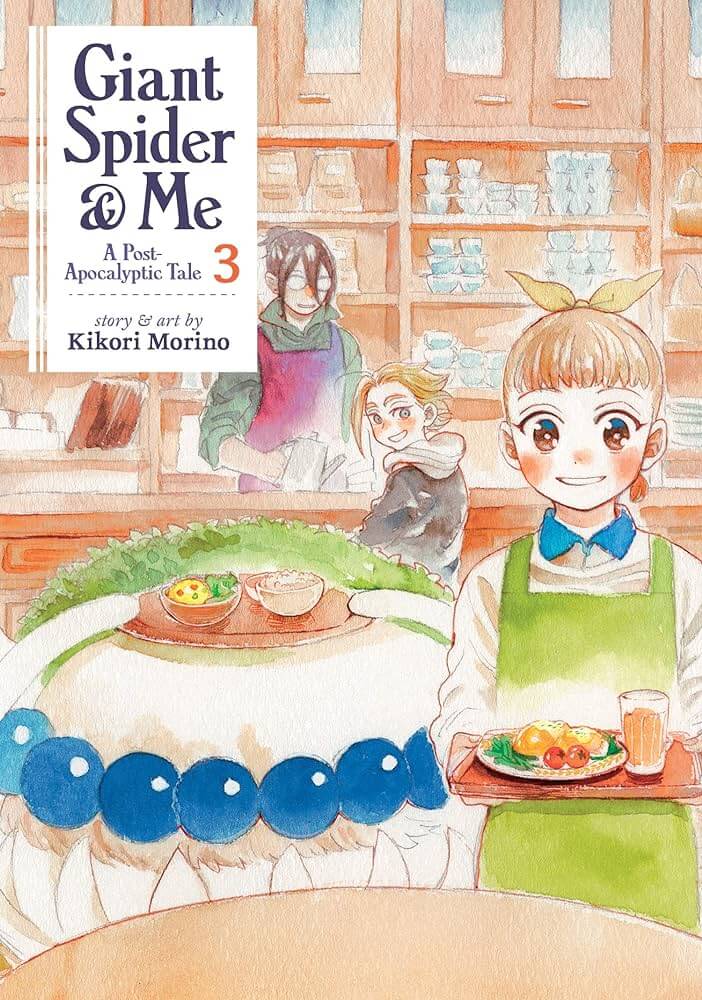
Nagi is a young girl, really still a child, but it’s not so unusual to live alone — in the dystopian landscape in which she’s surviving, people do what they must. However, when Nagi goes out to forage for food she discovers a creature that appears to be a large, mutated spider. At first Nagi is frightened, but it turns out the spider is quite sweet and likes her cooking! The strange pair form a bond, and for the first time since her father left, Nagi’s world begins to open up. Instead of eating monsters, she eats with a monster.
Giant Spider and Me boasts a beautifully illustrated dystopian setting, but it’s not really about climate change or disaster — it’s about food and relationships. Over three complete volumes, Morino presents a very soft, emotional cooking manga in which unlikely friends come together over food, just as the energetic companions Delicious in Dungeon do. If Kui’s emphasis on complex but worthwhile relationships is what entices you about Dungeon Meshi, Giant Spider and Me is another treat you’ll enjoy.
— Alenka Figa
Kakuriyo: Bed and Breakfast for Spirits
Waco Ioka, Midori Yuma and Laruha
Viz Media, 2019

One of Delicious in Dungeon’s high points is the incredible and innovative world-building. If you’re looking for another series that combines crafty world-building with tasty recipes, try Kakuriyo: Bed and Breakfast for Spirits! Aoi is a human but she’s always been able to see spirits, which comes with both good and bad consequences. Thankfully, as a young girl she was taken in by her grandfather, who trained her on how to stay safe, alive and away from creatures that want to devour her. His lessons carry her into adulthood but suddenly fail when Aoi learns her grandfather was deep in debt to the Tenjin-Ya inn in the spirit world, and she’s supposed to marry the owner to pay off his debt! Desperate to remain single and unconsumed, Aoi opens a bed and breakfast for spirits on the inn’s grounds to try and earn her way to freedom.
The premise of this manga might seem to have some red flags but I can promise it is actually very wholesome; the ogre who owns the inn is clearly a gentle, caring wife guy-in-training who just wants to protect Aoi. The spirit world in Kakuriyo is vibrant and full of wildly fun, handsome character designs, exciting markets and palaces, and tons of food! Rather than full recipes, this manga feels closer to a cooking show, as it always follows Aoi step-by-step through the cooking process. (Is cooking procedural a subgenre of cooking manga?!) While not as wild as Delicious in Dungeon there are some supernatural ingredients involved in the food, and food itself brings unlikely characters together. It’s a very sweet but incomplete series, and I hope we get more volumes in the future!
— Alenka Figa
Sweetness and Lightning
Gido Amagakure
Kodansha, 2016

A big theme in Delicious in Dungeon is family — blood family, found family, complicated family relationships in need of repair, family bonds that motivate characters to take big risks, and on and on! If you’re a sucker for a family and food-themed story you’re going to love Sweetness and Lightning. High School math teacher Kouhei Inuzuka lost his wife and is raising his preschool-aged daughter alone. Kouhei is not a skilled cook and feeds his daughter mostly pre-packaged meals, but when he sees her starting to eat less he grows worried. A chance encounter with one of his students, Kotori Iida, opens up an opportunity for the three of them: if they learn to cook together Kouhei can properly care for his daughter, and Kotori can combat the loneliness she feels as her mother’s career takes her away from home.
First: I want to note that I initially avoided this series because I was worried it involved a romantic relationship between a teacher and student, but it does NOT. This is an emotional cooking manga about grief, loneliness and found family. Each story features a recipe, and each cooking adventure pushes Kotori and Kouhei to improve their culinary skills and even overcome their fears! While this is ultimately a sweet, slice-of-life story there is a lot of exploration of grief and loss, especially as Kouhei has to navigate his daughter’s understanding of what it means to lose her mother, so this might not be the story for you right now. However it is a really beautiful and thoughtfully crafted story, full of love and light and food.
— Alenka Figa
Silver Spoon
Hiromu Arakawa
Yen Press, 2018-2020
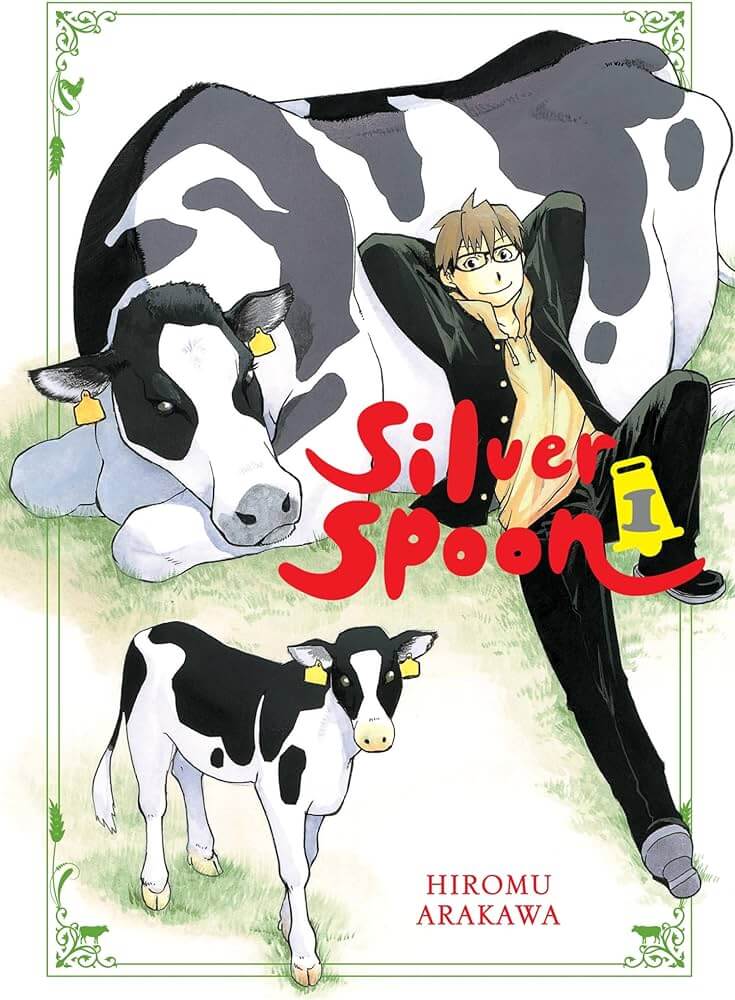
Hiromu Arakawa, the creator of Fullmetal Alchemist, was born on Japan’s northern island of Hokkaidō, where she grew up on a dairy farm. One of her most celebrated manga, Silver Spoon, draws on her personal experiences as a foundation for a fast-paced story about an overachieving teenager from the city who enrolls in an agricultural high school. Although Silver Spoon is firmly grounded in reality, the challenges faced by its characters are surprisingly intense. Like Delicious in Dungeon, Silver Spoon is concerned with the practical realities of where food comes from, as well as the intricacies of how to prepare meals from unprocessed ingredients. Silver Spoon also offers real-world analogies to many of the questions concerning ecosystem sustainability and the ethics of consumption presented by the fantasy of Delicious Meshi. If nothing else, Hiromu Arakawa and Ryōko Kui seem to be vibrating on the same creative wavelength when it comes to brilliantly diverse character art and deliciously dark humor.
— Kathryn Hemmann
She Loves to Cook, She Loves to Eat
Sakaomi Yuzaki
Yen Press, 2021-Present
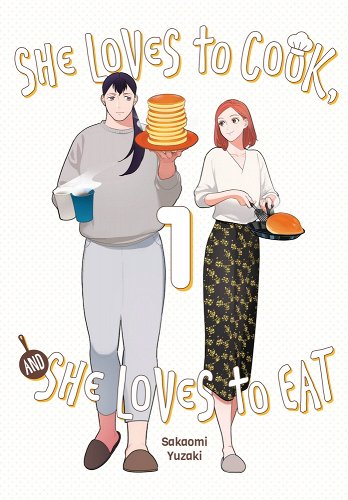
She Loves to Cook, and She Loves to Eat is about two neighbors who find friendship through food. After seeing her neighbor Kasuga going home with a solo smorgasbord, Nomoto realizes she might have found “the one”. Or at least the one who can help her eat all the amazing food she cooks. Although Nomoto is a great cook, the one thing that she never mastered was cooking for one.
Inspired by meals and recipes to feed groups, Nomoto always has copious leftovers that she can never finish. So she musters up the courage to offer some to Kasuga, who just so happens loves to eat. Thus starts a fun and feminist approach to food manga. Throughout volume one the two bond over food and discussions of their treatment in society, having frank discussions about what eating and cooking imply about themselves as people. And while I haven’t gotten my next course of She Loves to Cook, and She Loves to Eat yet, the first nourished my soul so that when I’m ready I know the series will be there.
— Paulina Przsystupa
Superman vs. Meshi
Satoshi Miyagawa (story), Kai Kitago (art)
Kodansha/DC Comics, 2023-2024
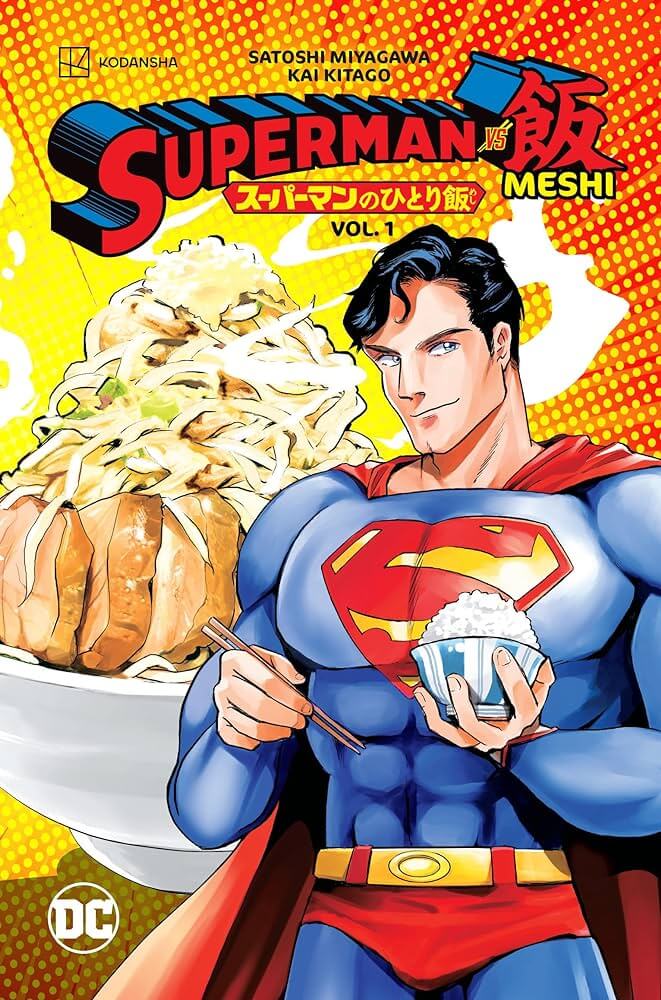
Yes, that Superman. This three-volume manga series pits the Man of Steel against an enemy no one saw coming – his own enormous, Krypton-sized appetite. Superman vs. Meshi boasts a premise that is both strangely specific and magically mundane: Superman loves Japanese chain restaurants, flying thousands of miles to grab some hamburger sushi or an ultra-deluxe pork bowl when he isn’t busy saving the world. That’s it, and it’s perfect.
Satoshi Miyagawa and Kai Kitago’s manga is packed with sharp, surprisingly subtle characterization (poor Supergirl, due to a detour in the Phantom Zone, is a teenager twenty years behind the current trends) and great visual gags (an egg in Superman’s hand turns into the angry visage of Lex Luthor). As with Delicious in Dungeon, Superman vs. Meshi explores how sitting down and eating a meal can bring people closer together, whether you’re the King of Atlantis or a football-playing cyborg. But, most importantly? The food looks delicious.
— Kayleigh Hearn
And there you have it, folks! There’s plenty of manga about cooking, adventures, and cooking adventures out there for you to read after Delicious in Dungeon, so order whatever you’d like. Your meal will be ready in just a moment.
Correction: The recommendation for Sweetness and Lightning was written by Alenka Figa, not Kathryn Hemmann
