
I became interested in artful comic books and strange, beautiful, punk independent music in the early to mid-2000s (for I wanted to make comic books and punk music, and other kinds of art), and so it was by luck, chance or providence that I became aware of the artwork and music of the Quebecois artist Geneviève Castrée.
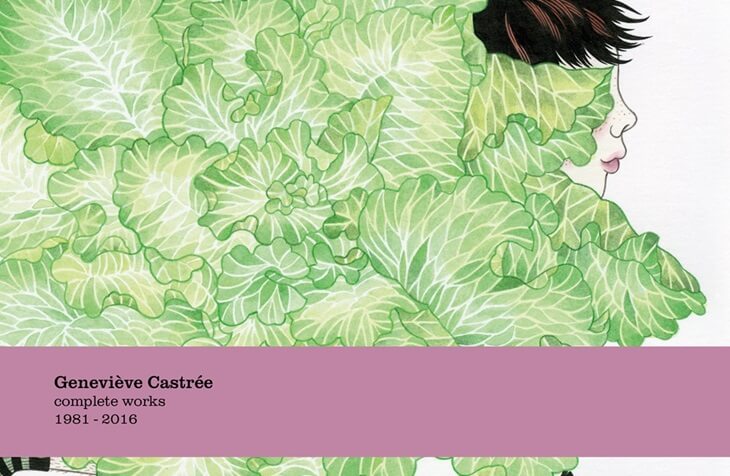
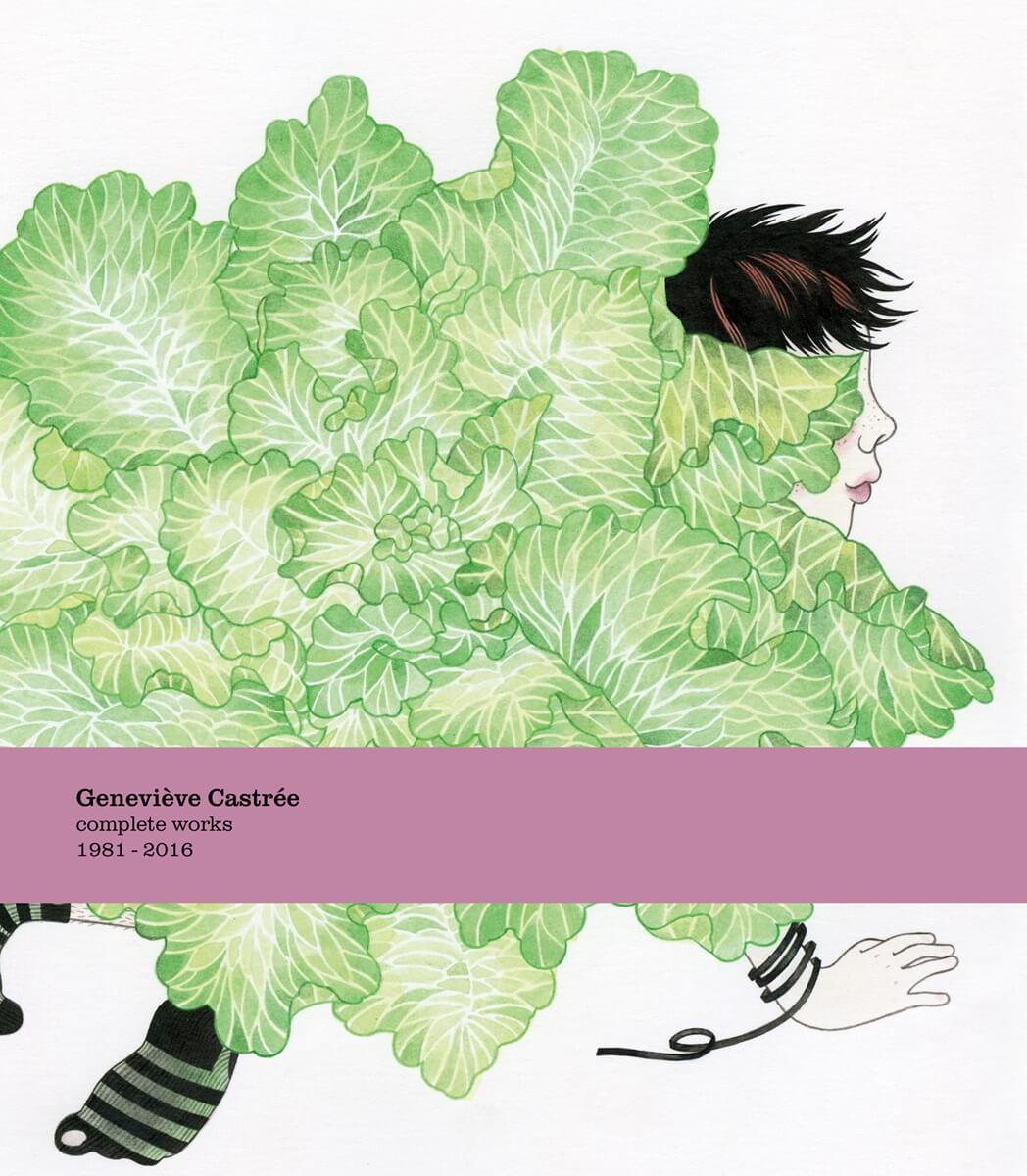
Geneviève Castrée: Complete Works 1981-2016
Geneviève Castrée
Drawn & Quarterly
2022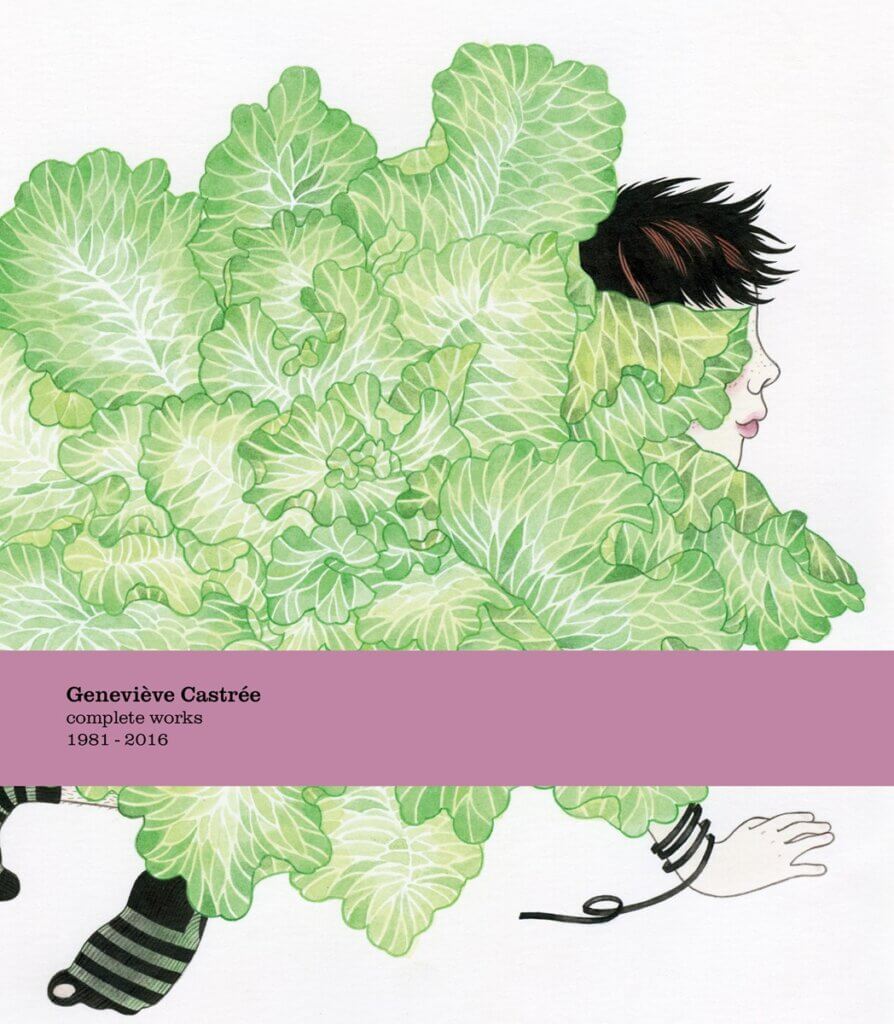
First, I found her story “We’re Wolf!”, credited as Geneviève Elverum, from Drawn & Quarterly Showcase: Book Three, 2005, for which she also painted the cover in sparse watercolors. I first took the book from my bag, having gotten it from the long-gone Brain Comics in Minneapolis, and read it on a break in Terry Beatty’s Anatomy For Cartooning class in art school. It was just after finding out my beloved cousin died of an OD in 2007.
“We’re Wolf!” follows a young woman, reading comic books (Tintin in Tibet), tossing and turning in bed in wild depression, only to find herself in giant empty-feeling pages, filled with snowy mountains and a big royal blue sky. The young woman, clad in a burgundy parka with white trim, looks over the mountainside. Her narration asks, in delicate yet strong cursive, as with almost all of Castrée’s lettering: “do I agree / with the way / I live?” Punk.
Images follow of rest, and work, surrounded by an intricate, reflected pattern of blue vines. Each corner of the vine-wrapped page holds a scalloped circle, each with two gesturing hands, with one word each, forming a sentence across two pages: “What Do You Need To Feel At Home?”
I know in those days I was always looking for a home–I was slowly in the process of figuring out why I felt that way at the time–though I really didn’t know I was searching for such places. I found one at the Pocketknife, a punk house run by (I mean… they lived there) some women friends of mine, including the band Kitten Forever. At one point, we went to an art show centered around the Kramers Ergot comics anthology at St. Catherine in St. Paul, and saw some of Castrée’s original works there. The Pocketknife ladies also at one point put on a show where Geneviève Castrée performed, under the name Woelv. Castrée performed a few different styles of music on record. Live, at least in this instance, she played hypnotizing loop music with an electric guitar. She sang in sharp and warbling notes in Quebecois French (which, I should note, I don’t understand). Her set was intense, fiery, arresting in its quiet, whispered moments and its searing guitar and near-screams.
The rhythms of Castrée’s work–both comics and music–speak to me about control. Her lines are truly finer than Hergé’s. The rhythms of control come on in full, rich display in Susceptible, Castrée’s 2013 graphic memoir for Drawn & Quarterly.
I look at the first pages of Susceptible, as I listen to Tout Seul dans la Foret en Plein Jour, Avez-Vous Peur by Woelv, and I fully realize what it is now: it is a musician’s understanding of the comic book page.
The cover of Susceptible features the angry, confused, hooded face of the young protagonist, Goglu, dark, stormy snowing clouds towering over her.
What follows?
A hand placing (reaching for?) a cup of water on a shelf, snow falling outside the window. A thousand flakes of snow, a thousand notches of wood grain in the shelf. The title page. An uneasy scene.
And from there, a young Goglu, as an infant, and then a child, growing, walks through a sparse bed of vines. As she walks and grows, the vines grow into her legs, poisoning her. She narrates: “I often think about what is innate and what is acquired. / Are our genes ever a valid excuse?” From the very beginning, self-doubt, self-blame, shame. And so begins one of the most heartrendingly authentically-told stories of emotional abuse from parental alcoholism, neglect, and other perfectly horrible things.
I’ve read Susceptible twice, once somewhat recently, and given how triggering it is for my particular family history, I decided to only skim it this time. However, despite its abject horrors, the book is also sublime. Such is life.
Then, in 2016, came the news: the world lost Geneviève Castrée, and her own child lost her mother, to pancreatic cancer.
I broke down in tears several times throughout the course of reading the mammoth tome Geneviève Castrée: Complete Works 1981–2016. The timeline presented for the title of the book is her entire brief life.
The title, like any label promising an artist’s ‘Complete Works’ is, as Castrée’s widower, the musician Phil Elverum, intimates in his introduction, a kind lie, a way to put said artist’s works to rest.
Even with an absolutely gigantic book that I struggle to even hold with two arms (not that I’m strong); even containing a full graphic memoir; even with media as diverse as paintings, screenprints, ceramic sculptures, collage, notebooks, album artwork for her own albums, book covers for her own poetry books–and as a crescendo in the emotions of this reader–a children’s book left unfinished, and completed by cartoonist Anders Nilsen…
With all that, this Complete Works of the Quebecois artist and musician Geneviève Castrée is finally, and heartbreakingly must be, incomplete. A book of artwork and comics, all inked and painted in watercolors, cannot be a boxed set of music Castrée recorded as Ô Paon, Woelv, and under other names; nor can it be two books of poetry, one released in life, one posthumous; nor can it, reasonably, feature every scrap of paper one has scribbled on beautifully.
The heavy task of editing, the beautiful job of sharing with a wider audience (‘wider’ is a strange word here, as the book does cost $99.95 USD/CAD. One hopes that libraries will pick it up) fell to the hands of Elverum, who edited and translated this book (with supplementary translation and translation revision by Aleshia Jensen), and provided an introduction (mentioned above), followed by another piece of writing by a friend of and inspiration to Geneviève Castrée, the cartoonist and artist Julie Doucet. I have thanked Phil for his music once as a teenager when he performed as The Microphones, once as a twenty-something when he performed as Mt. Eerie, and now I am an adult and I thank him for a third time: Thank you, Phil, for this service, of sharing the breadth of Geneviève Castrée’s work with all of us. For making a big book of all of her little stories. For I found partway through reading the book that this is something that she felt that she herself would never do.
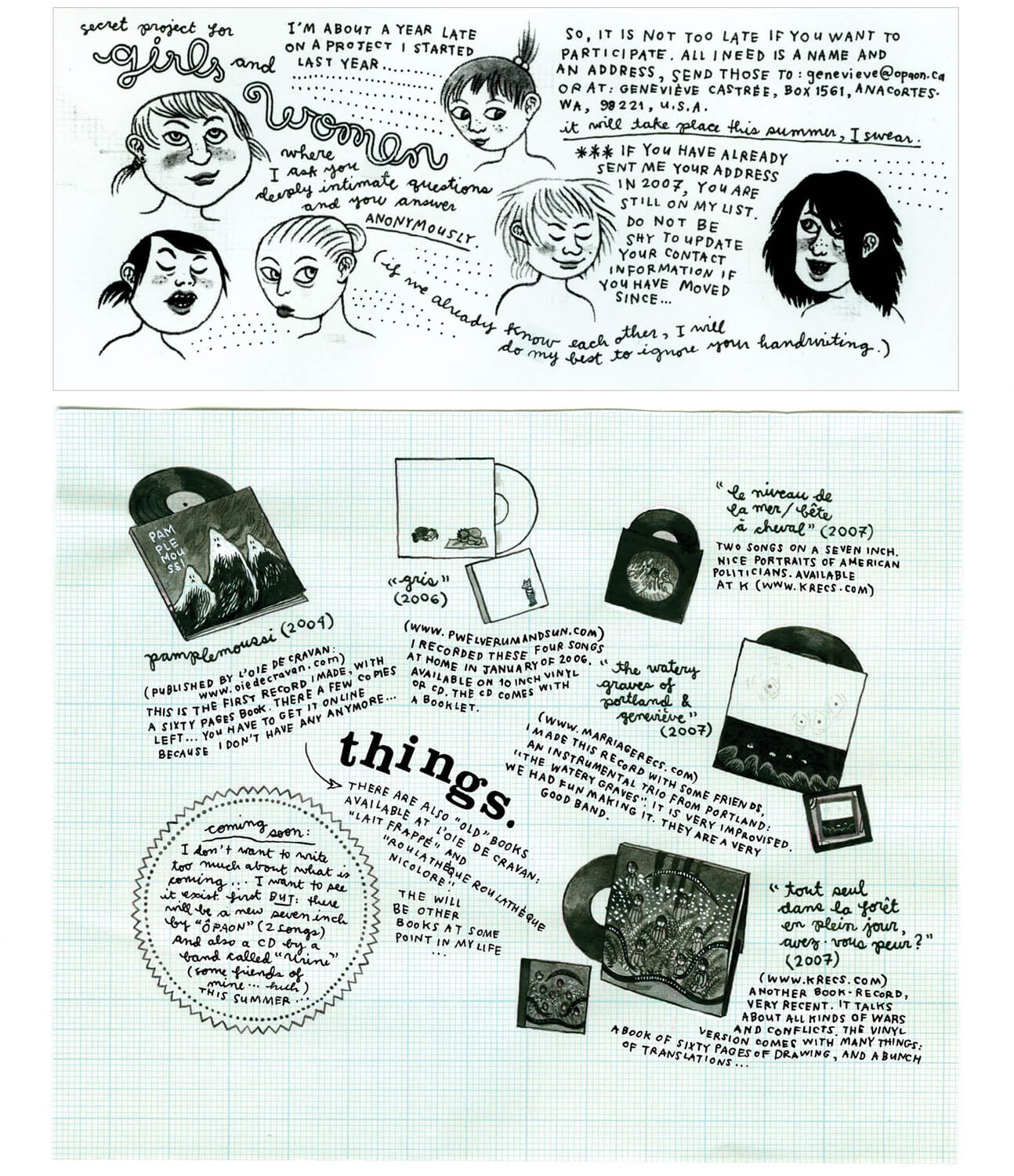
Elverum includes a hand-lettered newsletter from Geneviève, which included her email address. I keep all of my emails archived in case I ever need them. I wondered if I had ever emailed her, so I searched for her email address in my Gmail. This is what I found:
–––
Sep. 3, 2014, 5:42 PM
hi geneviève,
my name’s annie mok, i’m a cartoonist- we met a million years ago at a show of yours in minneapolis, at a house called the pocketknife.
i’m writing to ask a favor– i just finished a book of short comics, body talk, that i’m going to be pitching around: [the link was here, obviously]
i’m writing to ask, if you’d
1. like to read it
2. want to
could i ask you for a quote for it? like an author quote for the back cover.
i’m asking you because susceptible and your shorter work “we are wolf” means a lot to me.
no worries of course if you wouldn’t want to do any of that!
all best,
annie
–––
Sep. 8, 2014, 3:44 PM
Hello Annie,
I am not sure if you sent this to numerous cartoonists or just to me but just in case you specifically wanted me to read the book and say something about it, I am writing back. Finding a blurb for the back of a book can be a pretty depressing, embarrassing activity at times, that is how I felt when I was writing to people about “Susceptible”.
Reading through your book I felt that there were some wonderful things in there. My feelings about collections of various works/older works are that they are generally not my favorite kind of book. I myself have turned down a couple invitations to publish my older comics in collected book form because I like the idea of things being more consistent. I am probably an idiot, this is not how one makes a living as a cartoonist. Readers tend like being able to find various stories in one volume, but I am just really picky and I prefer making books that have more continuity.
That being said I appreciate you sending your book to me and I wish you the best of luck. I am definitely interested in stories about body talk.
Take care,
geneviève.
–––
Looking at the book in front of me… Knowing I couldn’t have read it unless Geneviève wasn’t here… Feels like a cruel joke.
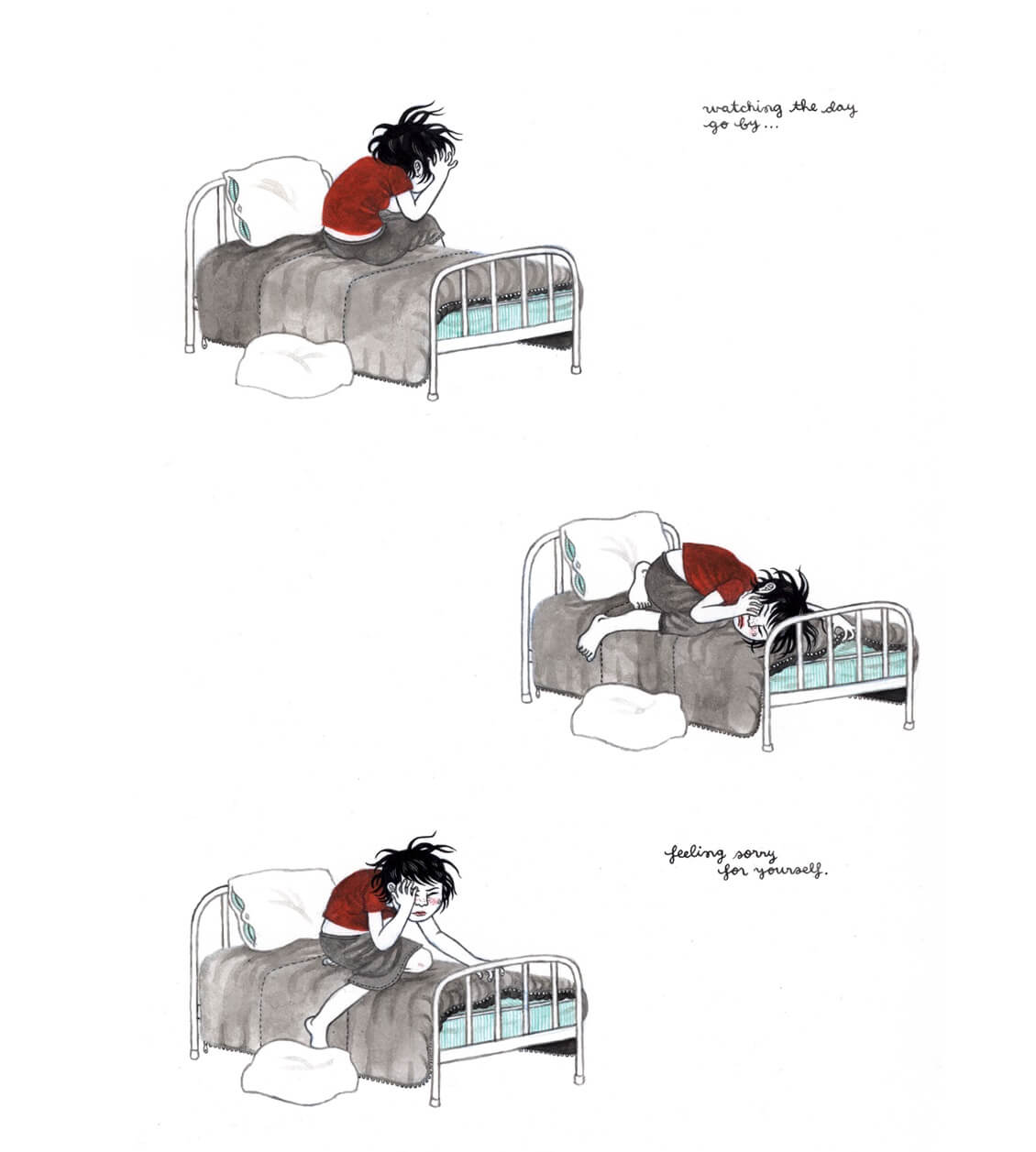
When I think of Castrée’s artwork, I think of cloth. In 2012, she drew herself wrapped up in quilts and comforters for “Blankets Are Always Sleeping” for Drawn & Quarterly: Twenty-Five Years of Contemporary Cartooning, Comics, And Graphic Novels. Although Castrée dedicated a lot of time to drawing and painting foliage, water, clouds, fire, grass, snow… To me, there is nothing she drew and painted more lovingly than clothing, blankets, pillows, their folds, their trimmings, and patterns.
Castrée discusses rest often in this collection. She often seemed to be making artwork, but she never treated it like a job—always drawing with pleasure. She never went on social media as far as I know, barely used the computer.
There’s this assumed attitude within comic book artists that everyone wants to draw faster. From Alex Toth to all my comic book teachers at art school, all the comic book advice I ever got was to focus on what’s essential to the exception of all else. But in the unpublished comics, “Drawing” and “Music” from 2010, Castrée gives a wonderfully different take. “I really love to draw,” she says, painting with watercolors, “I have drawn my whole life. I do it because I can’t help myself. I just have to… / But I like to take my time. Make it good. So I end up with more projects than what is reasonable.” A bunch of stones on her desk and surrounding her call out for attention: “I AM DUE!” “Me!” “Where are you?”
On the opposite page, “Music,” Castrée stands with fewer rocks calling for her appeals. She is plugged in with her burgundy electric guitar, a devilish smile, plaid rolled-up shirt, unkempt black hair. She says: “Music is exciting. Very cathartic… / I am not pushing it very hard these days. I am still casual about it… I think? / Just like drawing, it comes out on its own. It’s just there. It needs to happen. / And whenever I work on a long drawing project, I miss being loud… / And my fingers have become clumsy…”
The final words of this scene? Castrée’s guitar: “PLAY ME!”
PUNK!
