

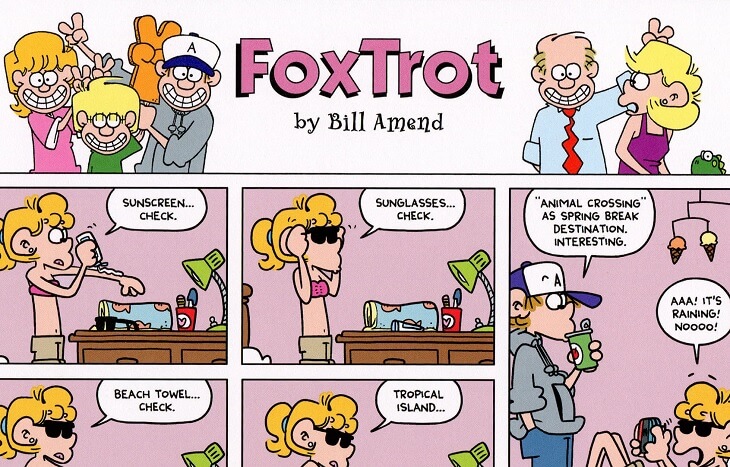
Bill Amend’s FoxTrot was one of the great successes of late-twentieth-century newspaper comics. At the end of its run as a daily feature in 2006, the strip was running in over 1000 papers, had published over 30 book collections, and Amend was a runner-up for the National Cartoonist’s Society’s title of Cartoonist of the Year1. (By comparison, Aaron McGruder’s The Boondocks was syndicated in 350 papers at the time he began winding it down2.) Among my childhood friends (’90s kids of varying degrees of nerdiness), it was widely read and appreciated.
So why doesn’t anyone talk about it anymore?
I’ve had the privilege of knowing a lot of cartoonists who were growing up at roughly the same time I was, yet I’ve never heard anyone cite FoxTrot as an influence. For that matter, I don’t recall it being so much as mentioned in my two years of cartoon school. Clearly, I don’t think about it too often myself, either, since it took me this long to notice its absence from the discourse.
But I did like the strip, back in the day, and it was to some extent an influence on the comics I drew at the time. I’m sure I’m not alone in that. So, again: why isn’t anyone talking about it anymore?
To answer this question, I did what any reasonable person would do: I bought the entire run of FoxTrot anthologies and read them all. (To be clear, FoxTrot is still running new Sunday strips today, but for the purposes of this venture I am only going to cover the strip’s initial run as a daily feature, from 1988 through 2006.)
My recollection of the strip, prior to rereading, was as follows: The art was pretty good but nothing remarkable. The writing was above-average and largely consisted of serialized storylines, occasionally touching on complex topics and handling them with surprising nuance. The humor was roughly on par with most other strips of the era, which is to say that it tried to be funny every time but rarely exceeded “slightly amusing.”
But what I found, as I plowed through 18 years’ worth of FoxTrot, was somewhat different.

First of all, purely in terms of drafting ability, Amend is an exceptionally good cartoonist. No one would describe FoxTrot’s style as realistic, but Amend’s drawings exemplify a kind of iconographic abstraction that is extremely difficult to pull off. His minimalistic, almost diagrammatic linework is worlds away from the expressive quality of Bill Watterson (Calvin and Hobbes) or Richard Thompson (Cul de Sac), but neither should it be confused for the merely passing-grade competency of Scott Adams (Dilbert) or Stephan Pastis (Pearls Before Swine). Amend’s drawings are precise and specific, every object easily recognizable as exactly what it is meant to be and nothing else. Chris Ware (whose drawing style is not entirely dissimilar to Amend’s) has said that “cartooning is not really drawing at all, but a complicated pictographic language intended to be read, not really seen” (Ware, Chris. The Acme Novelty Library. Pantheon, 2005) and FoxTrot definitely is an exemplar of this philosophy. The strip’s images can be understood instantaneously, read as effortlessly as the words.

Amend is also adept at creating drawings that are inherently funny, a surprisingly rare thing in the funny pages of recent years. FoxTrot’s characters spend a lot of time freaking out, and their wildly exaggerated features are delightful to look at even if the joke as written is relatively bland. Ridiculous slapstick is a component of this as well: exploding barbecues, model rocketry mayhem, and chaotic tumbles are all frequent occurrences. Even the absence of action can make for some funny drawings: Quincy the iguana, who is ostensibly mischievous but is invariably depicted sitting placidly on his haunches with a dead-eyed stare, is one of the strip’s best recurring gags. Many of these strips would be just as funny without words, which is more than can be said about most of FoxTrot’s contemporaries.
But this brings us to the quality of the jokes themselves. The ’90s through ’00s were not a banner era for newspaper comics; despite dozens of comics making an earnest effort to be funny every day, a person could read them religiously and still go months without a genuine laugh from any of them. (To be fair, this is still the case, and possibly always has been. There are always a few strips that transcend the pack but by and large most of them are only hypothetically funny.) A typical FoxTrot strip is mildly amusing, and a few times a year it managed to produce something hilarious. That’s not much of a legacy, but still explains some of its appeal, because most of its contemporaries were even less successful. (Compare it to something like Chip Sansome’s The Born Loser, for which “mildly amusing” would represent a new high-water mark.) Is FoxTrot funny? Sure… just not very.
A lot of FoxTrot’s humor is formulaic or repetitive. Many, many strips are variations on the same jokes, such as “Peter complains about too much homework. Paige complains about too much homework. Jason complains about not enough homework. Peter and Paige are annoyed.” This joke appeared in some form many times throughout the strip’s run, as did numerous others. A reader never has to go long between examples of “The coach is sad because he needs to put Peter in the baseball game,” or “Someone is suffering through a trip to the mall with Paige.” Most of these are distinct enough from each other that they can be understood as variations on a theme, but there are plenty of examples where the strip ran two near-identical jokes seemingly by accident:
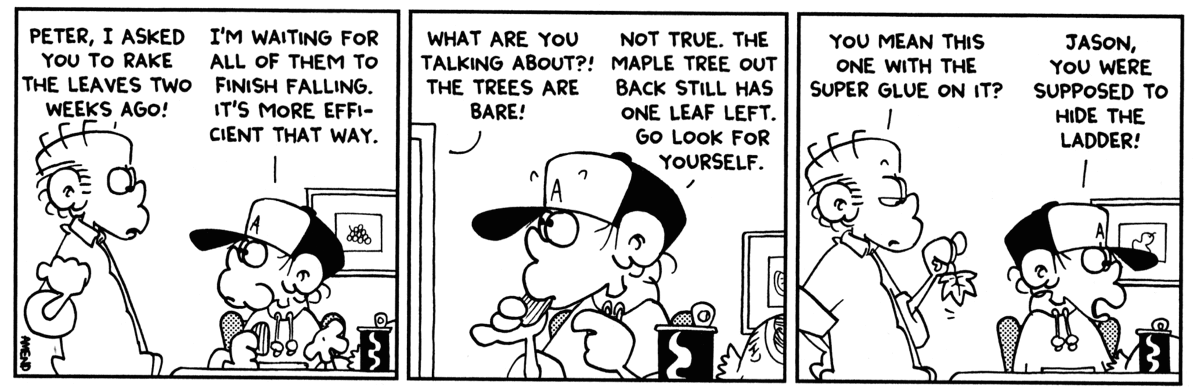

While the strip has had its share of memorable storylines, and we will discuss them later on, the bulk of any given FoxTrot anthology is interchangeable fare that readers will forget as soon as they turn the page.
But it’s time we move out of the abstract and talk about what FoxTrot is actually about. The strip is centered on a nuclear family, and is largely about interpersonal strife within that family; a setup which has been mined by the funny pages since their inception. The characters too are familiar archetypes: There’s Roger Fox, a slightly dopey dad with a vaguely defined office job and a fondness for chess. Andy Fox is a well-meaning mom who cooks unpleasant “healthy” food and writes a newspaper column. Peter Fox is a teenager who likes sports and rock and roll. Paige Fox, also a teenager, likes fashion. And Jason Fox, the kid brother, likes “nerdy” stuff and spends most of his time tormenting Paige. (Jason is arguably the strip’s most significant character, and we’ll get back to him. There is a lot to say about Jason.)
One thing that distinguishes FoxTrot from many of its contemporaries is that all of its characters get to have their own storylines. By the numbers, Jason definitely received the most storylines, and I’m guessing Andy the least, but all of the characters had starring roles on a regular basis. This prevents the strip from being locked into any one character’s perspective. Compare this to something like Lincoln Peirce’s Big Nate, which is always presented from the perspective of its title character, and thus all other characters are defined in relation to him. His relationships with his father (Marty) and his older sister (Ellen) are not dissimilar to Jason’s relationships to Roger and Paige, but where Roger and Paige are developed characters in their own right, Marty and Ellen will always, first and foremost, be described as “Nate’s dad” and “Nate’s sister.” (The respective Fandom wikis for these comics even back me up on this: the first sentence of Ellen’s page describes her as Nate’s sister, but Paige’s entry mentions Jason only in passing, in the second paragraph of her introduction.) FoxTrot was always an ensemble cast, and as such its primary characters were rounded out and humanized to a degree that is uncommon in the funny papers.

While the reader develops a fondness for all of the FoxTrot characters, they feel no such warmth toward each other. From the very first installment (seen above), FoxTrot was framed as a strip about a family in a state of constant turmoil, and this theme remained consistent throughout its run. The characters are locked in a constant cycle of aggression and simmering resentment to a degree that’s often unpleasant to read. The animosity is so consistent that on the rare occasions when Amend writes scenes in which the characters acknowledge they care about each other, the effect is disorienting and odd. Many of the strips largely revolve around the characters intentionally tormenting each other, and this is by far my least favorite aspect of the comic. This setup is common in the funny papers (see, for instance, Garfield’s constant humiliation and abuse of Jon and Odie, or Calvin’s ongoing crusade against Susie), and distasteful regardless of where it appears, but it’s particularly frustrating in a strip like FoxTrot, where today’s likable character can easily become the victim of tomorrow’s petty cruelty. To enjoy this kind of mean-spirited humor the reader must to some extent agree that the characters deserve mistreatment, and once you’ve had the chance to relate to both characters, that kind of reading is no longer feasible.
And thus we come to the Jason-and-Paige dynamic. One of the strip’s most frequently occurring bits involves Jason tormenting Paige using whatever means he can think of. These jokes appear so often that they are practically the default, FoxTrot’s equivalent to Beetle Bailey butting heads with Sarge. Jason’s campaign of terror occurs at all levels of complexity: one day he might simply call Paige “ugly” to her face, the next day he might build an elaborate website devoted to humiliating her. Paige is also the subject of much of Jason’s creative output: she is the primary villain of his occasional comic book project, and the victim of grisly deaths in various video games and flipbooks.

To be clear, Paige deserves none of this. She is invariably depicted minding her own business when Jason chooses to strike, and on the rare occasions when she attempts revenge, her fury is proportional at most. And, as discussed, we like Paige. She gets her own storylines, she has her own interests and motivations. There are occasional strips where she admits that she avoids being home whenever possible in order to avoid Jason, which, while played for laughs, is chillingly realistic, revealing the degree to which his cruelty has affected her life. As such, these antics aren’t very funny to begin with, and after being repeated ad nauseam, Paige’s misery becomes the most relatable aspect of a given strip.
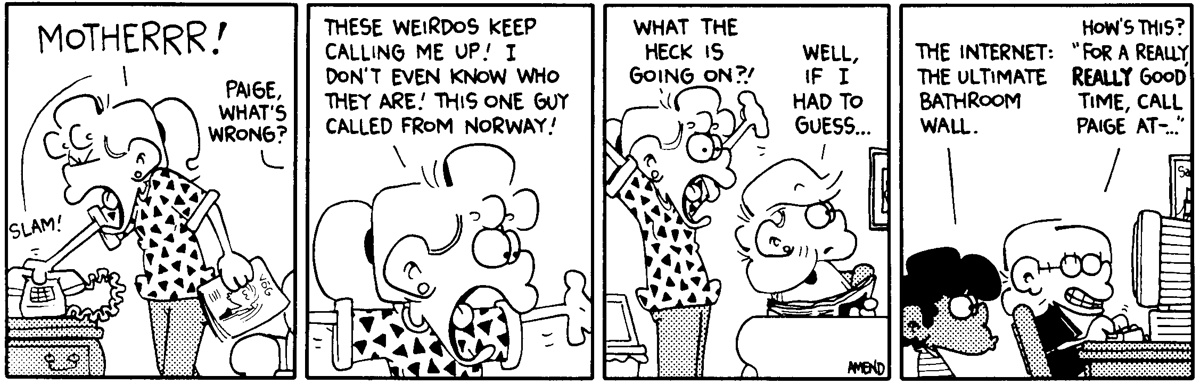
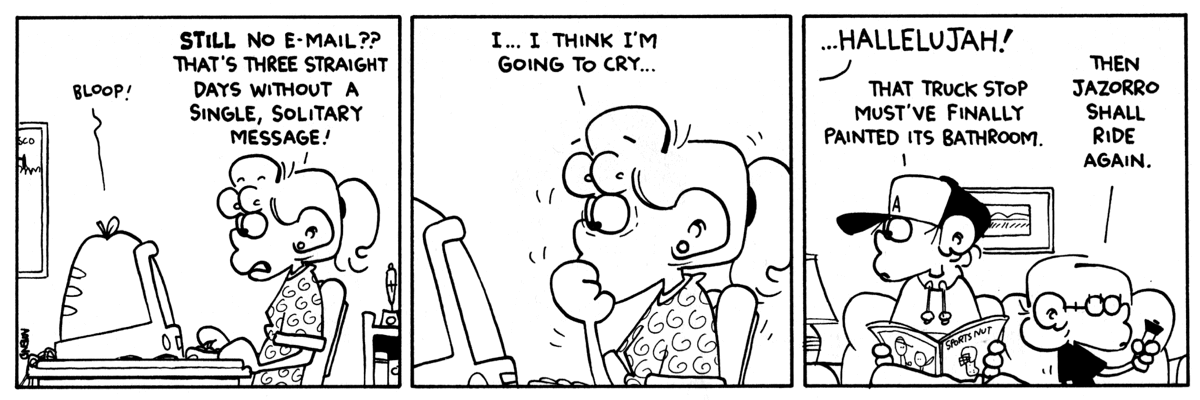
In addition, some of Jason’s antics are truly beyond the pale. There are three instances in which Jason opens her up to harassment by writing her contact information in “truck stop bathrooms,” a premise so horrifying that it’s surprising that Amend’s editor allowed it to run. This is an outlier, but some of his more frequent pranks are also troubling when given a moment of thought: in particular, those involving Quincy the iguana. Most frequently, this consists of Jason throwing or dropping Quincy onto Paige’s head. This may seem relatively innocuous, but it happens a lot, and exemplifies not just Jason’s indifference to his sister’s feelings, but his indifference to the safety of his pet. These strips often show Jason dropping Quincy from a considerable height or throwing him violently through the air, and on multiple occasions, Jason spreads glue on Quincy’s belly to adhere him to Paige’s face. It’s easy to write this off as silly comic strip slapstick (which it is, of course) but it highlights that many of Jason’s “harmless pranks” are not harmless. For all that he supposedly cares about Quincy (and Paige too, on some level), he sees their bodily safety as less important than his desire to cause mayhem.

But moving beyond Jason’s mistreatment of Paige, he’s also a petty misogynist in general. The setup of “young boys think girls are icky” is common in comic strips of course (which is not to say that it’s acceptable, but that’s a topic for another time), but Jason makes it such a significant part of his personality that even his peers within the strip find it off-putting. This becomes particularly noticeable in storylines involving Eileen Jacobson, who shares Jason’s interests and for some inexplicable reason wants to be his friend. Jason goes to extreme lengths to avoid being seen or associated with her, but he’s willing to indulge her desire for friendship whenever he gets something out of it: free ice cream, for instance, or an opportunity to try out the new GameStation 2. Jason’s friend Marcus, whose personality is usually identical to Jason’s, will play along with Jason’s theatrical girl-hating to a point, but he seems far less invested in it and often suggests that maybe hanging out with Eileen and her friend Phoebe would be more fun than arbitrarily spurning them. There are occasional storylines in which Jason gains a grudging respect for a girl (and even a dream sequence where he becomes a girl himself, which was deeply unsettling for me as a young trans kid), but the effect never lasts, and he’ll be right back to broadcasting exaggerated disgust the next time he’s forced by circumstance to exist within the vicinity of one. (It’s worth noting that his ire extends to grown women as well; he despises his teacher Miss O’Malley, who, by being smart and liking Quincy, fails to conform to his preconception of her gender.)
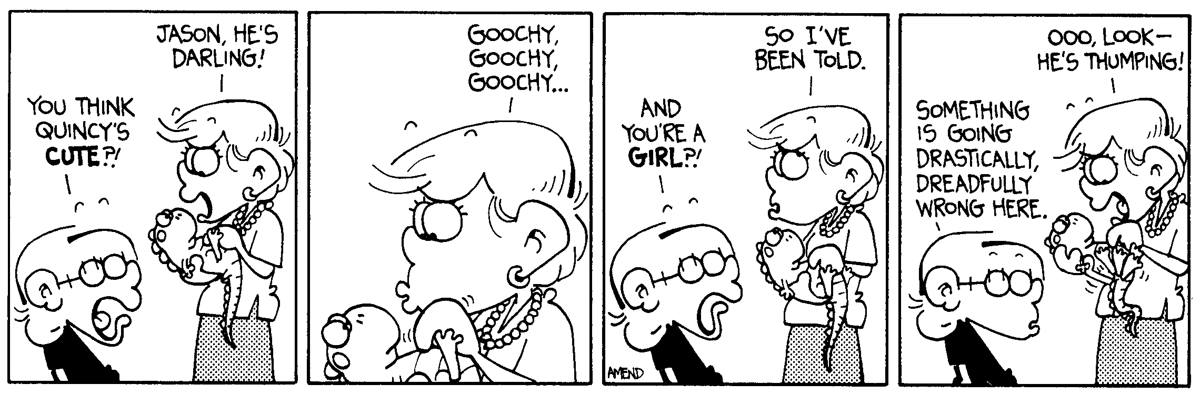
I will clarify, however, that FoxTrot itself is not essentially misogynistic: these jokes invariably depict Jason as being in the wrong, and the female characters he gets worked up over are well-developed in their own right. (Compare this to something like the previously mentioned The Born Loser, which includes a stock “mother-in-law” character who exists only for the sake of jokes about how much the sad-sack title character hates her.) But regardless of how the strip frames this behavior, he’s still doing it, and he’s probably the strip’s most significant character.
In short: Jason’s behavior is often abhorrent. Perhaps it seems more palatable when seen four panels a day, but when reading page after page of it in anthology form, it quickly becomes distasteful. It is entirely possible that the prominence of this insufferable, sadistic little brat is a major component of the strip’s slide into irrelevance.
But Jason aside, FoxTrot’s character work is fairly strong for what it is, and the strip’s run contains numerous memorable storylines that take advantage of their well-defined personalities: Andy’s self-doubt reaches crisis level during a visit from her extremely accomplished mother. Roger, who normally can’t catch a break, becomes drunk with power when he’s assigned to manage a sycophant. Paige, who is materialistic but means well, has a panic attack when goaded into shoplifting. These kinds of character-based stories are nuanced and relatable, and are definitely a high point of the strip.

Another prominent aspect of the strip is its timeliness. FoxTrot was always tightly connected to the moment in which it existed, mining prominent fads and trends for joke material. Pop culture is a particular focus: big movie releases are frequently mentioned, if not made the subjects of entire storylines, such as in a lengthy arc in which Andy developed an unhealthy fixation on Titanic. FoxTrot also coincided with the era in which “nerd culture” was becoming the media empire that it is today, and Jason is always at the forefront of it, cosplaying for whatever superhero, Star War, or fantasy franchise was premiering a new installment. (Some of these are barely even jokes, and are functionally closer to being advertisements.)
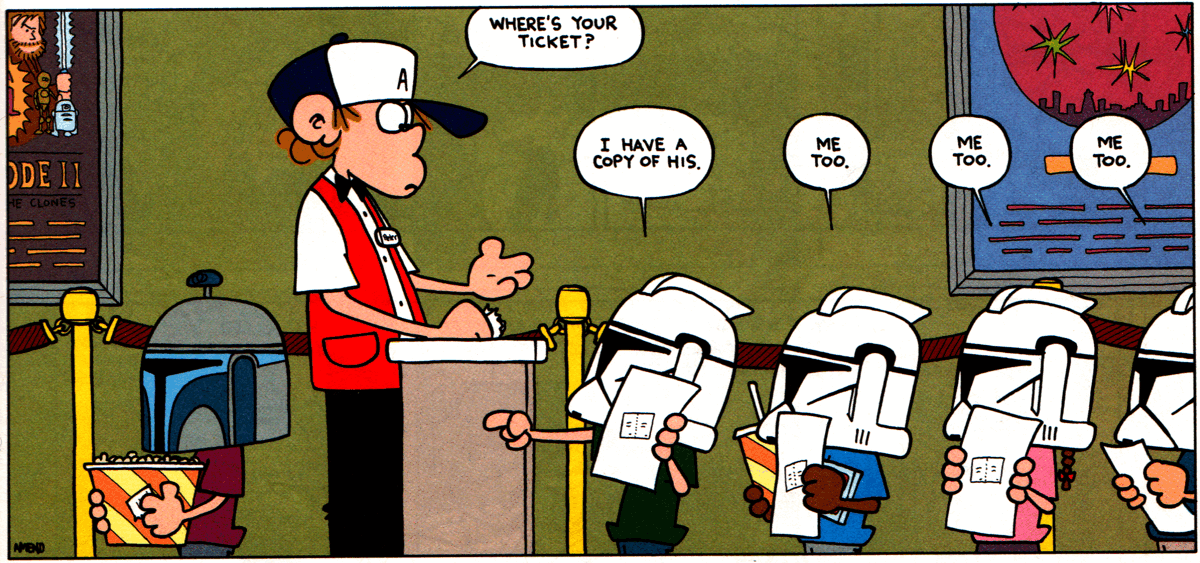
Prominent news events are acknowledged as well: entire storylines were written for the September 11th attacks and Hurricane Katrina. When appearing in newspapers, such references feel vivid and of the moment, but once frozen for perpetuity in a book collection, they quickly begin to turn the strip into nothing but an odd cultural artifact. As an exaggerated record of how people felt about various things (be it the release of Jurassic Park or the shifting relevance of Apple Computer), these kinds of strips can be interesting, but they are no longer fun in the way that they were meant to be. In a word, they’ve become dated.
The strip’s very explicit relationship to current events also tends to draw attention to the characters’ inability to age. This is the norm for comic strip characters, of course, but it becomes sort of surreal in this case, as time clearly passes in the FoxTrot universe, but only to loop back on itself in some fairly explicit ways. Every autumn brings Paige’s first year of high school. Peter and his girlfriend Denise celebrate the one-year anniversary of their relationship multiple times. In one strip about New Year’s Day of 1990, Peter mentions that he remembers New Year’s 1980. Yet when the strip ended, Peter would have been born in 1990. (That’s not even getting into the Sundays that continue to this day. Peter’s birthday has now crept all the way to 2007!) It’s interesting to compare this to strips like Calvin and Hobbes or Peanuts, which likewise didn’t age their characters, but by largely avoiding references to specific life events, don’t call attention to the surreality of the situation in the same way.
At this point, I think it’s fairly evident why FoxTrot is not much discussed in the comics world today, despite its former popularity and relevance. While it shines in certain ways, it is burdened by its contemporaneity, its repetitiveness, and its emphasis on some ugly character traits. But at the same time, I think FoxTrot has influenced certain cultural trends.

For one, FoxTrot was doing “nerd humor,” and more generally, niche-interest humor, at a time when it was far less common. Nowhere else on the comics page were you likely to find jokes about physics, arcane details of Star Wars, or computer programming. In the years since, such humor has become more commonplace, seen in popular shows like The Big Bang Theory and increasingly self-aware superhero films. I can’t say that any of this happened because of FoxTrot; more likely FoxTrot was simply an early manifestation of a trajectory that popular culture was already following.
But FoxTrot did leave a legacy in comics. Specifically, webcomics. While the strip may not have been on the minds of the creators of Big Bang Theory, it was certainly familiar to the creators of major geek-culture webcomics like Penny Arcade, Ctrl+Alt+Del, Real Life Comics, and PvP. While these creators haven’t necessarily cited FoxTrot as an influence per se, many of them have been in public dialogue with Amend for years. Amend has done at least one guest strip for Penny Arcade, another for xkcd, one for PvP, and parodied all three (along with Apple geekery comic The Joy of Tech) in one Sunday from 2008. (He’s also name-checked Hark! A Vagrant and Homestuck.) PvP creator Scott Kurtz has been particularly prominent in the FoxTrot/webcomics dialogue, addressing Amend directly on a few occasions. On the occasion of FoxTrot’s transition from daily to weekly, Kurtz published an open letter imploring Amend to use his clout to help kickstart a new online platform for comics publishing. In 2014, Kurtz published a strip in which one of his characters dared Jason Fox to take on the then-viral Ice Bucket Challenge, and Amend obliged. (Kurtz also dared Garfield and The Family Circus’s Jeffy. Garfield apparently could not be reached for comment, but incredibly, Jeffy actually followed through.)
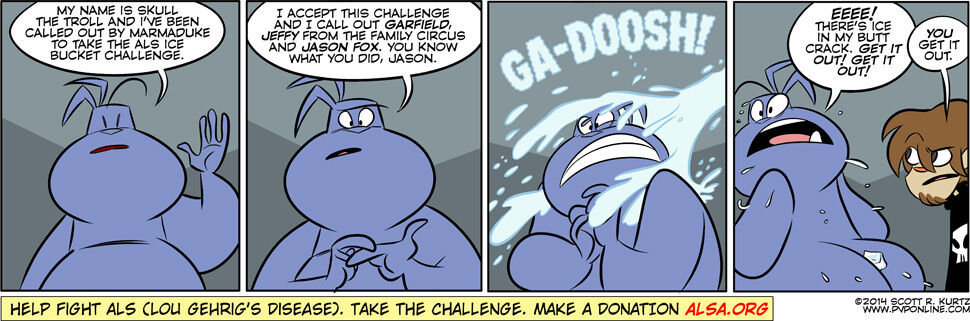
But the conversation goes beyond references and guest appearances. The way that nerd-culture gag webcomics are constructed is pure Amend: Four panels. A residential setting, with occasional flights of fancy. Make a joke about the latest movie or video game. Profit! Not to imply that these creators necessarily are as good at this as Amend (and they aren’t, by and large), but they are absolutely working in the same vein. These comics even resemble FoxTrot visually, with their simple linework and the “rubber-stamp” quality of the character depictions. (Of course, in Amend’s case this was down to his uncanny ability to render the characters perfectly every time, while in many webcomics it was the result of actual copy-paste.)
Since FoxTrot coincided with a larger trend away from newspaper funnies as a significant cultural institution, it can seem like it had no influence on the form. And due to some of its own shortcomings and limitations, it’s not surprising that it’s rarely discussed today. But where the four-panel gag comic still exists (i.e., the internet), the long shadow of Bill Amend and his weird little dysfunctional family can still be seen.

