

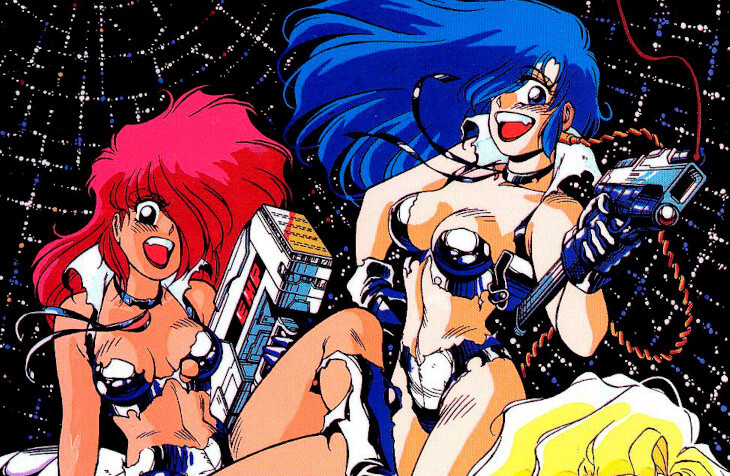
The American Dirty Pair comics by Toren Smith and Adam Warren are some of the best comics of the 90s and early aughts. During a time when American comics frequently were visually incoherent and overly self serious, The Dirty Pair was a breath of fresh air. The series was well illustrated beyond the lowered standards of 90s comics, and it was legitimately funny without letting that get in the way of telling compelling sci-fi stories. Unfortunately the fact that it’s a licensed American adaptation of a Japanese anime makes many of the people who should be fans disinterested. The series has been overlooked, and almost forgotten, outside of Dirty Pair fandom due to its out-of-print status, unjustly turning one of the best comics of its era into a historical footnote.
The premise of Dirty Pair is simple: it’s about Kei and Yuri, two scantily clad “trouble consultant” agents for the 3WA, a massive corporation that serves the United Galactica federation. They’re code named the Lovely Angels, but are known by most as The Dirty Pair because they usually cause massive amounts of collateral damage during their missions. Dirty Pair might sound like an ultra-violent black comedy, but the majority of civilian casualties in most Dirty Pair stories are unseen and not dwelled upon at length (most of the time). It’s an action comedy in a sci-fi setting, and while cheesecake is definitely part of Dirty Pair, the reason it’s been so enduring is the spirited relationship between the titular pair.
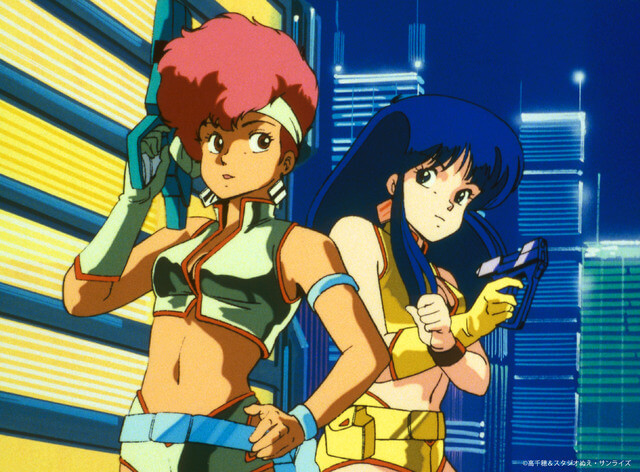
Something that’s constant across almost every iteration of Dirty Pair is that continuity isn’t much of a factor. The American comics aren’t in explicit continuity with the various anime, but the premise and characterization of the two main characters is pretty much always the same. You really can jump in almost anywhere and treat everything as if it’s in the same canon. The exception to this is the Dirty Pair Flash Original Video Animation (OVA), which is more of a complete reimagining than an attempt to do something new with the original characters.
Dirty Pair was originally created as a series of light novels written by Haruka Takachiho and illustrated by Yoshikazu Yasuhiko. It subsequently was made into a variety of anime. The Dirty Pair anime became about as popular as an anime could be in America in the 80s and early 90s. Back when official localizations were uncommon, the majority of anime consisted of fansubs on VHS being copied and traded. It’s difficult to quantify in hindsight how popular Dirty Pair was in the US, because almost all of the distribution happening was unofficial. To paint a picture of its grassroots success, the first anime fanfiction posted on Usenet was a Dirty Pair fanfiction. The belated first officially localized Dirty Pair anime to ever be released in America, Project Eden, was the best selling anime of 1994. In its 80s bootleg days Dirty Pair even managed to find its way into the hands of a comic artist attending the Kubert School named Adam Warren.

Since Dirty Pair, surprisingly, had never been turned into a manga in Japan, it made sense to turn it into a comic. Toren Smith traveled to Japan, showed Takachiho some spec art Adam Warren had created, and received the rights to make an adaptation. Adam Warren’s The Dirty Pair, which began publication in 1988, was the first officially licensed Dirty Pair thing to be released in the US. (The comic is called The Dirty Pair, while all the anime and light novels are called Dirty Pair.)
Incidentally, many of the early manga published alongside The Dirty Pair were translated by Toren Smith, and published by Dark Horse, who would start publishing every volume of the comic after the rights were transferred from Eclipse after a legal battle relating to unpaid royalties. Before manga became established in America, a lot of what was localized was sci-fi, which seemed to be most similar to the average superhero comic. Books being released contemporaneously to The Dirty Pair included Mai the Psychic Girl, one of the first localized manga; Shirow Masamune works like Appleseed and Ghost in the Shell; the largely forgotten Outlanders, now most well known for a bad OVA; and Masakazu Katsura’s take on superheroes Shadow Lady. Adam Warren also made a single volume Bubblegum Crisis comic.
By the time The Dirty Pair ended publication in 2002, shonen like Dragon Ball Z had exploded in popularity, and it turned out that the American taste for anime extended much further than what was most adjacent to American action comics, something that Toren Smith himself had anticipated when translating the slice-of-life fantasy manga Oh My Goddess!
I got into the Dirty Pair comics through the anime two or three years ago. I imagine a lot of comic fans got into the anime through the comic as it was being released in the 90s, but considering the comic is now out of print the opposite is probably true. I bought the cheapest volumes I could find used online and became an immediate fan.
The Dirty Pair comics are similar enough to the Japanese anime that they can both exist together in loose continuity, but there’s also a big difference in sensibility between the two. To put it succinctly, the Japanese anime is the product of a team of people working together, and the Dirty Pair comics were largely made by a single person. In the beginning, it was written by Toren Smith and Adam Warren, with illustrations by Warren, but after a few volumes Warren would become the sole writer and artist of the series. The anime has a Japanese sensibility, and the comics have a more American sensibility, even if they’re obviously trying to evoke the anime. The end result of these differences is that the comic is often weirder and more singular than the anime, and the targets of satire feel like they’re coming from a more American perspective.
The first volume of The Dirty Pair, Biohazards, was something of an inauspicious beginning, or at least it feels that way if read after the later volumes. Biohazards was the first professional comic work Adam Warren did after leaving the Kubert School. When that’s taken into consideration, it’s a remarkable achievement.
The plot involves an industrialist being kidnapped by a corporate rival and having his mind implanted into a raccoon body. The Dirty Pair are hired to rescue him, and after a short mission he convinces them to help him recover his stolen tissue samples and brain chip so that he can clone himself a new human body. In preparation for the mission the industrialist moves his mind from his raccoon body into a cyborg dog body.
Every volume of Warren’s comic had a scope and scale similar to a movie: perhaps because of the manga inspiration, it feels like he was “writing for the trade” about a decade before that became the default for American comics. Biohazards has a story that feels more OVA sized, as if budget were somehow a limitation in the comics medium. The locations feel less imaginative than they would later become, and the rivalry between two industrialists feels surprisingly small in scope.
Legitimately speculative sci-fi elements would later become a big part of Warren’s comic, but aside from the transhumanist element of Kei having an interest in a man who temporarily implanted his brain into a cyborg dog body there isn’t much of the weird future stuff to be found here. In this first volume there isn’t much that differentiates The Dirty Pair from a lot of the other sci-fi comics being published at the time, aside from the manga-influenced art style.
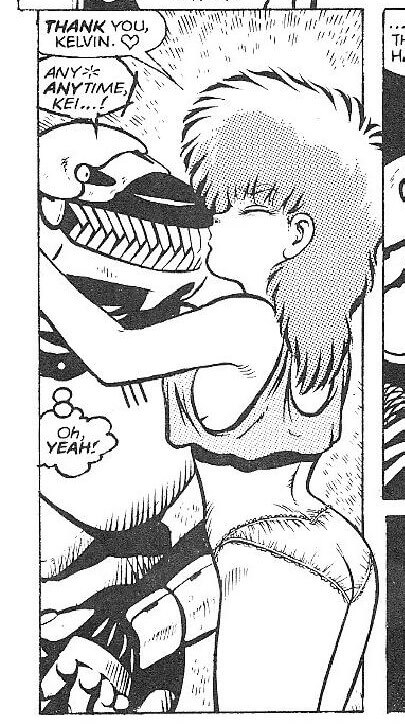
It’s still a decent read, and a solid foundation for future volumes. The Dirty Pair was of a piece with many of the first localized manga.
The next volume, Dangerous Acquaintances, was an improvement on Biohazards. The artstyle is very similar but marginally better. The panel-to-panel storytelling and visual clarity of the art is where Warren’s growing experience is most visible. Warren’s inking is cleaner, which reduces the subtle visual clutter that’s very pervasive in black and white comics drawn by inexperienced artists.
Dangerous Acquaintances opens with Kei and Yuri taking a vacation on a planet called Rocinante. Their vacation is almost immediately derailed when Kei spots Shasti, a former trouble consultant turned criminal. A dangerous acquaintance, if you will.
What makes Dangerous Acquaintances notably better than Biohazards is the inclusion of Shasti, a genetically-altered human created by the 3WA, as antagonist. Shasti is an interesting foil to Kei and Yuri. While the Dirty Pair are accident prone, and Kei in particular is filled with bluster, Shasti is a cool customer, and she’s better than Kei and Yuri at pretty much everything. As far as the reader can tell, she also isn’t plagued by bad luck. After her heel turn Shasti becomes an antagonistic mirror image of the Dirty Pair, except wrapped into the form of a single person.
Dangerous Acquaintances moves between the “present day” and the past, when Kei and Yuri were still training to become agents and Shasti and her partner Deidre were assigned to jobs with them. This flashback structure is maybe used a little too extensively, with the full nature of Shasti’s betrayal only being revealed in the last issue of the volume, but the presentation makes the narrative more interesting than it would be if told completely linearly.
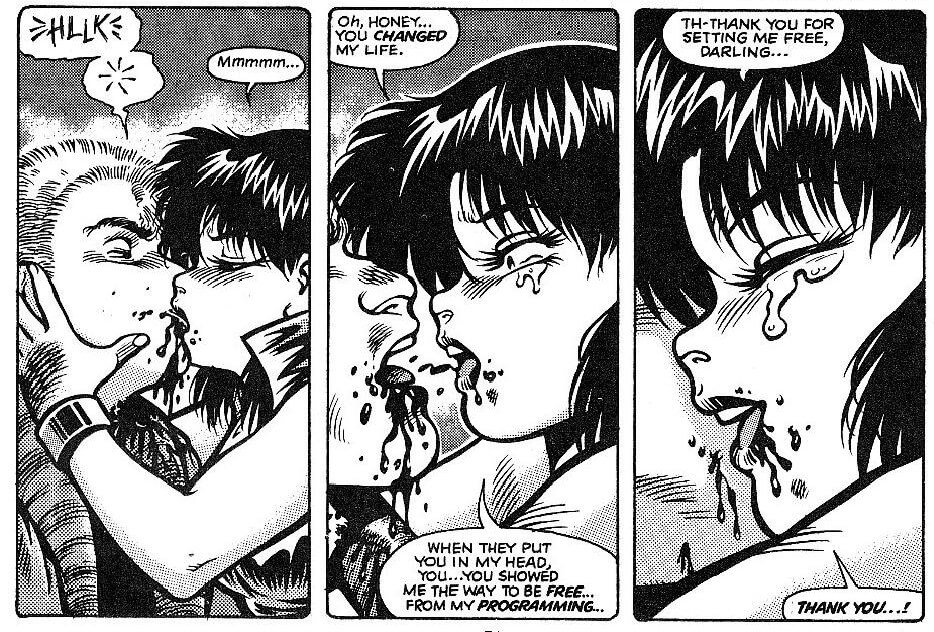
An interesting note about Shasti is that her brain has four, and then five, distinct personalities to aid her in 3WA missions. The final personality is one from a male criminal, designed to help her “get into his head” for a mission. As you may expect this is what turns her into an antagonist. What’s a little surprising is that nothing gender-related happens with this male personality—it allows her to get mad about being property of the 3WA, as someone grown in a test tube by the organization, and not much else.
A Plague of Angels would be the last volume written with Toren Smith, and the first great volume. The story details a journalist writing a story on the Dirty Pair while visiting them in their home on an O’Neill cylinder. The Dirty Pair have to take care of some criminals while the journalist follows them, including a guy who can transfer his consciousness into different bodies using a common cybernetic implant.
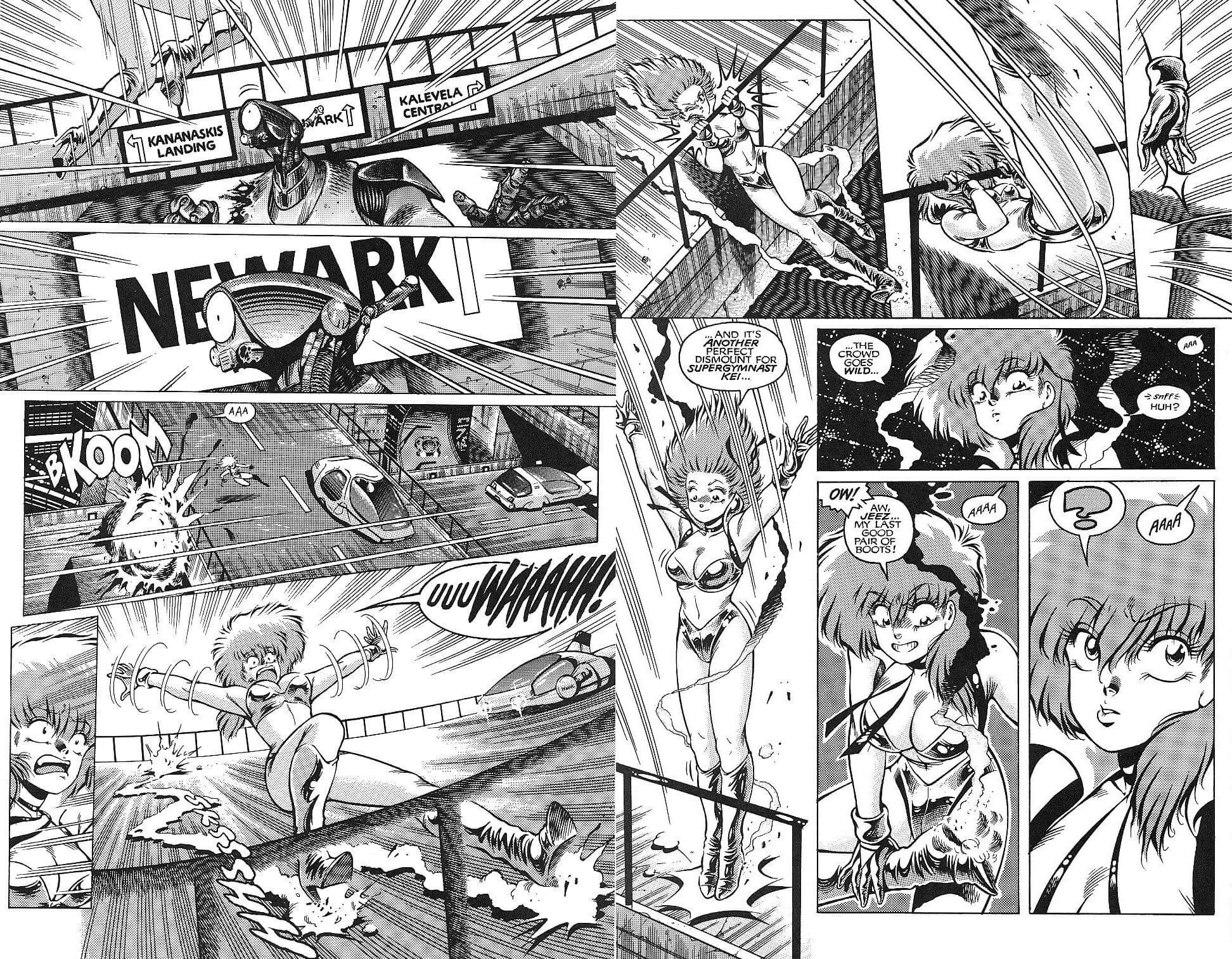
The dynamic shared between Kei, Yuri, and the journalist during the first few issues of this volume is very fun. Kei and Yuri each try to sound more impressive than the other for the article. Some secrets slip out after a few drinks. Some well placed thought bubbles allow us to be privy to the journalist’s thoughts on the duo. It’s great stuff.
The Dirty Pair are famous in universe in every iteration, which is how they always have a well known and feared nickname, but the Warren series puts a very large focus on that. A Plague of Angels and Fatal But Not Serious in particular tackle themes relating to celebrity that would later be used in Milligan and Allred’s X-Statix.
Something that was always present in The Dirty Pair that reaches fruition in this volume is environmental continuity. The backgrounds have become detailed and designed, the basic layout of a space is remembered, and the “camera” moves around it in a way that deepens the sense of place in the reader’s mind. A lot of comic artists can barely draw in perspective, but even when Warren does fake mathematical perspective he’s still brilliant at creating depth and volume.
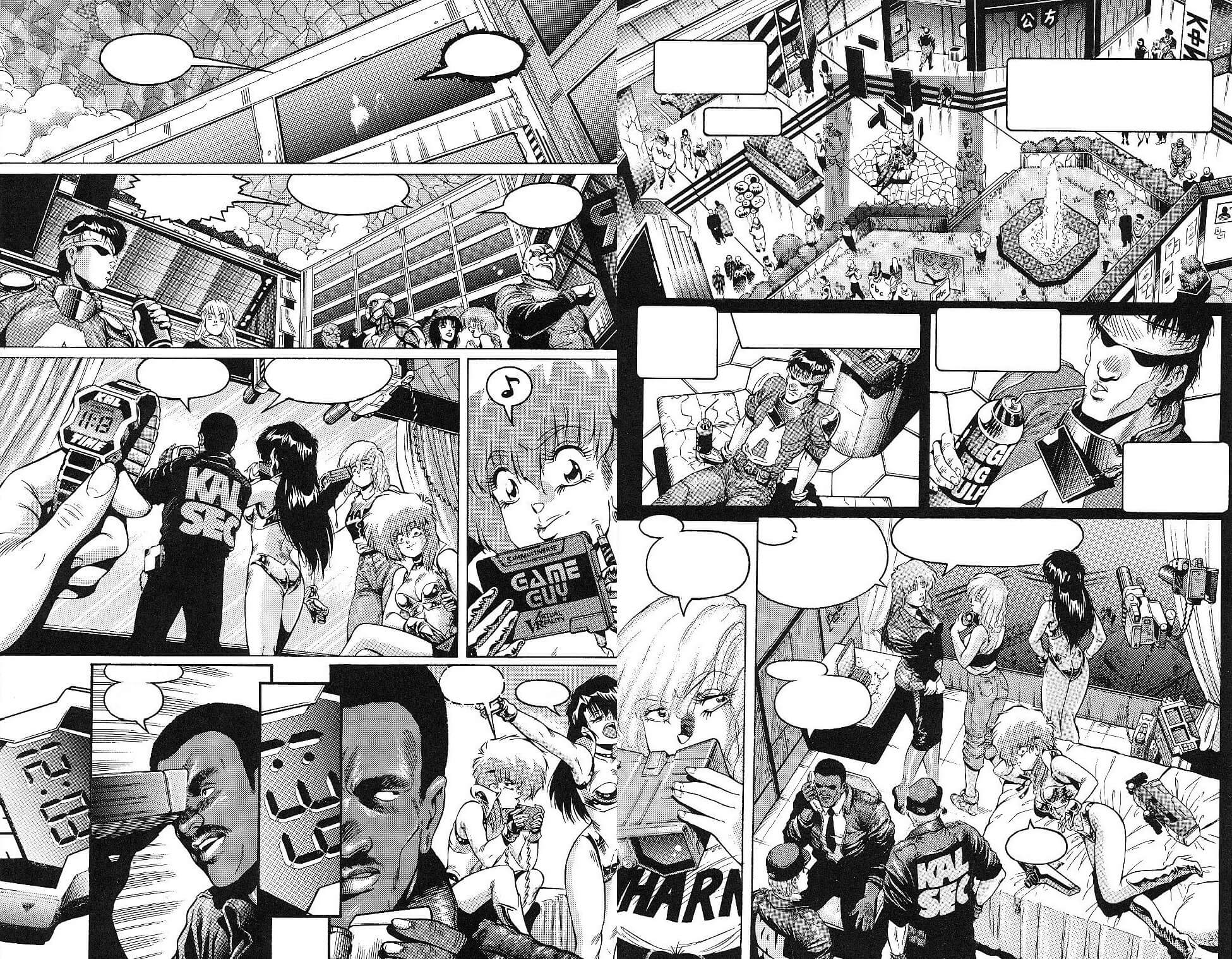
Sim Hell is what it looks like when a comic is firing on all cylinders. The story starts by establishing some anxieties Kei has about things coming between her and Yuri, with Kei dreaming about dying and going to Hell while Yuri goes to Heaven. Kei is feeling especially anxious because her and Yuri are getting ready for an audit by the 3WA, in which they will go through virtual simulations to see if they’re still capable of being trouble consultants. The emotional propulsion created during these first few pages continues throughout the entire book. Sim Hell simply starts and doesn’t stop.
The narrative thrust of the story is combined with an attention to detail seldom seen in comics. Like in the prior A Plague of Angels, environments continue to be portrayed with a level of consistency and geography that makes them easy to inhabit as a reader. But props, clothes, and various other items are designed in a way that makes the world feel very lived in. Adam Warren has a love of putting words on objects that seems incredibly masochistic and labor intensive, which sometimes is comedic but often adds a kind of verisimilitude.
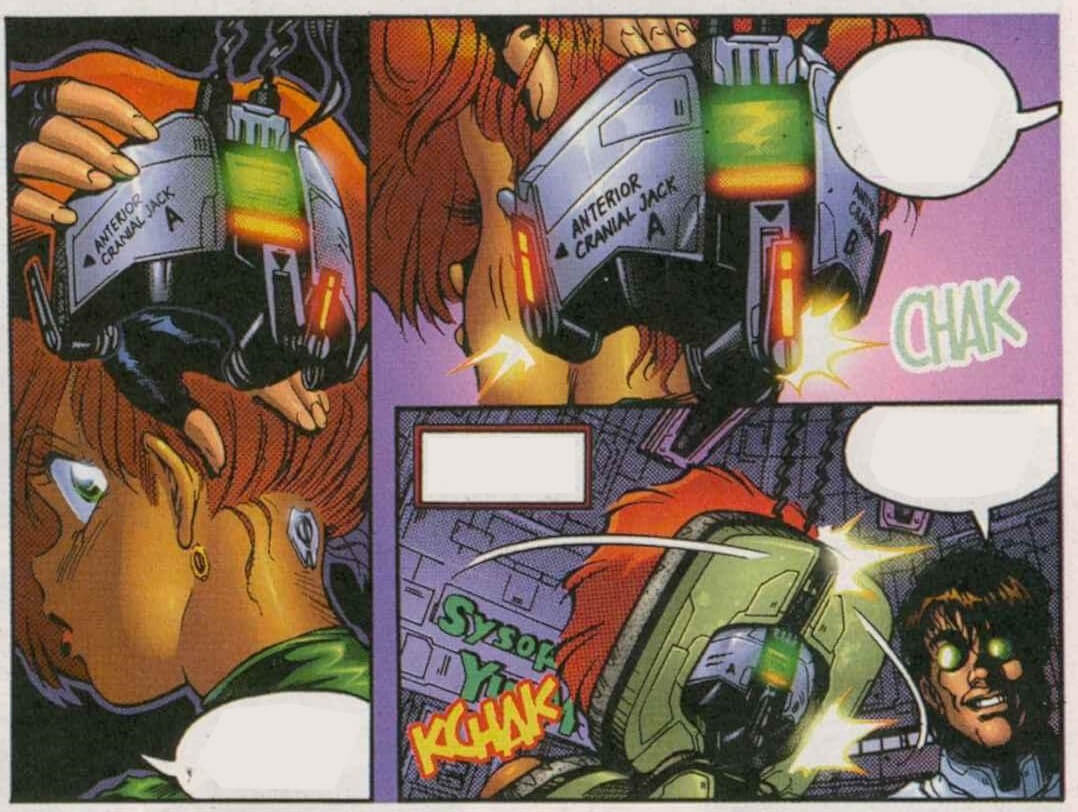
A design I particularly love in Sim Hell is this device placed on the back of Kei’s head to get her into the simulation, which in turn locks into a chair. Warren’s Dirty Pair is filled with these kinds of thought-out designs, and they allow the comic to become incredibly immersive and engaging.
Sim Hell is a book I’d easily place on the level of Miller’s Born Again, Windsor-Smith’s Weapon X, and Kirby’s OMAC. Weapon X is a good comparison on a purely illustrative level, because both books have such well-wrought technology art. The Dirty Pair is a great companion piece with OMAC. They’re both incredible sci-fi comics that feel like kindred spirits.
I’m almost certain Total Recall was a big inspiration, and in some ways Sim Hell prefigures elements of The Matrix. Unlike a lot of cyberspace stories from the 90s Sim Hell doesn’t feel dated, probably because the technology is a vehicle for a human story and not the raison d’etre for the narrative. Also there’s no bad CGI. I shouldn’t discuss the plot of Sim Hell further. It’s a story where it’s best to go in almost blind.
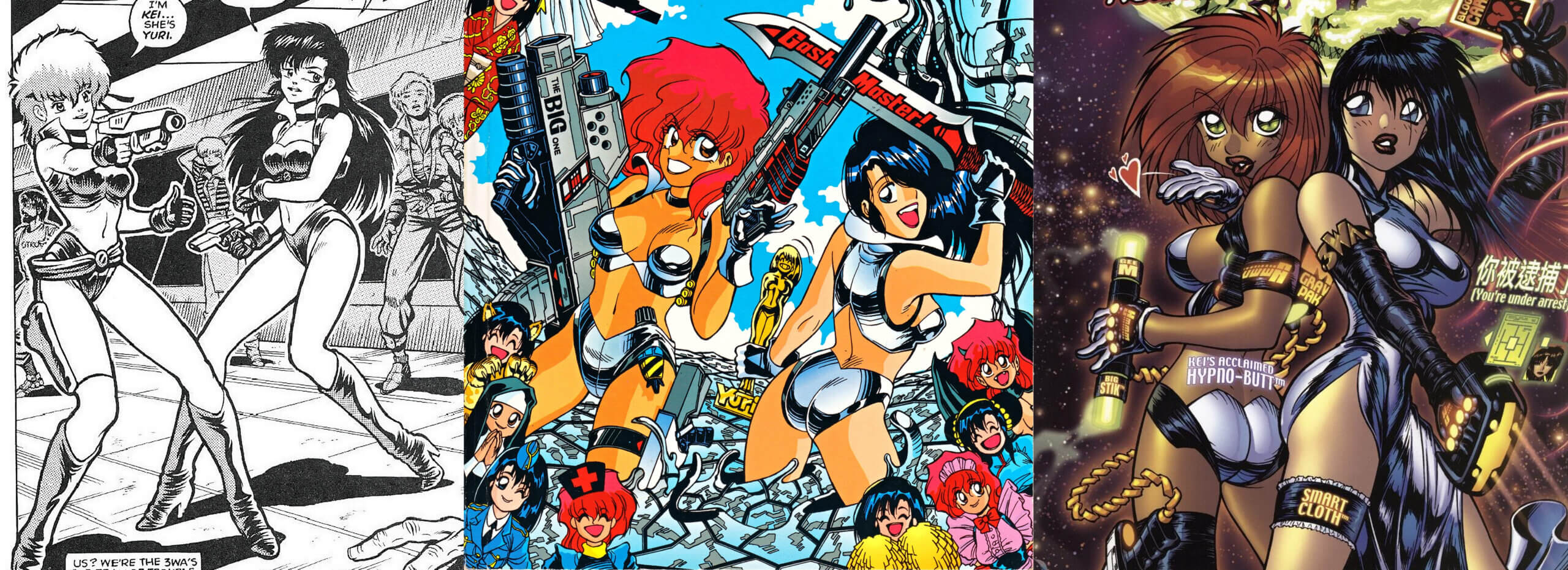
By the release of Sim Hell, Adam Warren’s art style had changed notably, and it would continue to change further, specifically in relation to faces and figure drawing. His earliest comics from the 80s and 90s, like Biohazard, had a look that felt like a middle ground between seinen stuff and the mainstream American comics style. By the aughts he’d developed a look that unfortunately hasn’t aged well, evoking American “How to Draw Manga” art books. He’s managed to make that style his own in his newer Empowered comics.
I understand that Warren’s artwork from the late 90s and early aughts looks very off putting at a glance, but once you sit with it for a while it becomes very good. Warren is a guy who knows his fundamentals, and he wasn’t approaching anime art as a novice. Even if you dislike his faces, the backgrounds are nothing to sneeze at.
Something else that changed his style was an adoption of color in later volumes of The Dirty Pair. By the time Warren drew his final black and white volume, Sim Hell, he’d become a virtuoso of black and white art, expertly creating textures and utilizing screentones to incredible effect (with the assistance of Tomoko Saito). Like many artists he dialed back fine detail when starting to use color. I find that his work became more appealing, if less greebly, with color. The natural separation color makes images easier to read at a glance, which is an important consideration in comic art. Sim Hell was the only volume of The Dirty Pair released in both black and white and color, with the color version appearing years later as a “remaster”.
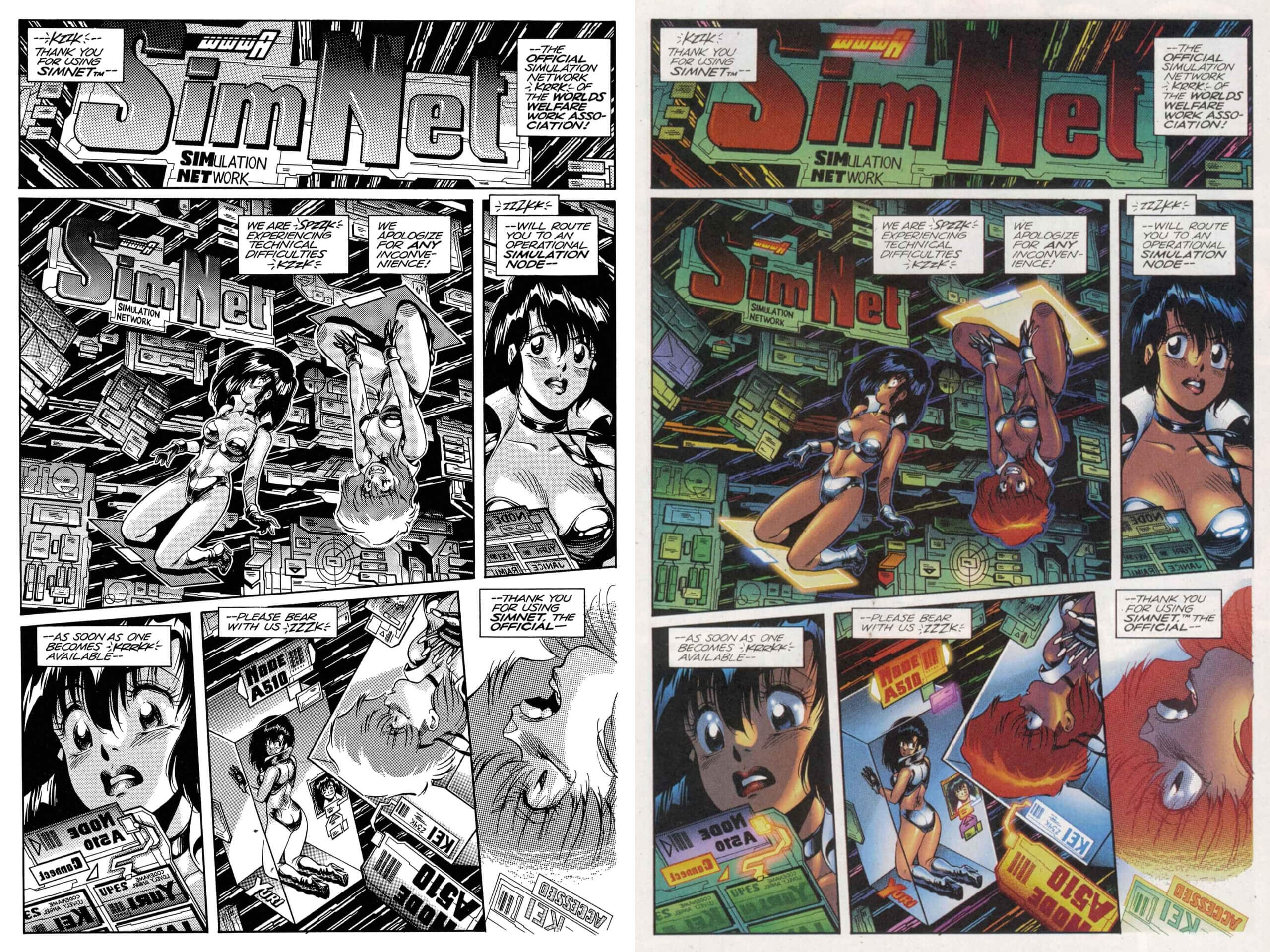
Sim Hell is an incredible comic, and Fatal But Not Serious, the next full volume, continues the hot streak. I don’t know which volume is better, just that I really like both of them. This volume mostly takes place at a convention devoted to Kei and Yuri. Things start to go horribly wrong almost immediately. Unlike every other volume of the comic, I don’t recommend starting here: this is basically a direct sequel to Sim Hell.
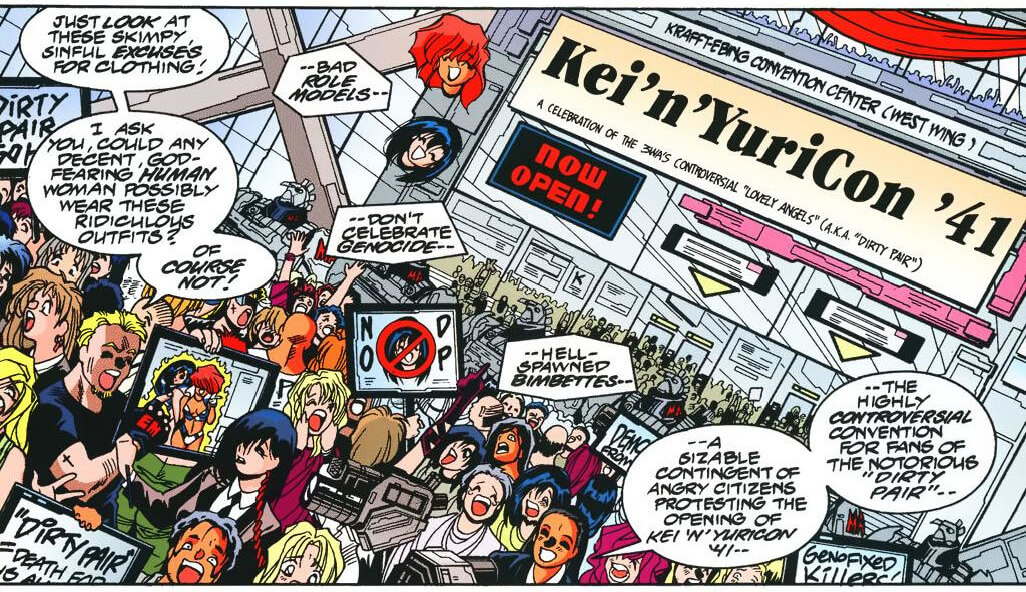
The environmental continuity stuff I mentioned while talking about A Plague of Angels reaches its zenith here: almost all of the story takes place inside of a convention center, and the layout of the building is consistent throughout. Fatal But Not Serious should be an object lesson to any comic artist what a difference making floor plans and other kinds of reference materials while drawing a book can make for reader immersion.
The storytelling here is incredible in other ways. Until the convention starts in earnest, the story moves between different points in time, showing us what the antagonists are up to, a pre-con interview with a few talking heads, a mission undertaken by the Pair that results in an injury, and the scene outside of the convention center before it opens. This movement between the past and present readies all of the moving pieces and emotional throughlines for when the book starts to move linearly. It’s a very smartly executed way to frontload the story with a lot of buildup and information without it feeling like boring exposition.
Something that really impresses in Fatal But Not Serious is the coloring: it imitates the look of anime cel coloring very well. It looks clean and allows for detailed inking, and it’s easy to read without looking like a four-color comic. I hesitate to say it’s the best The Dirty Pair ever looked, because the more airbrushed colors in the other color volumes are also good, but it’s a great style.
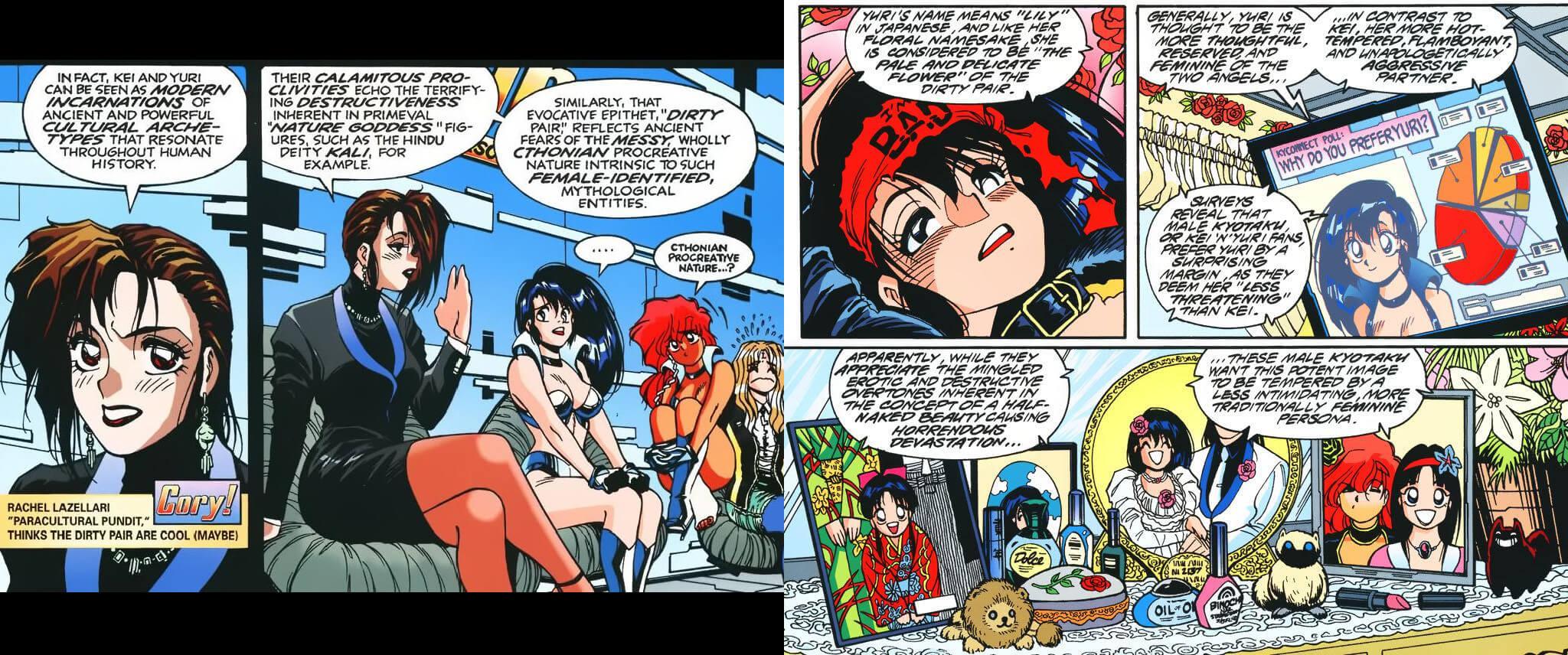
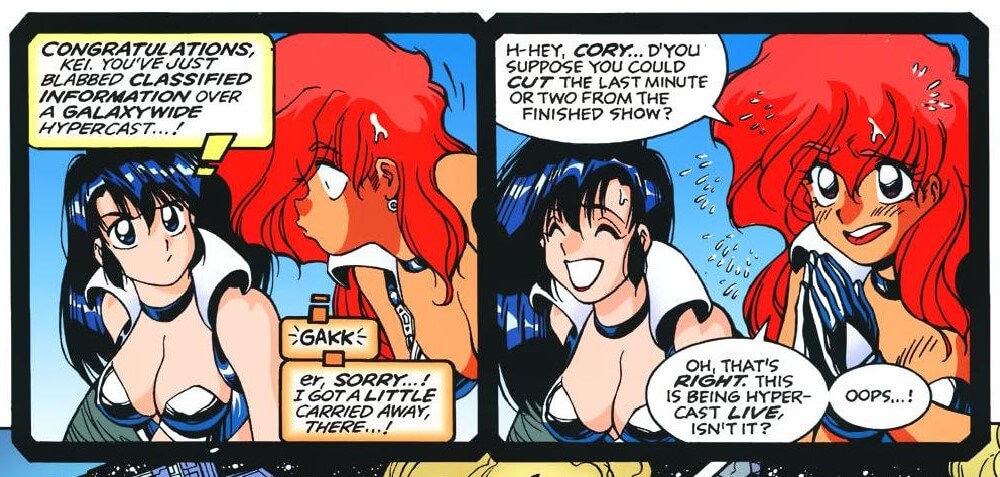
A lettering-adjacent device used very frequently in Fatal But Not Serious are colored speech balloons that are used to signify when Kei and Yuri are talking using a kind of thought-controlled remote communicator. It’s a kind of device that takes advantage of storytelling techniques that work best in comics. This speech balloon device would be used even more extensively in Run From the Future.
Run From the Future would be the last volume-length Dirty Pair story from Adam Warren. Every volume of The Dirty Pair has some weird sci-fi new wave type things, but Run From the Future takes all of that to a much further level. The entire story takes place inside of some Dyson trees (large trees growing out of comets) and the Dirty Pair arrive at said Dyson trees in a sentient biomechanical spaceship. Warren gets a lot of mileage in this story imagining what the interior of such a place would look like.

The story involves Kei and Yuri being sent into the tree to capture 50 criminals within the space of 100 minutes, which emphasizes the feeling that these stories are meant to be movie-length. Many of the criminals are involved in weird future subcultures, and the strange gizmos used by Kei, Yuri, and the criminals they’re facing are a major focus in the storytelling. Run From the Future is easily the most episodic Dirty Pair comic, with several encounters built around comedic enemies like a sentient leather catsuit, and gadgets such as a device that sharpens hair into a weapon and a chemical that turns spit into a sedative that leaves people in a suggestive state.
Some of the early digital coloring here is a bit dated, reminiscent of The Dark Knight Strikes Again. Because of the nature of the tree habitat setting, this also has some of the least detailed backgrounds in the entire series. We are regularly shown exterior shots of the Dyson tree showing us where Yuri and Kei are relative to each other, but the interior of the tree never has a strong sense of location. Unlike most of Fatal But Not Serious, you don’t have a great idea of where you are just by looking at a background. That can mostly be forgiven by the fact that there are so many discreet rooms in the location, instead of it taking place in a very open convention center. There are some very interesting environments in the tree, like a giant water tank and some black markets.
The highly saturated and dated coloring is a bit of a novelty over 20 years later, and ultimately the less detailed backgrounds are mostly different and not necessarily worse. But if there’s anything that I really dislike about this volume, it’s that the characterization of Kei and Yuri seems to have inadvertently changed with Adam Warren’s art style.
Warren’s artwork gradually became more cartoonish, silly, and overtly comedic over the course of the 90s. Exaggerated expressions became more common and it’s generally more difficult to imagine the characters in a dramatic context. The side effect of all this is that it makes most characters look less intelligent, which is fine in the SoCal world of Gen 13. There’s nothing inherently bad about the different style, but it’s not a great fit for The Dirty Pair, because it makes Kei and Yuri feel dumber. If all of their dialogue was written on a sheet of paper and mixed with how they spoke in older volumes I doubt much of a difference would be perceptible, but it’s hard to look past the characterization implied by the more vacant-looking faces. This change in style also coincides with Run From the Future being the most cheesecake-y volume, which really is an unfortunate combination.
That being said, the banter between Kei and Yuri is a bigger focus than usual in this story. The two characters spend almost the entire volume talking to each other remotely, and a lot of the dialogue is lightweight and humorous, as if listening to two people talk over Discord while playing a game. Run From the Future is about a much more routine mission for Kei and Yuri than what’s shown in prior volumes, and the lower stakes felt by the pair make for some very fun and different exchanges.
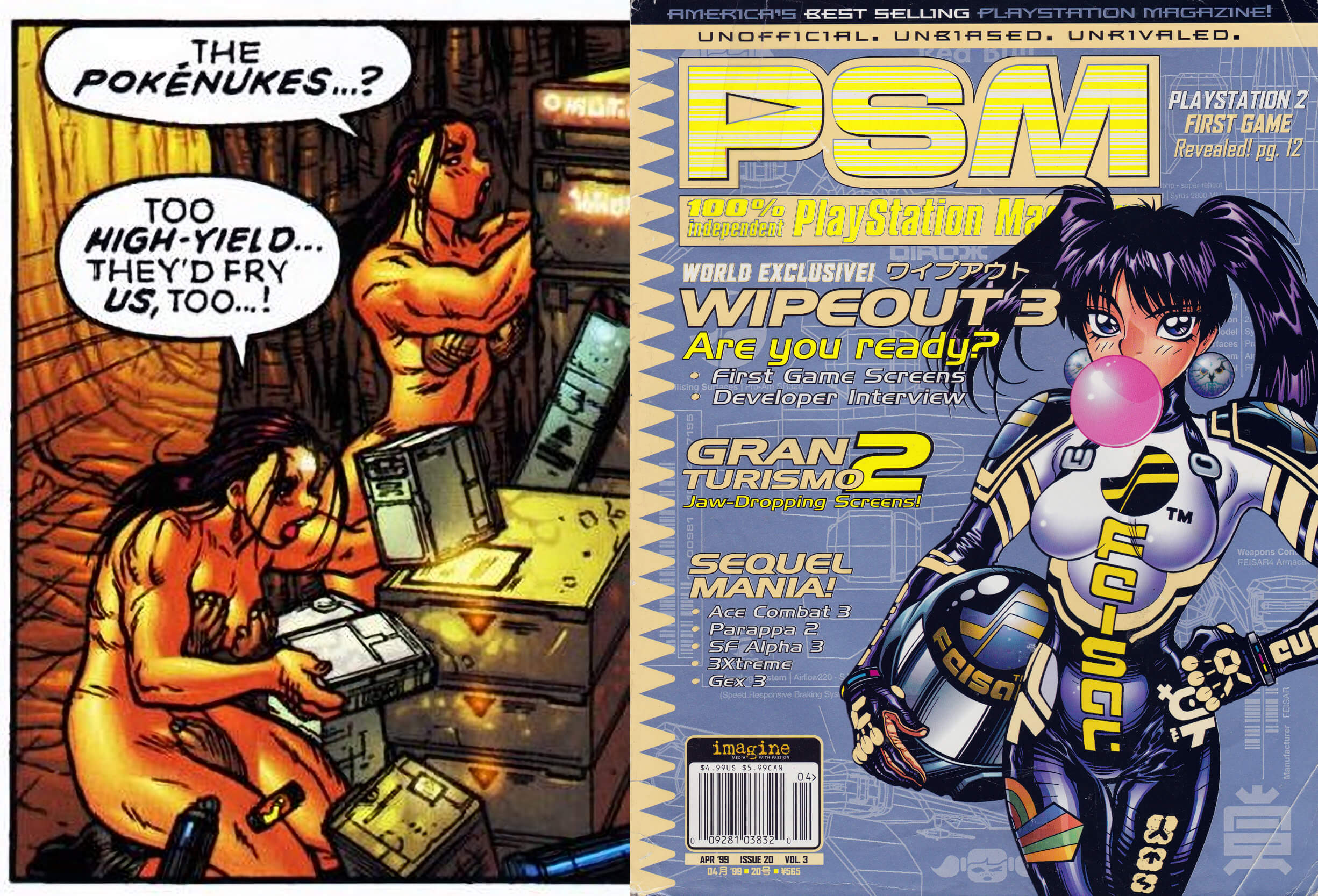
Right: An Adam Warren illustrated PSM cover
This volume has a “gamer culture” feel to it that the other volumes don’t really have. I remembered while reading Run From the Future that Warren used to do art for PlayStation Magazine. There are some pretty overt references to videogames in the dialogue, and the “capture 50 people in 100 minutes” mission feels like something from a game.
Run From the Future is easily the most flawed volume post-Dangerous Acquaintances, but it’s still pretty strong on its own merits. While this didn’t leave me feeling like I’d just read a work of great substance after finishing it like Sim Hell or Fatal But Not Serious, it’s still a very fun read. The interesting setting, weird gadgets, and interactions between Kei and Yuri make this worth reading. A small subplot in Run From the Future is devoted to setting up a future volume featuring Shasti from Dangerous Acquaintances. Unfortunately this story never happened, and Adam Warren never wrote a Dirty Pair story designed to be a finale or send-off.
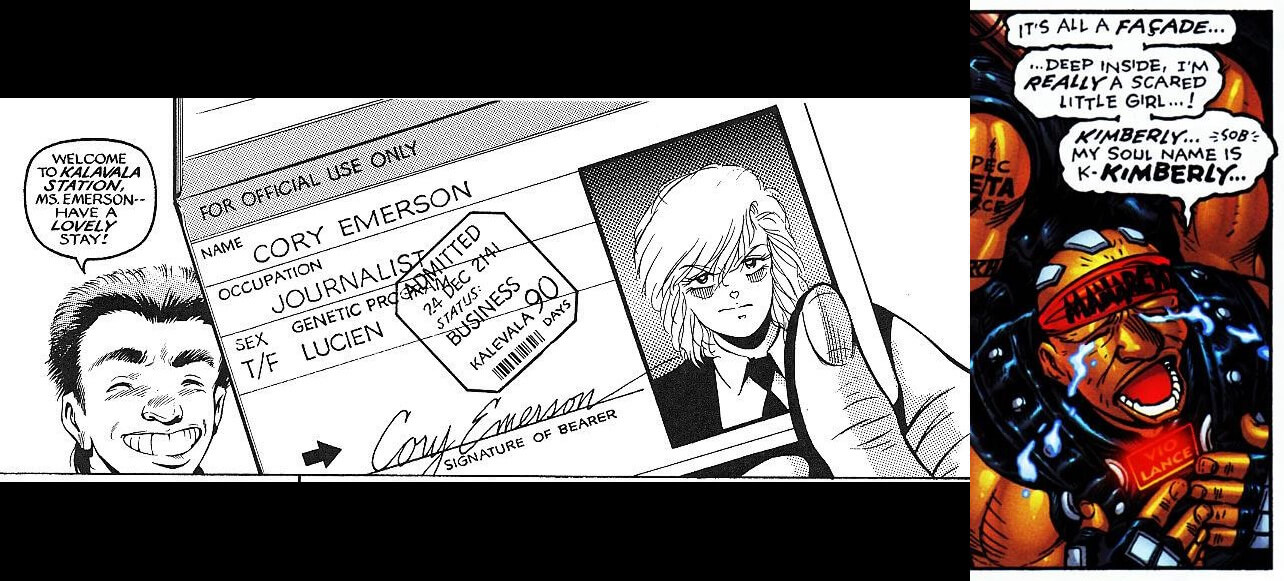
the butt of a joke. [Sources: A Plague of Angels, Run From the Future]
Something that really elevates Warren’s work is that it’s clear he’s a person of broader culture than mainstream comics and genre movies. All of the dialogue from the feminist character in Fatal But Not Serious is meant to be a little tongue in cheek, but the notable thing is that all of it is stuff that actually makes sense, and does resemble what a feminist might say in real life. Likewise there’s a general verisimilitude to the world of The Dirty Pair, such as the fact Kei and Yuri would even get audited by the 3WA to begin with in Sim Hell.
Hopefully by this point I’ve emphasized that Adam Warren is a master storyteller in the comics medium. The pictures I’ve included in this essay should show that he’s an excellent draftsman. Many comic artists who rose to prominence in the 90s could draw great pictures, but couldn’t tell clear stories with them. Warren’s work is usually very detailed while also being easy to understand. He put a lot of work into making the world of The Dirty Pair feel real on a design level, with gadgets and locations that don’t feel like they were drawn improvisationally. Outside of the formalist qualities of Warren’s comics, he’s also a great writer. The adventures of Kei and Yuri are fun and exuberant in a way that comedic comics often strive to be but rarely are.
Something unfortunate is that every volume of The Dirty Pair has been out of print for a long time. Adam Warren and Dark Horse have been wanting to reprint the entire series as a pair of omnibi, but the Japanese licensor has been unresponsive. It’s a real tragedy, because it’s a series that deserves to be seen.
Across Adam Warren’s six volumes he created some of the greatest sci-fi comics ever. While it’s laudable in itself that The Dirty Pair was not another space opera thing trying to be Star Wars, at its core the reason The Dirty Pair is a great comic is that it’s simply incredibly well made. It’s an ultimate expression of what became possible in American comics after things like residuals were introduced and creators no longer had to draw three books a month; the attention to detail found in these books cannot be found in a mainstream comic published before roughly 1985. The layouts are masterful, the backgrounds are about three times as good as they needed to be, and if it turned out anything past volume 2 wasn’t sketched out in advance or otherwise planned in some form I’d be stunned. The bawdy anime-inspired action comedy of The Dirty Pair will not be to everyone’s taste, but if it’s to your sensibility it might become a new favorite.

