
Oglaf, the long-running webcomic by Trudy Cooper and Doug Bayne, is perhaps best not spoken about in polite company. Launched in 2008, it’s a raunchy, riotous take on fantasy, sex, and comedy. Held together by punchlines and the occasional recurring character rather than an ongoing plot, Oglaf feels a bit like a graphically sexual, chaotic newspaper strip.
Warning: Almost no links in this article are safe for work. Click at your own discretion.
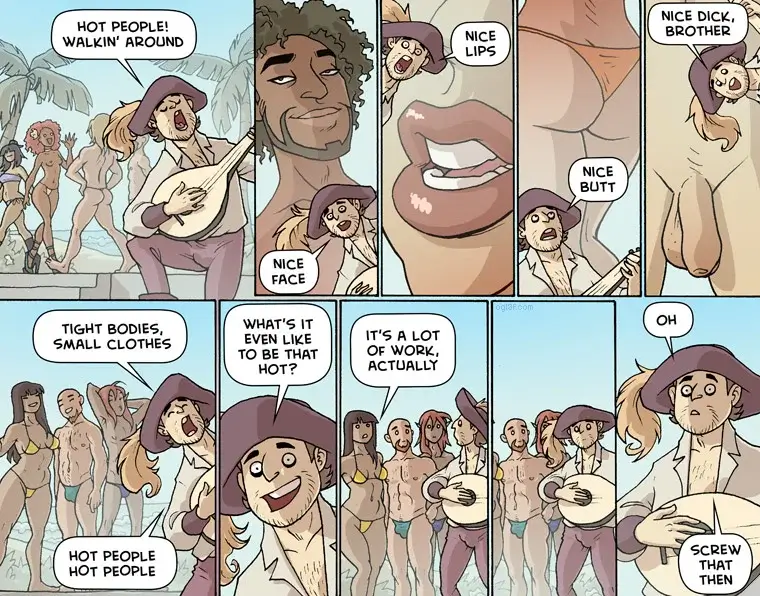
If you go searching for Oglaf content on Google, the terms “Oglaf” and “Oglaf webcomic” both turn up the TV Tropes and Wikipedia pages before even the comic’s Twitter account. Click through a few strips and you’ll see why—it’s not just mildly titillating. The comic routinely features graphic sex and nudity, some of which is strange and off-putting. Sure, somebody’s into everything, but Oglaf delights not just in the depiction of palatable sex, but at pushing in the boundaries of what sex and sexiness even is. The sex comedy genre has fallen somewhat out of fashion, but as tempting as it is to suggest that a comic that contains as much sex and comedy as Oglaf belongs to that genre, I’d argue something different: Oglaf, by virtue of juxtaposing humor, sex, and humor about sex, is burlesque.
The word “burlesque” often brings up images of women fan-dancing to brass bands, which is not inaccurate, but not the full picture. Burlesque can be many things; works that blend humor and sex are about as old as stories themselves. But as a deliberate approach to mockery, burlesque goes back to the notoriously prudish Victorian era. While sex and sexuality were of course part of the equation, the main mode of operation was parody and lampooning. What was more subversive in the buttoned-up Victorian era than teasing flashes of breast and thigh in an adaptation of a prim and proper stage show? (Publisher’s note: Check out these past articles about burlesque performances and genre for more examples of modern burlesque culture and connections to comics.)
Today, burlesque tends to be more playfully sexual and less about lampooning. But the core aspect of teasing is still there; burlesque tends to wink and suggest rather than bare it all the way you might expect from the exotic dances expected at a strip club. The performances I’ve seen — which, admittedly, are not representative of all burlesque everywhere — also often push at the boundaries of what’s acceptably titillating by mashing up nudity with strange (a voguing Babadook) or playful scenarios (Miss Fisher’s Murder Mysteries‘s Dot sexily overcoming her fear of telephones). Even when it’s clear a routine is meant to be sexy, there’s always a playfulness to it — humor, teasing, or taboo — rather than straightforward consumable sexuality.
Both Oglaf and modern stage burlesque are more risque than classic burlesque. Before we can truly say that it is burlesque, normally thought of as physical performance, we have to establish what Oglaf isn’t. Though not every Oglaf strip contains graphic nudity or sex, a great many of them do. Sex and desire are everywhere. Calling it pornographic would not be inaccurate, but, while you could certainly get your rocks off to Oglaf, surely there are more focused places for that. Just like burlesque, titillation is part of, but not the entire appeal. So perhaps it’s not porn, per se, but erotica.
In “Juicily Juxtaposed: Pleasure Tropes In The History Of Erotic Comics,” a peer-reviewed article published in Teorija in praksa in 2016, Tilen Izar Lunaček bravely attempts to define the difference between porn and erotica in comics, a medium that, by its nature, shows things visually. “If I was ever asked what I feel the difference was between erotica and pornography (or, more to the point, between artistic and artless works with sex as their central theme),” writes Lunaček, “I would have to state that it lies neither in the list of organs on display nor on whether the audience’s arousal is the work’s central goal or not, but rather, in whether the work presents its material in all its due complexity and makes us, even while coming, wonder at what works and why in human sexuality.”
Lunaček avoids the temptation to point toward graphic depictions of sex and the body (which Oglaf has) or whether the goal is to get the viewer off (also arguably true of Oglaf) as evidence that something is either pornography or erotica. Instead, he suggests that comics have the unique potential to be unflinchingly erotic in incredible ways precisely because they are not beholden to reality. He cites Oglaf specifically as an example of how comics can be a multitude of things at once, calling it “a deliciously smart analysis of the dialectics of the homo and hetero-; domination and submission-; and restriction and pleasure-dichotomies that warrants repetitive readings either with or without a hand down one’s pants.” Or more simply: Oglaf, like many other comics that contain depictions of nudity with the possibility of titillation, forces us to consider the truth of how we feel about categories we see as stable. Boundaries we often see as rigid — homo- and heterosexuality, masculinity and femininity, and so on — are flexible in Oglaf to the point of meaninglessness. Because everything is sex(y), perhaps nothing is.
And looking at some Oglaf strips, this blurring of the line between acceptable and unacceptable sexiness becomes clear. Take “Chauncey, Earl of Gloom,” in which a man tells a woman about his deep abiding fetish for sex where an owl is watching. The woman testifies that she can do a pretty good owl impression. It turns out she means that she can turn her head around and stare at him, and the comic ends with a fairly graphic sex scene in which she does exactly that. While he has sex with her from behind, she stares with wide eyes, and asks him to literally feed her baby rats. In this particular case, if we stripped all the dialogue away, the scene would still be largely unsettling rather than sexy. But sex is happening. The bodies of those having sex (flexible neck aside) are normative and attractive. The people involved seem to be having a decent time. The bodies are, in a very normative way, sexy. The line, “Feed me a live baby rat,” is not. But maybe we find it a little hot anyway, because our brains are strange and complex.
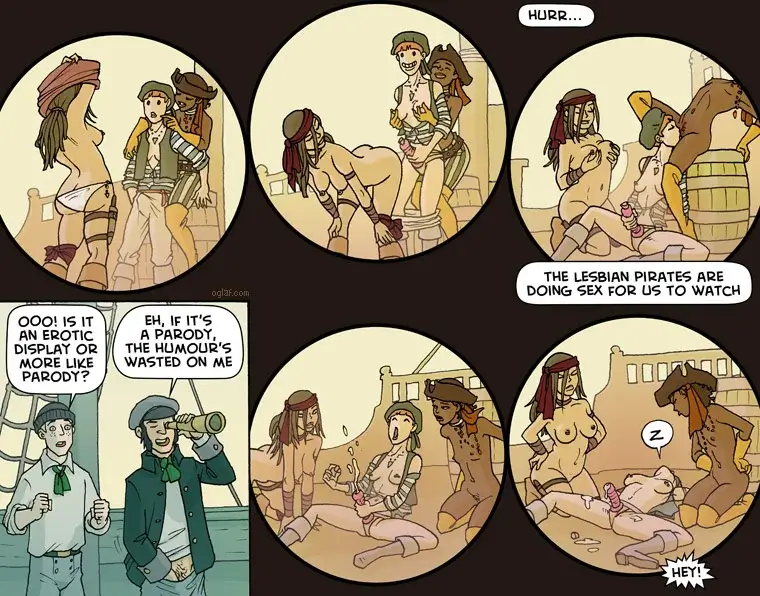
This feeling of unease — attractive bodies unsettlingly used! — often results in a laugh. We know there’s something a little weird about finding something like that sexy. Or something like this, which more or less makes the point of this essay for me. Lesbian pirates have sex where male pirates can watch, and the male pirates are uncertain as to whether it’s parody or not until one of the lesbian pirates orgasms and promptly falls asleep while the other lesbian pirates look on in disgust. But maybe we do find it sexy anyway, and we feel a little embarrassed about it. The discomfort can be eye-opening.
I’m comparing Oglaf to burlesque because it reminds me of the burlesque shows I’ve seen, where comedy and taboo and discomfort and sexuality all overlap. There’s a freedom to treating sex and violence with humor and levity. I’ve seen many pop culture-influenced burlesque acts that go beyond “Your favorite character takes their clothes off.” Think, for example, of a character like River Tam in Firefly — a character mistreated by the narrative, overly and prematurely sexualized by a now-disgraced showrunner. I’ve seen Verity Germaine twice do a routine in which she dresses as River and dances with two large axes straight out of Serenity. It’s sensual, sure. But whatever might have been true of River’s characterization and treatment within Firefly is different from the emotions evoked by Verity Germaine’s performance. As Amanda Vail writes, it evokes rage and sadness as well as a mastery over her body that never — that could never, given who the creator is — come to fruition in the series itself. This tangling of power, rage, beauty, and titillation — because it is burlesque, and it is sensual in a way that’s entirely outside of River Tam as a character — can be a bit uncomfortable to watch. The performance may not be funny, but it is still purposeful critique of its source material.
For another, less taboo example, during a Miss Fisher’s Murder Mysteries-themed show that raised money for Planned Parenthood in the wake of Donald Trump’s election, performer The Shanghai Pearl performed a routine as Miss Fisher to Liz Phair’s “H.W.C.” that involved dancing and stripping inside of a giant diaphragm. The routine celebrated the protofeminist sexual liberation of the character alongside a modern declaration of desire to an audience that feared that that liberation would start moving backwards. It was sexy and sexual, but the sight of the diaphragm was also shocking and funny — this tool of liberation, something that might be discussed but not seen, and certainly not sexualized, seemed both outdated and newly relevant again. The performance was titillating, but also shocking, a little uncomfortable in bringing together 1920s liberation alongside calls to defund access to birth control and abortion.
While Cooper and Bayne may intend nothing more than crude jokes and bodies mashed together with a consistent punchline of, “…and then they had sex,” to treat sex (something that is both taboo and deeply sought after in our culture) as something silly, throwaway, and inconsequential. But for myself as a reader, it edges toward critique. Even the comic’s off-color jokes — some of which slip past edgy and into offensive—are made less impactful due to context. What does it mean to be objectified if you can wield the gaze right back? What if sex was as effective at solving conflict as violence? What if a justification for chainmail bikinis made both as little and as much sense as such a silly concept deserves?
These aren’t inherently serious questions. They are punchlines more often than they are anything else, but their lack of seriousness is precisely the point. Oglaf is not precious about sex; it’s a fact of the comic’s universe, as it is in ours, but it’s also treated with absurdity. Sex is absurd, when you get right down to it, and that’s part of what makes Oglaf stand out as burlesque among other comedies, and even among the more niche genre of sex comedies.
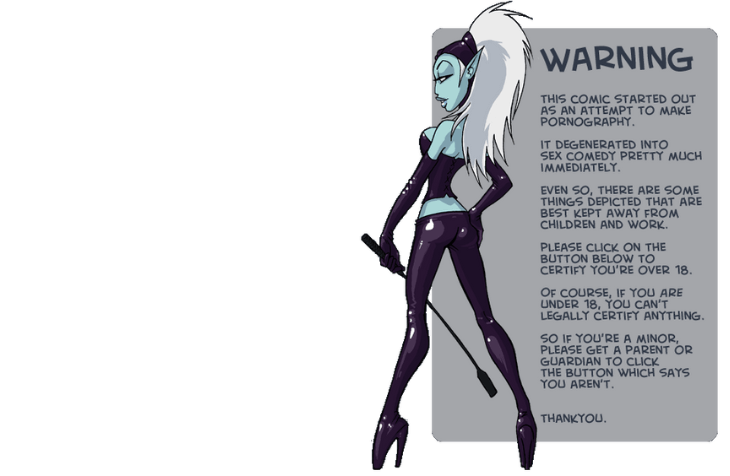
As Cooper and Bayne write on the age confirmation page, “This comic started out as an attempt to make pornography. It degenerated into sex comedy pretty much immediately.” That might be true; but even at its most pornographic, there is something more to it. In the opening — and only longform — story arc we meet Sandoval, an eternally sexually frustrated servant who’s repeatedly tasked with degrading errands of a sexual nature. Sandoval’s spent semen (called, charmingly, a “cumsprite”) reports his transgressions back to his scantily clad boss, who punishes him for masturbating with yet more teasingly sexual tasks. There’s an air of mockery about it. “Just try to find this sexy,” it seems to say, as the scantily clad boss magics the servant’s penis away, telling him they can have sex if he finds it in time. He doesn’t, naturally, but it turns out having a sensitive penis detached from your body can lead you toward other forms of satisfaction.
Is it horny? Absolutely. Is it sexy? Arguably. But it’s also not exclusively either of those things, which is where Oglaf‘s strength lies. It’s absurd. It’s strange. It’s daring you to find something as fantastical, weird, and unsettling as a man autofellating his detached penis sexy. In mixing these emotions, Oglaf achieves burlesque — the juxtaposition of titillation and mockery. That, and the lack of certainty over who the target of mockery is (sex itself, the characters, or the reader), is what makes it unique and refreshing, even 15 years after its debut.

