
Disability has long had a presence in visual culture, but all too often it has been represented as something monstrous and non-normative. Scars and other disfigurements have been used as an easy way to signal a character’s moral depravity, how they deal with painful trauma, or how they’ve been deified into inspirational figures (as Stella Young put it, they’ve become inspiration porn).
These kinds of representations completely ignore the lived reality of disabled people. As someone with a disability, I use identity-first language in recognition of how disability is inextricably tied to who I am and how I experience the world. I appreciate that not everyone feels the same way and some may prefer other terminology.
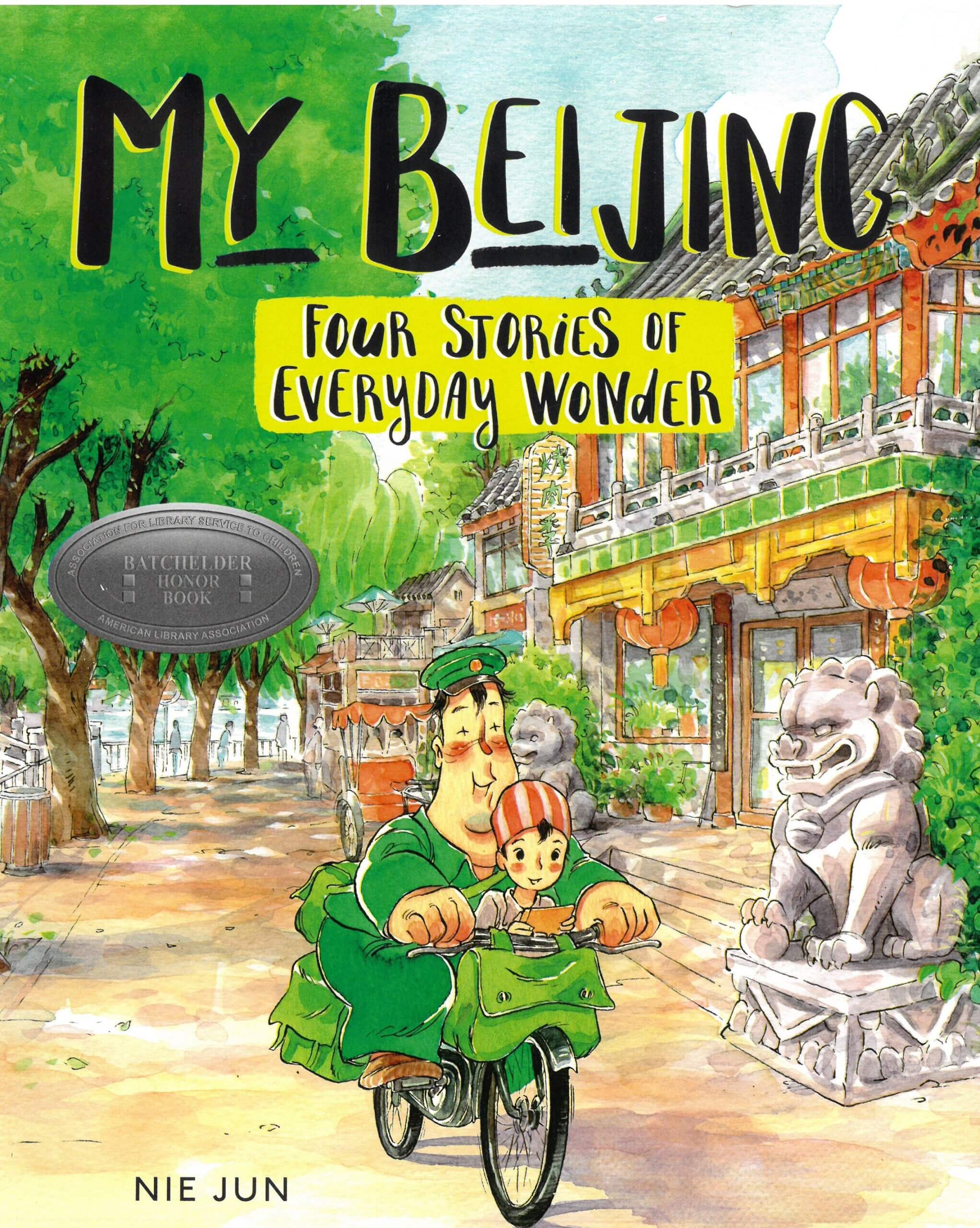
I also wonder: where’s the joy and wonder for disabled characters? Where’s the complexity and richness of disabled people living their daily lives? These kinds of portrayals are hard to find. That’s why it was so refreshing to me to read My Beijing: Four Stories of Everyday Wonder by Chinese writer and artist Nie Jun (translated into English by Edward Gauvin for Lerner Books in 2016). My Beijing is a series of four lovely short comics stories focused on a little girl named Yu’er and her doting grandfather. The stories take apart what normativity means and instead suggest that community care and connection are both doable and beneficial for everyone—not just the disabled character.
First things first: the statistics on disability in children’s literature, let alone comics more specifically, aren’t great. Margaret Kingsbury cites a 2019 study by the Cooperative Children’s Book Center, noting that “only 3.4% of children’s books have disabled main characters.”
These numbers are a few years old now (plus, they’re localized to the United States), but the rate of change in publishing is very slow. Employees at HarperCollins, one of the so-called big five publishing companies, went on strike from November 2022-February 2023, and one of their calls was for the publisher to “address the lack of diversity in its workforce,” including in its children’s book section.
Aside from the Eisner Award-winning El Deafo by Cece Bell which discusses Cece’s hearing loss as a child, there aren’t many comics specifically that offer solid, nuanced representation of disability. I’m not counting superhero comics here (though I welcome the conversation); as one of my favourite pieces of commentary by Chelsea Jackson notes, disability is too often reduced to a plot device in superhero stories, including the movie adaptations. (Books like Uncanny Bodies: Superhero Comics and Disability, edited by Scott T. Smith and José Alaniz, are trying to change that narrative).
In other words, there’s work to be done in creating a community for supporting disability and representation in kids’ comics and for thinking about how community care can be modeled. In My Beijing, Yu’er lives in a small Beijing neighbourhood called a hutong and wants to compete in the Special Olympics in swimming. She has an unnamed disability, most likely related to mobility. Her grandfather has a specially adapted bicycle and drives her around the hutong. He supports her, and rather than dismissing her Olympic dreams as silly or unreasonable, he proposes building their own pool, thus removing barriers and creating a safe space for her.
Yu’er’s disability isn’t named or described in the comics beyond the visual cues (crutches and the specialized bicycle) which hint that it’s related to mobility. Although I fully understand the importance of seeing specific disabilities represented accurately and without stigma, at the same time I appreciate that the comic doesn’t try to define Yu’er or pigeonhole her into a narrow category. For example, there’s been significant discussion happening in the autistic community about how “high” and “low” functioning labels actually hurt autistic people and flatten the diversity and the impact of their experiences.
Instead, the comic focuses on care and community. In one panel, Yu’er looks after her grandfather, who has injured his back. The harness rigged up by him to help Yu’er with swimming practice can be seen to the right of the panel, held by another kid. This single panel shows how Yu’er and her grandfather both have bodily impairments and they help each other in different ways. It’s a wonderful example of mutual care and of the potential for social understandings of disability to re-shape relationships. Disability is not only about “catering” to the “special” needs of the disabled person: it’s about making all of our relationships and social structures more accessible, and that benefits everyone.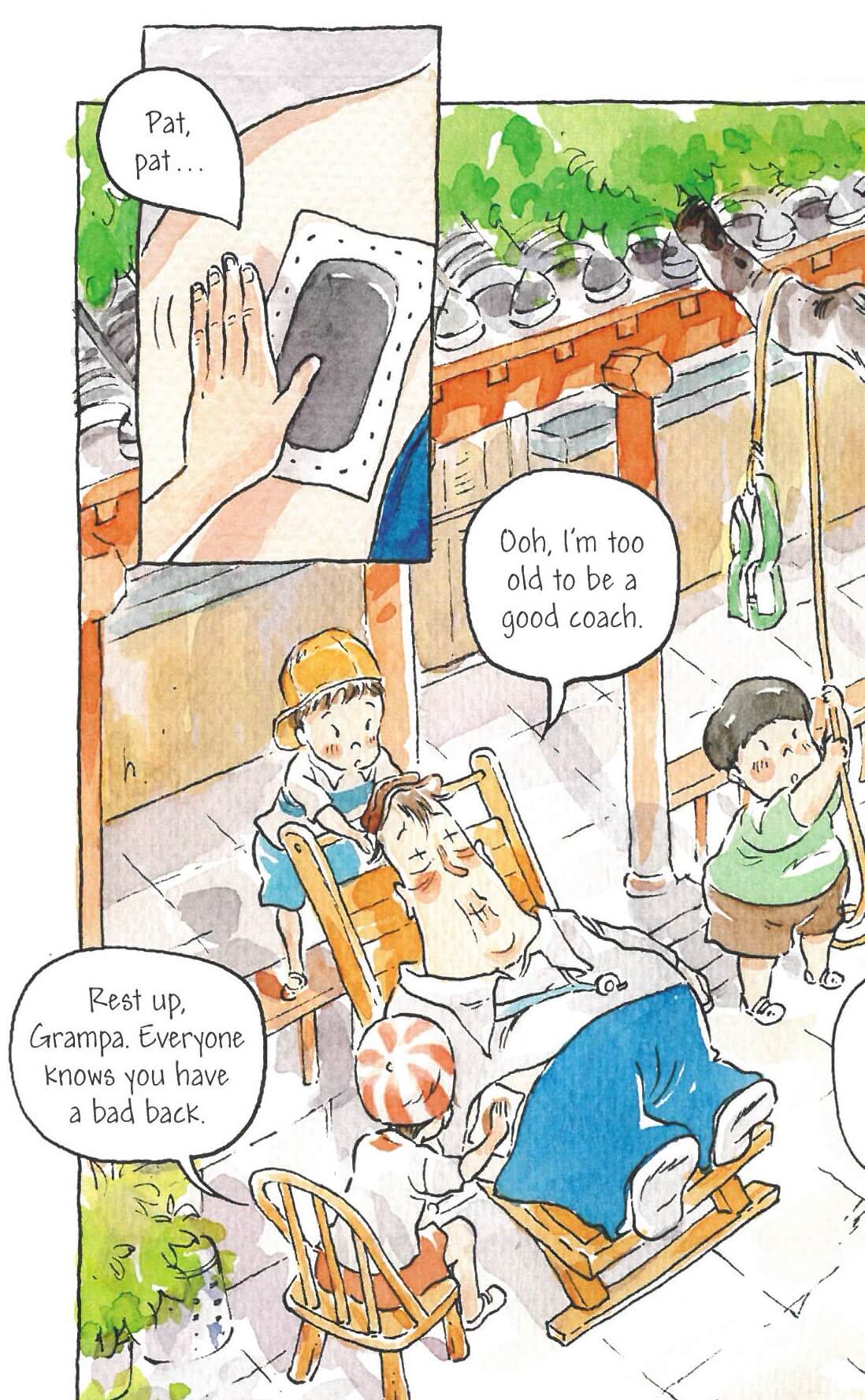
Yu’er does experience bullying and exclusion: she’s not allowed to take swimming lessons at the local pool, and other kids make fun of her. In this sense, she is pushed out of community spaces and isolated because of her disability. But she also finds true friends in the hutong who appreciate her dreams. One of them remarks of Yu’er’s training: “It’s serious stuff. I heard she’s training for the Olympics.” This adorable kid doesn’t distinguish between the Olympics and the Special Olympics, seeing them both as equally of value and as equally challenging.
The last panel of the first short story takes up the entire page: Yu’er is swimming (flying?) through the air above her city. Her disability is never cured, nor is it traumatic for her. These elements alone combine for a radical representation of disability in popular culture, because, as Alaina Leary argues, disability is all too often depicted as causing the disabled character trauma, being a tragedy for them, or needing a cure.
But what’s also really important about this panel is how it ties Yu’er to her city: she floats over her hutong. It’s her Beijing, just like the title suggests. The scene foregrounds her basic claim: that her disability doesn’t make her any less entitled to a relationship to the city itself. It’s a significant claim, given how disabled people are all too often prevented from having such relationships to the places they live via architectural, structural, and other barriers to access. Instead of being erased from or pushed out of public spaces, she is front and centre, definitely not invisible at all. And that visibility has positive effects: the other kids who had formerly called her names now remark on how graceful she is.
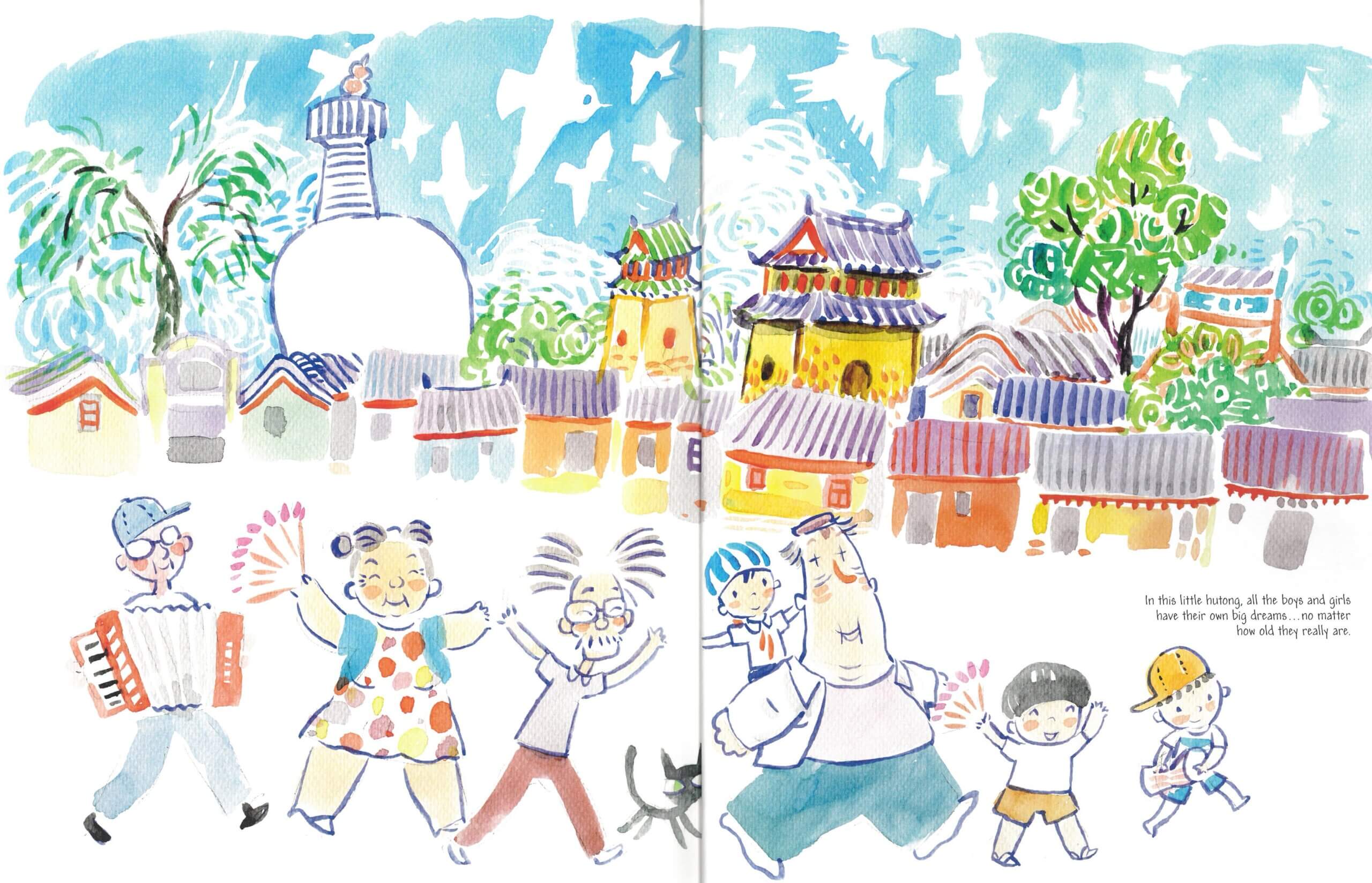
Swimming is one activity in which Yu’er finds joy and connection, and art is another. In the last short story in My Beijing, Yu’er takes up art lessons with an elderly man named Pumpkin. He’s described as grumpy by his wife and has isolated himself from the other families in the hutong. After he faces a health scare, he reconsiders his artistic dreams and becomes an art teacher to Yu’er. Art becomes a key way both of them express and share their joy and wonder in the world around them. No inspiration porn here, just a reciprocal relationship based on a mutual interest. The end of the comic is a two-page spread of one of Yu’er’s paintings, which includes her grandfather and their friends, all under the bright and welcoming canopy of their hutong.
Disability studies highlights the importance of community in shaping access and making inclusion a reality, not just a dream. As the pandemic has demonstrated, we’re all tied to each other in incredibly fragile but beautiful ways, and My Beijing visually shows how Yu’er and her grandfather create a life and a home, wonder and joy, in a Beijing hutong.
Want to do more reading? Amanda Leduc’s amazing book Disfigured: On Fairy Tales, Disability, and Making Space is a good place to start, as is the website Disability in Kidlit. The latter had provided reviews, but is currently on “indefinite hiatus” (the website is still live, so you can browse through their existing catalogue of reviews).
