

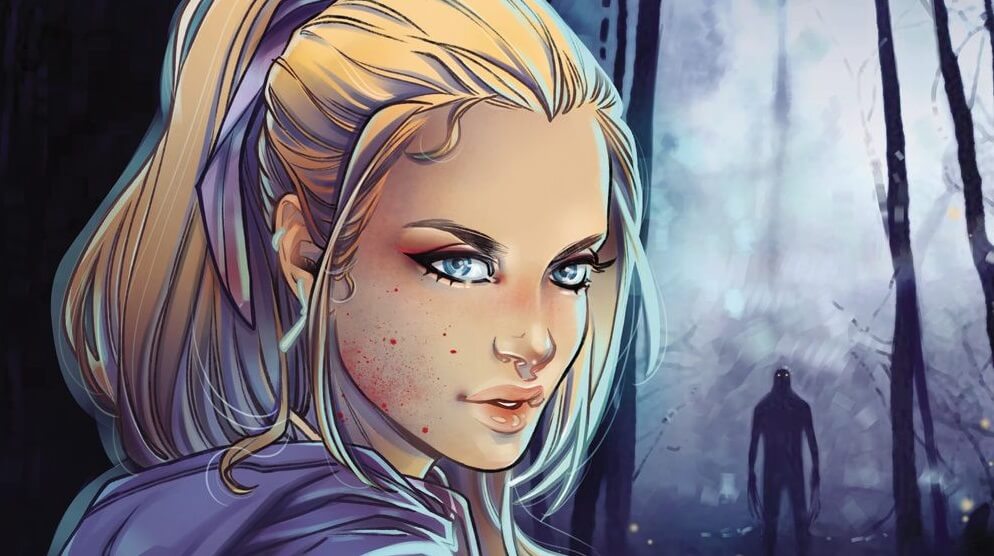
Betty: the Final Girl sports spine-tingling art and gore, but its story lengths come up too short.
Betty: The Final Girl
Carola Borelli (Art); Laura Braga (Art and Cover); Casey Gilly (Writing); Matt Herms (Colors); Megan Hutchinson (Cover); Sam Maggs (Writing); Jack Morelli (Letters); Natalie Nardozza (Art); Micol Ostow (Writing); Ellie Wright (Colors)
Archie Comics
February 15, 2023

Betty: The Final Girl is like a slasher that smash-cuts to its ending a couple minutes too soon. I desperately wanted more from a couple of its stories but they felt too rushed to accommodate the book’s length. The scenarios are creative, and the characters well-written, but I wanted to spend a little more time lingering in its carnage.
The four-story issue brings the slasher genre to the Archie comics world. A “final girl” is a horror heroine (or hero) who survives the serial stalking of the movie’s villain to confront them in a show of bravery at the end of the film. And so it goes for Betty, who is the issue’s central final girl — as are a number of Riverdale’s most fascinating femmes. In the framing story, Betty and Veronica sit for Veronica’s bratty cousin, Leeroy, at Veronica’s family’s “charming little cabin in the woods” — which, in predictable Lodge terms, is actually a pretty sizable and fancy estate. Veronica heads out into a snowstorm to get them food, and Betty babysits Leroy before falling asleep in front of the set in the home theater. Each mini-diversion (and writer and art change) is presented as one of Betty’s dreams.
The most interesting of these stories, “Be Mine or Die” (Borelli/Gilly/Morelli/Wright) pits Brigitte Reilly against a serial killer who’s already murdered nine of Riverdale’s best and brightest young women, leaving valentines before killing them. His next target is Brigitte, but Brigitte comes to the battle prepared. She is well-versed in horror podcasts. I loved a lot of this story, from the art to the gore to the banter she shares with her best friend, Maria Rodriguez. Maria proves she’s a real friend in this one, and the ending is satisfying – but I really wanted to know something crucial to the ending that the audience is never let in on!
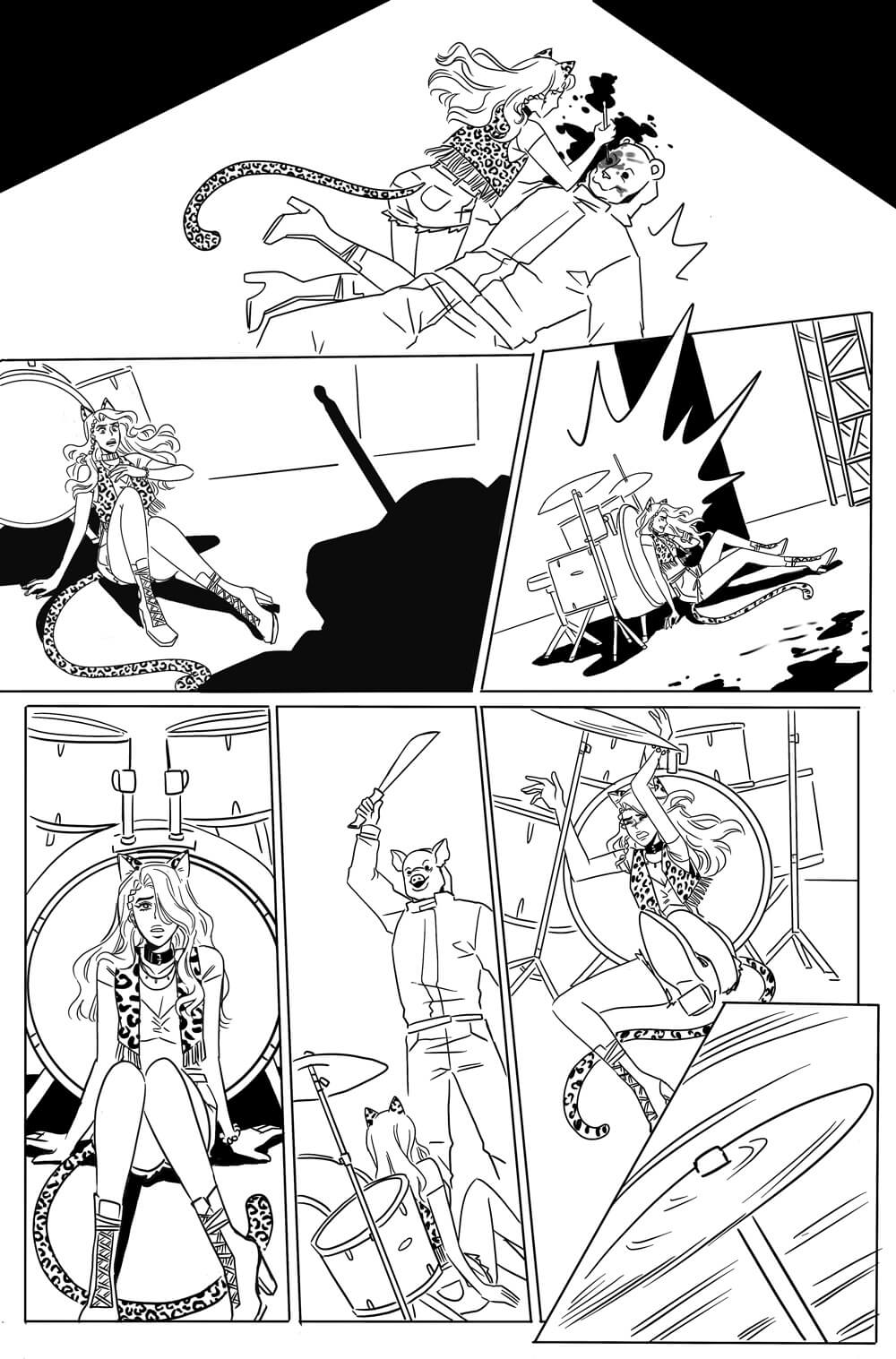
“Melody’s Next” (Maggs/Nardozza/Herms/Moelli) proves to be the biggest disappointment of the issue, which makes me sad as the preview art for it had me pumped to read it. It’s got a great concept – Melody Valentine is stalked during a Pussycats performance by a bunch of bloodthirsty, animal mask-wearing serial killers. Melody’s clumsiness saves the day in a bloody fashion.
But there are more questions here than answers. Why do the rest of the Pussycats abandon their friend and audience to such a terrible fate without a single reaction or protective action? Did the masked killers murder the whole audience? Shouldn’t there be witnesses when…oh well. It’s clearly going for the end-panel joke it wanted, but that joke didn’t land well with me. Arguably, we’re working on Betty’s dream logic here, but it felt misbegotten, a gap in sensibility that spoiled the gristly, awesome fun. A snippet of a fever dream that ought to be more fulsome.
Last of all is “Rosemary’s Babysitter” (Ostow/Braga/Wright/Morelli), which shows us Betty babysitting…a different kid? Yep, we have Rosie, who lives in a fancy smart home and is being watched by Betty. When Betty gets a series of creepy texts after putting Rosie to bed, she assumes it’s Reggie Mantle playing a dirty trick on her. That is, before she finds that body on her doorstep. “Rosemary’s Babysitter” suffers from – well, having no ending at all, as Betty ends up being pulled out of her dream before we find out what happens to Rosie and even this version of Betty herself.
As with “Melody’s Next,” we get a great buildup and a lot of atmosphere that seems to dead-end due to a lack of page space. Betty makes an excellent final girl – she’s smart, resourceful, calm, and tough – but we don’t get to see her in action for very long. And then there’s the wrap-around story, which is beautifully illustrated and provides a fun twist that almost, if not quite, makes sense. In fact, the book at large shows off the potential of the idea but does not allow each story to fully play out. The issue in general needed more time to bake.
The issue’s art definitely isn’t the problem; I love Laura Braga’s take on Betty and Veronica, which makes them often look like blood-laden Barbie dolls. Borelli acquits herself well, too, giving us a freshly redesigned Brigitte, whose curves have been retained but her hairstyle modernized along with her wardrobe. Brigitte also gets to make use of the issue’s most explicit bits of gore. Nardozza goes a little bit more angular with her Pussycats, but she’s no slouch in the blood and guts department either. Morelli, who does the yeoman’s work of lettering nearly every Archie book in print provides something lively here that plays with font sizes, shapes, and colors in a jocular way.
In the end, Betty: The Final Girl takes a stab at perfection but falls a couple of blood-speckled inches short.
