

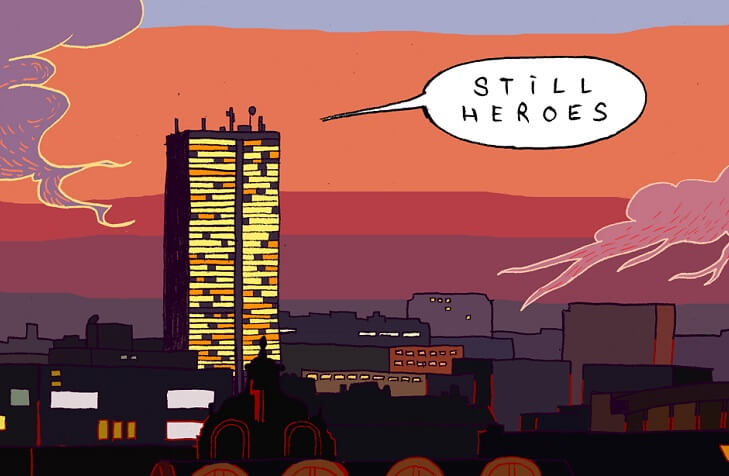
Brussels-based artist Exaheva recently released her interactive digital comic Still Heroes, a tender story of self-discovery that experiments with reader agency in visual storytelling. Readers follow main character Emeline’s struggles after her superhero group suddenly disbands and she finds herself lost for direction. Though seemingly a superhero narrative, Still Heroes touches on intimate experiences with grief, friendship, and love, heightened by the comic’s interactivity and musical elements. A sneak peek was exhibited in the 2021 “United Comics of Belgium” collective showcase at the Brussels Comics Art Museum. The final version of Still Heroes has since featured at comics festivals across Belgium and France alongside Mekka Nikki, a sci-fi series co-created by Exaheva and Félix Laurent.
Exaheva invited me to her studio where we chatted about what digital comics look like to her, the importance of queer representation in her work, and what it’s been like to see both Still Heroes and Mekka Nikki be released in 2022.
This interview has been translated from French. Edited for length and clarity.
Starting with the title of Still Heroes, how would you describe the relationship between the still and the heroic in this comic? [Editor’s note: the title Still Heroes is originally in English]
I thought a lot about the title and actually came up with it near the end of the process! It’s a play on words of sorts and has a few different interpretations. First of all, Still Heroes: in spite of everything that happens to Emeline, she still wants to act in a way that is worthy of a heroine in her daily life. Then there is Still Heroes in the sense of stillness, of calm. I wanted to take on the structure of a superhero narrative, but in reverse, with the beginning having the most action. The story becomes calmer and calmer, settling down along with Emeline herself. It shows the softness, the slowness of the life of a superhero. On top of that, I also thought about the notion of still life in painting. Even in digital form, a comic is made up of moments frozen in time, each frame representing an instant, a photo of a moment, with these moments all superposed to create a story. In the end, I thought that this title reflected both the form and the content of the comic.
Part of what I found so fun about Still Heroes is how it plays with the boundaries of the medium while still remaining distinctly a comic. What was it like telling this story in digital form? How did you approach interactivity as a narrative strategy?
The whole project was based on maintaining the codes of the comic form, and by that I mean a story told through a sequence of panels rather than through full animation. Within that, there are moments where I play around with panels that grow in size or open up when clicked, panels that suddenly appear of their own accord, characters that shift within them, this sort of rhythmic effect. This touches on what a digital comic is to me: it is in keeping with the codes of the comics form, but unsettled by the possibilities that are not fully accessible in the same way on paper as in digital form.
Since my goal was to really stay close to an adaptation of the comic as a medium, I didn’t want it to feel like a game, with winning or losing, with good or bad decisions. People often imagine interactive stories as having choices built into them, but I find that this can sometimes result in focusing too much on the outcome and the “correct” choices that will get you there. Instead, I focused my exploration on interactions, and specifically interactions that add substance to the story and reinforce the readers’ immersion in the main character’s experiences. I asked myself each time: does this interaction reinforce an aspect of the story or an identification with Emeline? If the answer was no, that meant that the interaction was not particularly useful, and I didn’t want to drown the story in superfluous digital aspects. I wanted everything to be really calculated! That’s also why music isn’t always present, and I know that this bothered some people a little.
Oh?
Yeah, this was one of the slightly more negative pieces of feedback I received, which is totally fine of course, but sometimes people found it odd that there was not music or sound all the time. And I can understand that, especially when people are accustomed to visual novels and video games. I went for an approach where the sound should also tell a story, that all of the auditory moments should have a narrative purpose. There are relatively few of them, for that matter. But in moments with music or sound, I wanted people to really notice it!
As a reader, some of the cooler moments were when I lost control of the rhythm of the comic, like when one character interrupts another or, without spoiling anything, when linear time goes a bit wobbly. There is a sort of toying with the readers in moments, though gently!
Exactly! I enjoy putting systems into place, and then once readers are used to that function and start taking it for granted, I might change things up a little bit.
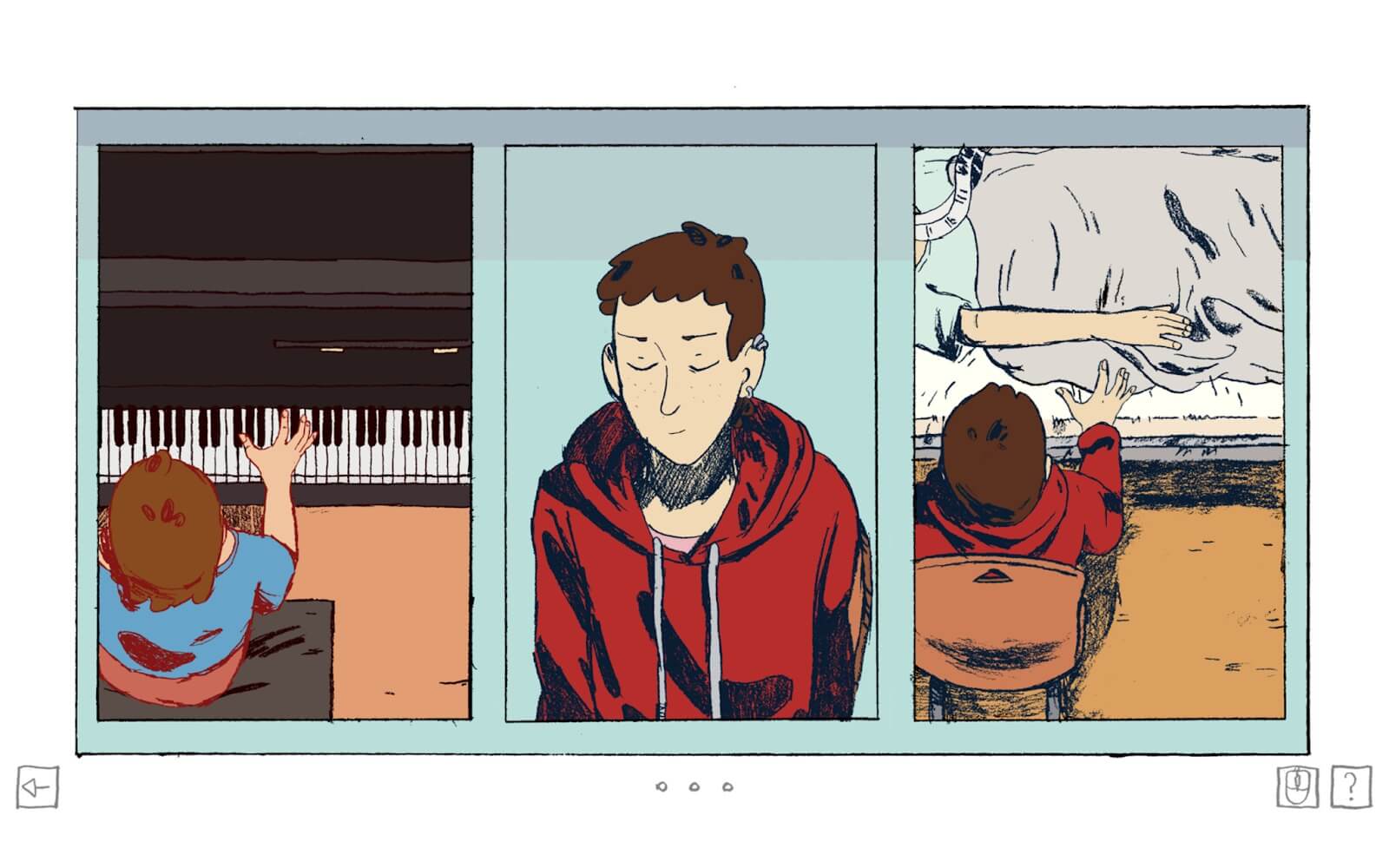
That was one of the big issues for me: I wanted everything to be fluid, without having too many instructions or explanations before the story begins. This was inspired by how well-designed video games can teach a player the rules and systems without them realizing it. You learn things just through playing the game, and little by little the game becomes more complex, but you have also been learning and progressing at the same time. In a digital comic, the more mechanisms there are, the more complicated it becomes to render them fluid. That’s why I did a lot of beta testing on Still Heroes with a wide variety of people. In the beginning, there were no instructions at all, and I wanted to see what would happen. It did end up stumping people at times, so I ultimately added a short introductory sequence using piano keys to show that it was possible to interact with them and to hear the audio output. Then in the first interactions of the story, if you don’t click after a certain amount of time, there is a little “click here” animation that appears, since a few people got stuck at the very beginning. That also involved some testing: how much time should pass before the little click-here animation appears, before too much frustration builds in the reader?
Something that connects Still Heroes to Mekka Nikki and your online comics like Slowly is a sort of subdued queer joy that runs through them. What is the importance of queerness in its different forms in your work?
It’s worth noting first that both Still Heroes and Mekka Nikki are stories I started working on years before I came out publicly, so in a way I connected to the characters I invented and explored my own trans identity through them. In terms of queer representation generally, what I really like and what makes me super happy is when things are represented in a way that’s soft, that’s simple, that can be purely beautiful, without commentary or justification. Of course it’s important that more explicitly activist or militant books exist and I have great respect for that as well, that’s just not how I personally approach things. I want my characters to live their lives, talk about other things, and have their queerness be one aspect of their personality and not the only one. Without giving any spoilers, there is a trans character in Mekka Nikki, who is also the character who represents me the most since she developed throughout the story and followed my own growth. And although that’s not the main point of the story, it’s important to me that young trans people who read this comic can also think to themselves, huh, it can actually be as simple as that. Sometimes everything just seems so complicated, so burdened with meaning.
In a way, I make the comics that I would have wanted to read when I was younger. I did read plenty of great comics, but my life could have gone differently had there been more queer representation in comics, especially where it was treated as being something normal. Teenagers and young adults in particular, often girls and non-binary readers, have told us how great it was to come across these characters, and that is really encouraging and makes me so happy. I wrote these characters because I wanted to, because they felt important to me, and it’s so cool to see them resonating with people today.
How would you say your work is influenced by Franco-Belgian BD, Anglophone comics, and/or manga traditions?
I would say that a lot of my inspiration comes from manga, which was in a way my first real aesthetic shock as a child, and also the first vaguely queer representations even if it all was very hidden. I am definitely influenced by Japanese narrative structures, by the dynamics of the narration. I try then to insert my own values, precisely the ones that I did not necessarily find in the stories I grew up with. American cartoons from the beginning of the 2010s like Steven Universe and Adventure Time, that whole vibe, also influenced me and brought me a new vision of how to tell stories while being a bit subversive, that is to say subverting the classic narrative scheme. And then of course I have an attachment to Franco-Belgian BD even if the older institutions can have a hard time separating themselves from the older classics and moving forward. I don’t want to put anything down that came before me though, not at all, especially when that’s the whole world that constructed me. We just build off of things without necessarily erasing the past.
Are there any particular comics bringing you joy at the moment?
I would say that comics made by my friends here in Brussels always bring me joy. It’s really cool to read a comic made by somebody you know well, who you saw sweating, doubting, worrying it would suck, and then you finally see the comic and it’s just marvellous! It’s hard to list them all, but many were involved in a collective exhibition we organized. Otherwise, plenty of queer indie manga, one being Love my Life by Ebine Yamaji.
Still Heroes is available in English and French on itch.io and Steam. Episodes of Mekka Nikki have been translated into English at Attaque Surprise. Exaheva also regularly publishes short comics and illustrations to Instagram, @exaheva, and Tumblr.
