
In our Editorial Eye series, we go behind the scenes with comic and book editors to learn about their role in the creative process and discover how their passion for their industry helps shape their work.
Karen Berger is running the show at Berger Books, and that’s great for comics. In February, I had the opportunity to chat with legendary editor Karen Berger about her imprint at Dark Horse, Berger Books, which celebrated its 5-year anniversary in January . The imprint is in many ways the culmination of a dream, which Berger summed up as: “I wanted to get my hands dirty again.” Berger’s decision to leave Vertigo Comics ten years ago now seems to have been in part due to the editor becoming a victim of her own success. Berger explained to me that, “The line became so big, and I had several editors at various times, over the course of the 20 years, that I didn’t do a lot of hands-on editing. It was more working on acquisitions and working with editors on helping them develop the projects when I first got them.” That was something that Berger had missed.
When I imagine what being an editor at the height of Vertigo comics looked like, I see The Daily Planet newsroom from Richard Donner’s Superman. The hustle and bustle and chaos of meeting deadlines and coordinating stories. But instead of Perry White there’s Jenette Kahn as editor-in-chief. “Jenette is really the person who’s responsible for the explosive creativity that happened in the eighties and the nineties,” Berger explained to me. “It was all Jenette. If it wasn’t for her, we wouldn’t have had the backing and the support and the person in charge encouraging us to be fearless and to take creative risks.” Taking creative risks wasn’t just a goal under Kahn’s time as Editor-in-Chief, it was an editorial mandate. In a 2001 interview with Sequential Tart, Kahn shared the anti-capitalist benchmarks for creativity at DC during her tenure at the time, stating: “From the beginning we encouraged both our editors and writers to take risks. It was a DC maxim (and I hope still is) that if you weren’t writing off a certain amount of material each year as unusable, then you weren’t doing your job. If everything you did was publishable, you weren’t taking enough chances.”

Although it shares a similar confluence of economic and organizational factors that created the unprecedented creativity and experimentation that was the Vertigo Age, it’s apparent that Berger Books is operating on a very different model by exclusively publishing original graphic novels, and that is something special. At Dark Horse, Mike Richardson has created an environment that enables Berger to work in this capacity and without being beholden to a larger corporate agenda as she was at DC and Warner Bros. Berger is openly appreciative of that, and of Richardson.
If there is an element of artistry in the laborious task of project management that is editorial work, it is in the ability to envision a story as the best possible version of itself. But helping a writer tell the best story doesn’t necessarily mean providing feedback on drafts. Sometimes it can be having conversations about elements in a story that will never be made explicit in the text. This is where the editorial magic happens–in places outside the page. In our conversation, Berger describes one such scenario: “If I feel that there needs to be more character development, then we can talk about that. We can talk about what the character’s backstory is and why they are doing it–what motivates them to do what they are doing in this story. And not even all that stuff has to even come out in the actual script itself. But you need to have a character that’s well-informed and well-structured. Silently structured, even. Grounded. Just to make them believable characters and relatable characters.”
This kind of support isn’t editing, but it’s the work of an editor. Much in the same way that mentoring new talent is not found in the job description, but it also seems to be another of the hands-on part of the job that Berger enjoys most. I mentioned to Berger that I read a profile by Berger’s alma mater Brooklyn College, where there are statements from G. Willow Wilson and Phil Jimenez about how their success at their craft is in no small part due to the personal attention paid to them by Berger in their early years, and the fondness in her tone is evident. Jimenez described meeting Berger “briefly at a convention, and when I moved from California to NYC to attend college, I immediately called her up at DC Comics (which is just what a young novice would do) and asked if I could see her at the office. Surprisingly, she said yes, and after a few failed attempts, I finally got to visit her there.” This in the mid-80s. “He was sixteen,” Berger replied. “And he lived in California. He used to come with his mom to New York. And he’s so sweet.”
Although Berger is most often connected with the writers of the Vertigo books at the time–including Alan Moore, Neil Gaiman, and Grant Morrison–her editorial approach has always been mindful of comics as visual art. “It’s really interesting and it’s kind of ironic,” Berger observed. “Comics had always been an artist’s medium, for obvious reasons. And when Alan Moore came in, he really changed the whole outlook of how the writer is really driving the boat here.” The British recruitment drive of the mid-1980s that Berger embarked on was decidedly writer-focused. “But it’s a medium, man,” she added, laughing. “It’s a format with filmic aspects to it, but in a format and in a storytelling mode that’s distinct unto itself,” Berger mused. “There is something wonderful about comics that you really can’t find in any other storytelling medium. I mean, you can slow it down. You can ponder a page. You can ponder a line. The confluence of art and the way that art echoes with words is just a fabulous thing.”
Berger reads comics as a visual medium, and for her, the art is not a secondary concern. She says, bluntly, “You know, I don’t care how well a story is written. If the art’s not good, I’m not going to read it.” And the list of artists from the early days of Vertigo were just as unconventional, experimental, and talented as the writers they were paired with. “So many artists were kind of just experimenting and breaking the mold,” Berger agrees. “From Dave McKean to Duncan Fegredo, to some of the photographers I worked with like Gavin Wilson who did the Sandman Mystery Theatre covers and Steven John Phillips.” When asked about how her affinity for modern art influenced her editorial practice, Berger says, “That philosophy in terms of working with artists who don’t draw like everybody else, who want to try different styles but keep the story relatable, has really been part of my editorial philosophy, and it’s something that I just took on with me to Berger Books.”
The first wave of Berger Books did contain titles from creative teams that included people who Berger worked with at Vertigo, like Peter Milligan, James Romburger, Devin Grayson, Ian Culbard, and G. Willow Wilson, as well as longtime friends like J.M. DeMatteis, who Berger credits with getting her into comics when they were both in New York in the late 70s. Thanks to the creator-owned model of the original Vertigo titles, Berger Books has also been able to publish new editions, called Essentials editions, of some of the original Vertigo titles that were out of print, like Dave Gibbons’ The Originals. Berger Books also published a prequel to the Vertigo series Incognegro by Mat Johnson, Incognegro: Renaissance. But it’s not only that.
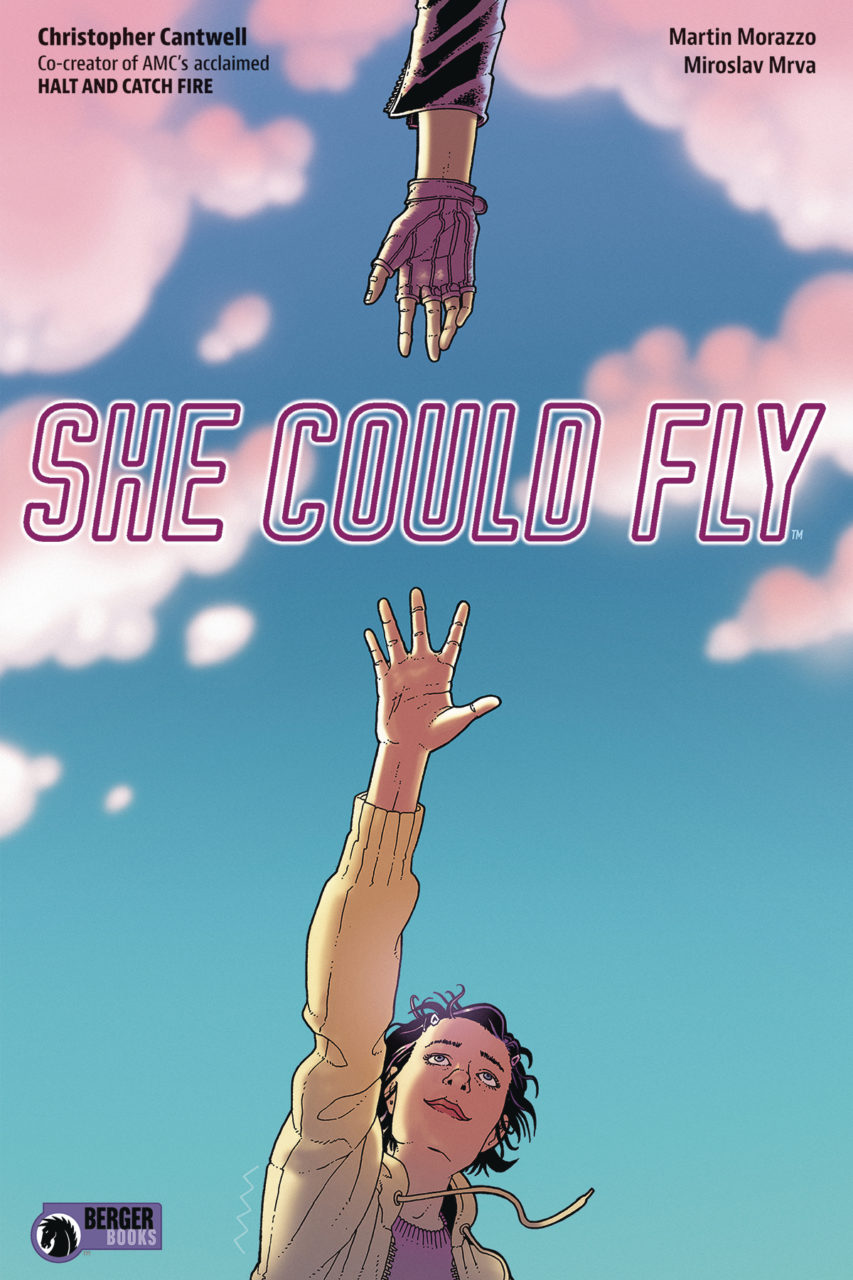
With the career she’s had, Berger could only publish stories with creative teams entirely composed of people she has worked with before for the rest of her life and never run out of new people to work with, but that’s not the goal. “When I started Berger Books, I wanted to specifically work with more women and also with more people who are underrepresented in, you know, in, in the creative arts,” Berger says. In January I interviewed Amy Chu and Soo Lee, the creative team for the January Berger Book release Carmilla. Neither had worked with Berger before, but both had jumped at the chance. Other new Berger Books writers and artists include David Aja, Tana Ford, and Christian Ward–who have all previously worked at Marvel. Berger’s ability to recruit new talent from other media has also continued at Berger Books. Prior to his comics debut, She Could Fly, Cantwell was best known for the AMC television series Halt and Catch Fire. Now, Cantwell is a successful writer on multiple Marvel comics titles, and his Doctor Doom series was nominated for the Best New Series Eisner Award in 2020.
Prior to the pandemic, Berger Books put out single issues of the miniseries serially, but then the pandemic happened. The complete shutdown of production gave everyone time to rethink their lives. It gave Berger time away from the month-to-month grind, and a little bit of clarity, it seems. While the other monthly comics at Dark Horse have started up again, Berger Books has shifted away from that format entirely–on purpose. “From a stress aspect and also time management after being on that monthly track for so many years, it was nice to be able to kind of recalibrate my life and my work schedule,” Berger admitted.
Her comment reminded me of the same kind of relief and a-ha moment expressed by traditional television showrunners who move to streaming. Eric Kripke, the showrunner of The Boys, when asked if he would ever go back to the network model of TV in an interview with Variety, was quoted as saying: “I can’t see ever going back to network. It’s the ability to do two things: have most of your scripts written before you shoot a day of film, and then have all the episodes finished before you turn them over to air.” This model of production is not merely a logistical luxury to better manage budgets, but one that allows for a fuller realization of the showrunner’s overall artistic vision for the series. While different editors have different approaches, the showrunner model is the best analogy for the work that Berger does, in terms of both logistics and creative scope. To be able to edit an entire story, in whole, without the pressure of monthly deadlines affords Berger the ability to take her visionary abilities to the next level.
We should all be excited for what it means for the next wave of Berger Books, and let’s be clear. Berger Books is not Vertigo 2.0. It’s The Karen Berger Show. It’s not a boutique imprint. It’s prestige television. And Karen Berger is the editor. But she is is also the showrunner. “With Berger Books I just wanted to have my own little world, you know, just me. My husband Richard Burning is the art director and graphic designer, and he was creative director at DC for many years and design director there as well before that. And I also have a wonderful assistant, Rae Boyadjis.” Boyadjis was recently promoted from Assistant Editor to Associate Editor in 2021, but that should not be taken as a sign of forthcoming expansion. There will be no jumping of sharks in the future. At the end of the interview, Berger is clear that she’s more than happy with the way things have turned, post-Vertigo. “I just wanted to have my own little thing, you know? I don’t want it to get too big. I kind of like having something that’s kinda warm and cozy.”
