
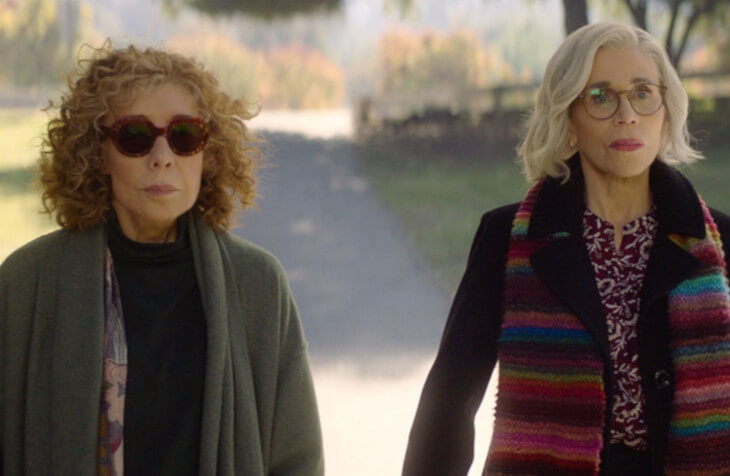
In Paul Weitz’ Moving On, Claire (Jane Fonda) and Evvie (Lily Tomlin) reunite at their mutual friend’s funeral and combine forces to complete a mission. Will they go through with it?
Moving On
Paul Weitz (director and writer), Tobias Datum (cinematography), Hilda Rasula (editor)
Jane Fonda, Malcolm McDowell, Lily Tomlin, Richard Roundtree, Sarah Burns (cast)
September 9, 2022 (TIFF)
Content warning: Sexual assault
The success of Grace and Frankie has led to Jane Fonda and Lily Tomlin reuniting for Moving On, a story about two friends, reconnection and revenge written and directed by American Pie director Paul Weitz.
Claire (Fonda) arrives at her old friend Joyce’s funeral, but her first and only words to Joyce’s widower Howard (Malcolm McDowell) leave him and the audience speechless. It’s obvious Claire does not like Howard, but we’re left wondering why? That’s a mystery that isn’t hard to solve, but once the truth is revealed in all its details, it’s uncomfortable to face.
Claire reunites with Evvie (Tomlin) at the funeral, and the two of them rekindle a friendship that’s seen better days. Claire has a mission she must accomplish during the funeral weekend in California and, despite her reservations, Evvie agrees to help. Along the way, Evvie becomes more open about her life circumstances with Claire — but Claire’s arc involves her reigniting a romance with Ralph, a man from her past. You see the problem here, right? There’s a disconnect between Evvie becoming closer to Claire while Claire is looking elsewhere for love. And once again, the prominent romance is straight, while the queer one is over and written like an afterthought. Credit where it’s due though, these kinds of dramedies usually don’t feature Black actors, so seeing Richard Roundtree pop up was exciting.
Moving On does not go as expected, which is surprising considering the very first scene is a comic trope done to death in modern cinema. But the events after that are… unique, is one way to put it.
From looking at the promotional materials one might expect this film is some kind of sweet story about friendship in our senior years, but it isn’t. See, this is why I usually don’t go into a screening with expectations of the story and characterizations, but I somehow let my guard down with this film. It’s much darker than the promotional materials would have you believe, but it lacks heart. What does work in the film is its practical look at growing older and how age can change your way of life. There are a few jokes thrown in about aging, but I never felt that the jokes were aimed at the people getting old; the jokes were more about the act of getting old. Yes, arthritis might mean you can’t do particular things, but it can also mean you make connections you may never have made otherwise. Thankfully Paul Weitz includes such elements with sincerity, not maliciousness.
There are a few cliches though, including a cringeworthy funeral scene. Hollywood really loves making those. The film also fails to grasp its tone or style. Given the dark subplot, the humour that is a staple of Paul Weitz’ earlier output feels out of place at times. There are some storylines that don’t need to be couched in comedy. But for the most part, where the story in Moving On failed, at least the jokes make you laugh.
I did struggle with how the film follows multiple points of view but they only emerge when needed. This gives the film a disjointed, scattered feeling. We learn a lot about Evvie, who is a captivating character, but she seems to be written to serve the plot, not the other way around.
However, Lily Tomlin looks like she’s thoroughly enjoying playing her multi-layered character. Malcolm McDowell is well cast as Howard, but again, the comedy with and around him doesn’t work at all because of what his character has done–one can’t laugh at or with Howard because we know what a horrible person he is, even before the truth is revealed. Jane Fonda seems too restrained. I expected much more from her in this role. Claire lacks dynamism, but Fonda’s comic timing is on par with Tomlin’s, so the performance isn’t a complete write-off. Richard Roundtree has curtailed screen time, but he brings so much panache and suaveness to the film. I could have watched him talk for the entire run time.
Because Moving On misses the mark when it comes to tone and story, it’s hard to walk away from the film with concrete feelings about it. The film is funny, but it lacks the tenderness and chemistry audiences have come to expect from the Fonda-Tomlin dynamic. The film also tries to pack in way too many elements, including social commentary about everything from class, women’s agency, and sexual dynamics to queerness, and the script starts chasing several threads at once and ends up reaching an unsatisfying conclusion for all. Was there a good film hidden within? I think an effort was made to share a story and send a message, but that’s about the only thing we can take away from the film. The problem with Moving On is that it never quite accepts what it could be, and fails at what it wants to be.
