

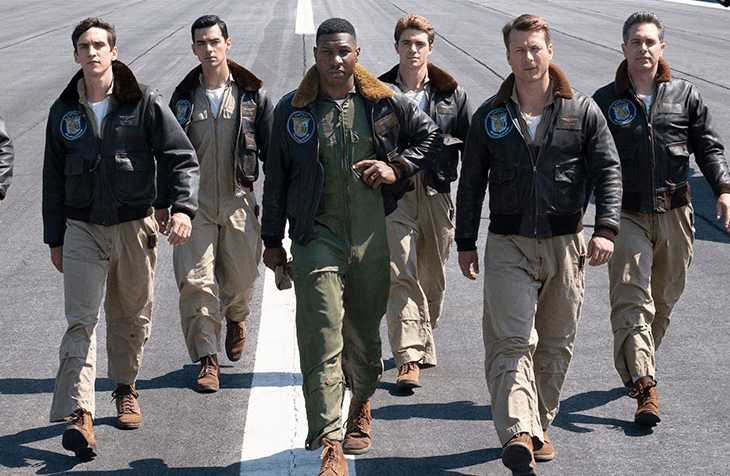
Devotion tells the story of Jesse Brown (Jonathan Majors), the first African-American aviator, his wingman, and fellow pilots as they are called upon to risk their lives in the Korean War.
Devotion
JD Dillard (director), Jake Crane, Jonathan A.H. Stewart (writer), Erik Messerschmidt (cinematography), Billy Fox (editor)
Jonathan Majors, Glen Powell, Christina Jackson, Thomas Sadoski, Joe Jonas (cast)
September 12, 2022 (TIFF)
Content warning: Racism, racist language
Devotion brings the life of celebrated aviator Jesse Brown (Jonathan Majors) to the screen. I assume at least some Americans will be familiar with Brown as he was the first African-American aviator to complete Navy training, but since I’ve lived in several countries, each with their own histories, Brown’s story is new to me.
The film, based on Adam Makos’ book Devotion: An Epic Story of Heroism, Friendship, and Sacrifice is sad, heartbreaking, and poignant. History has a habit of forgetting how much communities of colour achieved and sacrificed in the past, and it’s important that films like this one tell these forgotten stories.
In Devotion, Brown is introduced to the audience through his eventual wingman, Tom Hudner (Glen Powell), who joins the squadron as they’re on the cusp of being commissioned to join the Korean War. Brown is antagonistic towards Hudner from the get-go, but Hudner isn’t daunted.
Brown is different from the rest of his cohorts—not only is he a Black man in an all-white squadron, but he’s also the only one who is married with a child, and he’s conspicuously missing from the lavish parties thrown for the squadron. But Brown is a cut above the rest, and he doesn’t let the racism of the time stop him from achieving his dreams.
Devotion is part historical journey and part action film. I ended up at an IMAX viewing of the film at the 2022 Toronto International Film Festival, and that kind of screen really does suit the flight scenes well. From all the TIFF viewings I attended, watching Devotion in IMAX was the most immersive experience for me, which is probably why the film had an even more emotional impact than I had expected.
But despite the spectacle, the flight scenes just weren’t that interesting to me. This was my problem with the original Top Gun film as well—the spectacle of flying doesn’t grip me as much as the people who are piloting. In Devotion, I would have gladly spent an extra five minutes with the characters interacting with each other than another scene of them flying their craft through the air.
The trouble with IMAX screens is that they are notorious for darkening the image, so a lot of the time the actors’ faces were hidden in shadow. There was definitely a lot of nuanced acting in Devotion that I just couldn’t make out despite squinting non-stop. One powerfully emotional scene was completely lost in the dark screen! The times I could see the actors, the acting was good, but understated. Majors and Powell deliver solid performances but the rest of the cast was unmemorable.
There were a couple of moments, however, where the performances confused me. During the second act, there is a shocking moment that is expertly executed. But, the reactions of the characters were all over the place. Was one character heartless? Did the second character not realize the significance of what he’d witnessed? What was going on there?
Devotion is generally well-paced and compelling and the ending is so heartbreaking that you will end up crying. But the execution is muddled. Why start with Hudner’s point of view when it’s Brown’s story? And the third act makes a meal of being a character study by introducing multiple points of view, thereby making Brown a passenger in his own story.
It’s obvious that the screenwriters were trying to get through as many story beats and plot points as possible, since the creators forgot to develop the central relationships. Tom and Jesse’s friendship is pivotal to the denouement, yet, they spend more time fighting and arguing than spending time with each other and being friends. The final act would have been even more powerful if the connection between the characters had paved the way for those final scenes.
I feel the same about the rest of the cast. The squadron that Brown and Hudner are part of felt more like wallpaper than actual characters. It doesn’t help that aside from Powell and Majors, every other main character in the film looks exactly the same. They’re all dark-haired men with chiselled faces and cocky attitudes. I couldn’t tell them apart, so their dynamics were completely lost on me. What was their particular relationship with each character? I feel like we deserved to see their uniqueness.
Devotion is unflinching in its portrayal of racism in the US and beyond in the 1950s. It’s not easy to watch, but these scenes are a reminder of how hard heroes of yore fought for the little progress that’s been made up until today. I am glad that the filmmakers chose not to showcase Brown’s entire life and the hardships he faced, instead showing him at the top while still trying to better himself.
Without spoiling anything, the climax of the film was a surprise. I didn’t see that ending coming, but the way it happens struck me as both intriguing and odd. I view the denouement as an act in three parts—the inciting incident, the saving grace, the finale. The first was poorly paced. The second was beautifully shot. The third was intense and heartbreaking. This was all brilliant to watch, but like the rest of the film, muddled.
Devotion needed to spend more time building the characters and choosing a point of view. The best parts of the film are the character interactions, especially the way they are allowed to be emotional and affectionate, despite being in the navy. This is a story that needs to be told, and it’s better late than never.

