

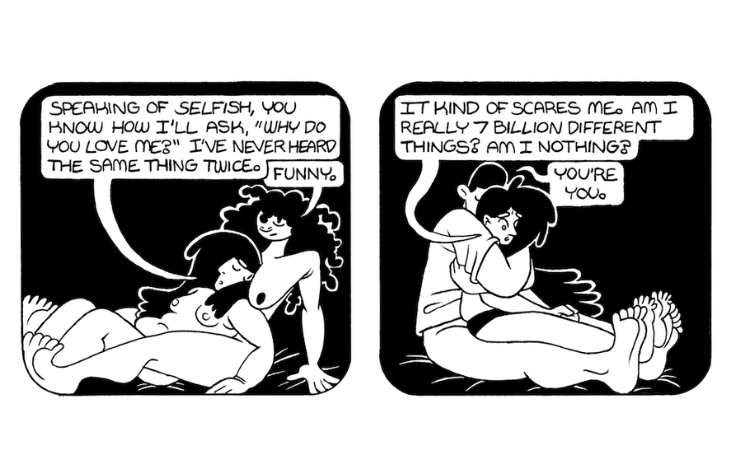
The Lover of Everyone in the World feels like a thought experiment – what would it be like to feel real, romantic love for every person on earth? What would it mean to be in that many relationships, and to feel that much real love for such a wide variety of people? How would it impact people to share a partner with everyone in the world?
The Lover of Everyone in the World
Beatrix Urkowitz
Parsifal Press
May 2022

There are four parts to this comic: “The Lover of Everyone in the World,” “The Lovers of the Lover of Everyone in the World,” “Everyone Breaks Up with the Lover of Everyone in the World,” and “The Annoying Person.” The first part was originally published in 2018, the second two together in a zine in 2019, and the fourth separately but also in 2019. “The Annoying Person” differs in many ways from the rest of the book, but its inclusion feels right. I think it posits a question very much related to the questions at the core of the whole collection, but we’ll get to that. First: The Lover.
Urkowitz does not introduce The Lover with a name; she is simply The Lover. In the first comic, we see her with a different partner on each page, asking questions about how they feel about her, the nature of her relationship with them, and the nature of her relationship with everyone. The Lover of Everyone in the World is a small, square book and each black and white panel takes up a single page, so each lover initially gets their own small space – their own little world in which they should get to be alone with The Lover. However, The Lover is never fully separate from anyone. She expresses guilt and worry on each page; she seems to be in a constant state of apologizing. She gives so much, physically and emotionally, but she can never give enough.
In this first part, each page/panel feels deeply intimate, despite The Lover’s anxiety. Urkowitz’s illustrations are concise. There are no backgrounds, just cleanly drawn figures on black ink. The panel outlines have curved corners, so there is no sharpness present – only the softness of intertwined bodies. The Lover gently touches or holds her partners, and they hold her as she spirals into an identity crisis. Each panel has a warmth, even a heat generated by the intimacy of the scene as well as the intensity of The Lover’s worry.
my graphic novel "The Lover of Everyone in the World" is now up for an Ignatz Award. here is the first story (titled simply "The Lover of Everyone in the World") from that book. [continues below, 1/6] pic.twitter.com/RXn7sPtB1N
— Beatrix Urkowitz (@bmfu) August 25, 2022
In comparison the second part, which focuses on her lovers, feels cool. Not cold, because it’s clear the lovers do really love The Lover, but the panels are no longer a window into an intimate moment. Instead, they feel like a snapshot of a question answered during an interview about The Lover. Each of these people has a luxury The Lover cannot afford: time alone. Except for a pair that The Lover always interacts with together, each person has a single panel/page of time to reflect on their relationship with her. Unsurprisingly it’s not all roses, especially as Urkowitz broaches an awful and inevitable point: if The Lover loves everyone, that means she loves abusers, and the survivors she also loves have to live with that fact.
This point arises again in the third part, “Everyone Breaks Up with the Lover of Everyone in the World.” Finally, we see The Lover take up her own space on the page. She’s slowly getting dressed, pulling on a pair of tights, as a series of overlapping word balloons that connect to unseen people off-page break up with her. Among their reasons for doing so is the simple, unbearable fact that she loves people who have harmed her lovers. “But I don’t love them for beating you!” she proclaims, one foot in her tights, one hand earnestly on her heart. Just overlapping her elbow is the series of word balloons bearing the horrific response: “But we were right to beat them.”
The Lover is a whole person; in the breakup comic, when she is finally alone and acting of her own volition, Urkowitz even reveals her name – Julie. However, she is also an experiment in extreme empathy. It’s important to note here that The Lover is shown on the very first page to have breasts and a penis, implying that she is trans. Urkowitz must have a specific reason for showing us Julie’s naked self immediately; her art is very focused, and the choice to give each panel its own page pushes the reader to take in every detail. So, why do we need to know that Julie is trans? Because if anyone is capable of crafting a unique and endless series of relationships it is a person who is constantly demanded to empathize, and that is trans people. We are the ones that are forced to understand. People struggle with our pronouns, our style, or the way we move through the world, so we’re the ones who have to give them time and grace.
It requires a bottomless well of empathy to love absolutely everyone, but how does one acquire such empathy? Julie has said yes to every single plea for understanding, but doing so requires extreme denial, because loving everyone doesn’t just mean experiencing every possible joy. It also means experiencing every kind of toxicity possible. And if one is willing to remain in every single type of toxic relationship, to still love and forgive every toxic person, it follows that they are willing to continue loving them even as they abuse others.
And then there is “The Annoying Person.”
"The Annoying Person" originally appeared in @TheLiftedBrow, and is part of "The Lover of Everyone in the World," available here: https://t.co/bVEswdZnn4 pic.twitter.com/pACOMBXH5i
— Beatrix Urkowitz (@bmfu) March 28, 2020
The Annoying Person is, in a way, The Lover’s complete opposite. She inserts herself into every relationship and situation, but leaves no room for others. She sings so loudly at karaoke that she drowns out every conversation, request and feeling. She forces you to watch whichever TV show she wants to watch and laughs endlessly through it, not caring if you like it. She fails to provide adequate customer service at her job. She is oblivious.
The Annoying Person isn’t a bad person. She’s an activist – an annoying one who wears weird costumes to meetings, but she shows up. She brings good wine to a causal hangout. She’s a fun roommate, she just never cleans. Unlike the previous comics, Urkowitz creates a nameless narrator who describes The Annoying Person in each panel. However, this narrator lacks empathy and curiosity. To them The Annoying Person is no more than her epithet, and when she reaches out to acknowledge her loneliness, the narrator simply finds a reason to escape. Perhaps the right balance between The Lover and The Annoying Person is someone who has empathy but also knows how to put themself first, a feat the narrator doesn’t achieve.
There is so much more to this comic. It’s a short, seemingly simple read but I could go back to it again and again, pondering these cautionary tales about the limits of and need for empathy. Urkowitz never shows us what Julie eventually derives from experiencing history’s most intense and all-consuming relationship; we last see her as she walks away from a bar immediately post breakup. We don’t know what she’ll do next, or what kind of person she’ll become. Maybe she’ll learn something from The Annoying Person, or maybe I’m wrong – maybe the right lesson here isn’t that Julie needs to put herself first. Urkowitz doesn’t give the reader a simple moral, just a scene of Julie, miserable, leaving behind all the people that have loved her, except for her self.
While Urkowitz has left me much to ponder, she has not left me wondering why she earned an Ignatz nomination. The Lover of Everyone in the World is a brilliant meditation on love and empathy, and I am going to sit with it for a long time.
