

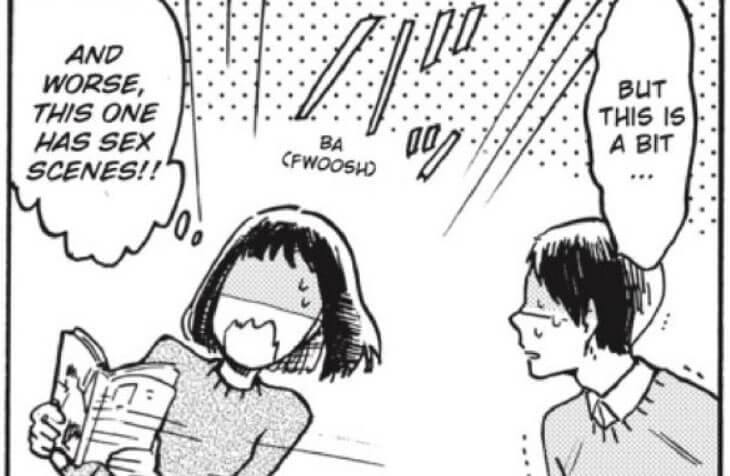
The premise for I Want to Be a Wall is too great to not garner attention. An asexual, aromantic boys love (BL) fan marries a gay man still in love with his childhood best friend. The first volume of this quirky manga is a sweet slice of life story about a married couple who will never be attracted to each other.
I Want to Be a Wall
Honami Shirono (creator), Emma Schumacker (Translation), Alexis Eckerman (Lettering)
Yen Press
17 May 2022

When I read the premise, I hoped the book would fall into a group of manga that I have come to adore. I call it “married couple, with a twist”. It’s where I categorize series like The Way of the Househusband and The Full Time Wife Escapist. And I’ve heard Spy x Family may fall into this too but I’ve not experienced that series yet.
As much as I love the previously listed series, my fear with each is that the twist, gimmick, or quirk will outweigh anything else. And that after a chapter or two, the quirk will no longer interest me. However, I Want to be a Wall (like the others) doesn’t rely on the shock of its twist. Instead, the married-but-never-attracted-to-each-other premise is just the start of the story.
While this introductory volume makes sure that the audience understands that premise, Shirono doesn’t use it for gags or laughs. Instead, the characters and the volume just see it as the state of things. Moving from that starting point, this volume suggests that the series will be one filled with love and care. Even if our protagonists don’t fall for each other.
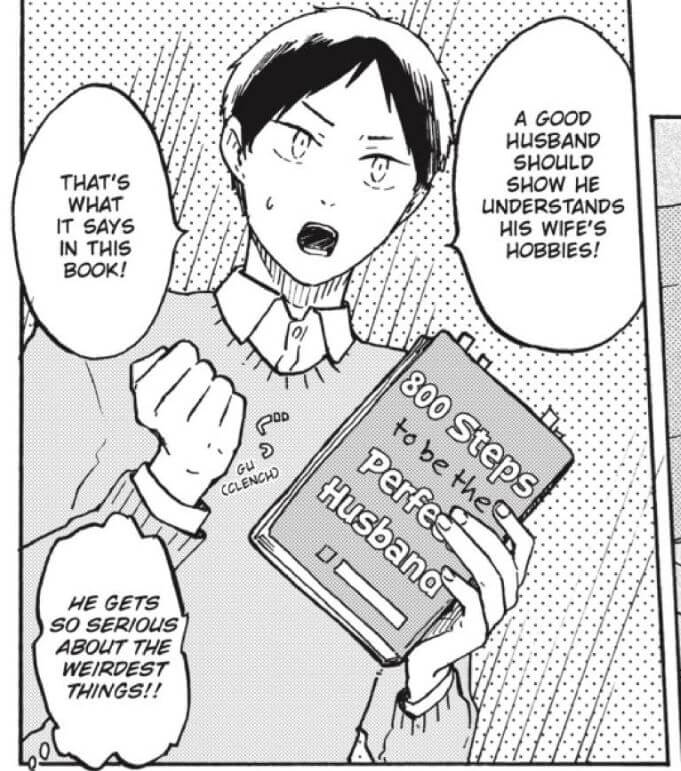
We see this desire to care for each other at various points in the book. The first is when Gakurouta (Gaku for short, the husband) appears with the husband-help book 800 Steps to be the Perfect Husband. His stance with a clenched fist and the action lines, demonstrates his determination to be the best husband he can for Yuriko (his wife). And he’s taking on this duty with no expectation of reward.
What I love about this is that this scene appears in the first chapter and then again almost 100 pages later. The book reappears when Gaku is disappointed that he didn’t walk Yuriko home from the train station. Contrasting the first scene, Gaku’s face is closed up and sad. The image illustrates his dismay at missing the chance to practice what he had learned from the book.
Such moments, invested me in these characters and reviewing the book has made me love the volume more because I’m struggling to find the right words to use to describe Gaku and Yuriko’s relationship. Because it isn’t not a love story. Or even one that lacks attraction necessarily. But it’s not exactly, not romantic.
Instead, our married protags dedicate themselves to a caring partnership just because they want to. Yuriko decides, after a bad attempt at cooking breakfast by Gaku, to make dinner for them. She decides to “channel her OTP” and make some “Croquettes of Love”. In her own determination panel, fist clenched around her phone and a determined, though more fanatical, look on her face, Yuriko buys the ingredients. Only to get home and realize that Gaku did the same thing.
In a cute realization, Yuriko comments that “They say ‘like marries like’?”. I love this scene because the story allows Yuriko and Gaku time to see each other as similar through their mutual desire to care for one another without expectations beyond that. This idea of many ways to care is supported through Yuriko’s self-discovery story. Shirono explores Yuriko’s ace identity in a complex way that reminds allosexual and alloromantic folks that there are many ways to want to be around and care for people.
In addition, this volume depicts a gay man exploring BL. I find this important because in most series I’ve read–such as Wotakoi: Love is Hrad for Otaku and Skullfaced-bookseller Honda-San–BL is almost exclusively seen as something read by heterosexual women. This makes Gaku’s interest stand out to me. He approaches it with open curiosity that it’s fun to see.

In a bonus chapter, Gaku stumbles upon a light novel of Yuriko’s that is, of course, BL, and I love how Shirono captures how the genre ensnares him. Previously in the volume, Gaku purchased his own BL manga to understand Yuriko’s interests better.
In this scene though, Shirono captures Gaku’s shock and awe at discovering that there are books in the same genre in a fun series of panels. First, Gaku innocently picks up a book that Yuriko left out. Suddenly, the dust jacket falls away revealing its true nature. As if he naked himself, the book shocks yet intrigues Gaku. Shirono captures this by juxtaposing his embarrassed face with the words “A BL novel” in large, bold letters behind him.
We then get the sense that knowing the book’s true nature, Gaku cannot stop himself from reading it. Through this bonus piece, Shirono expertly captures this snowballing event through the use of another well-placed background.
As the book bewitches Gaku, Shirono pulls some of the text of the book out so that we can read alongside our main character. Who, we find out a few pages later, appearing almost like a ghost, has managed to read the whole book by the time his wife wakes up.
Overall, I’m excited to see where this series goes. It’s a unique queer love story that I hope continues to develop slowly. The first volume invested me in the lives of these two fully realized characters and never overplayed the premise that they won’t fall in love.
In addition, it left me wanting more. With questions like, how did they meet? Why did they marry? How, or did they, come out to each other? All these questions leave me excited to read the next volume and thrilled to see this book in the world.

