
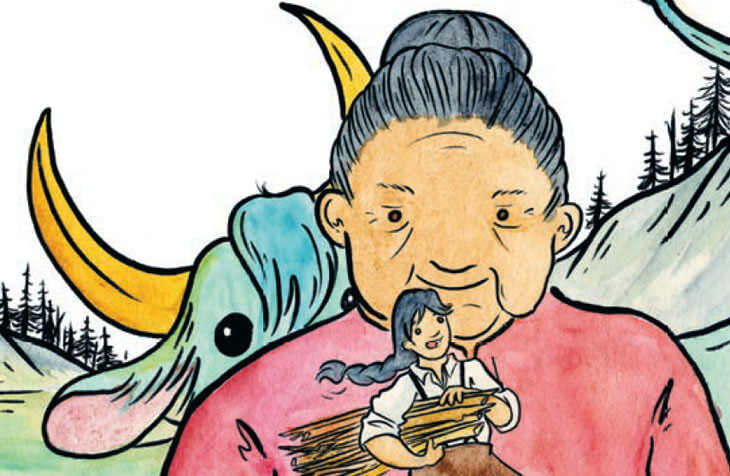
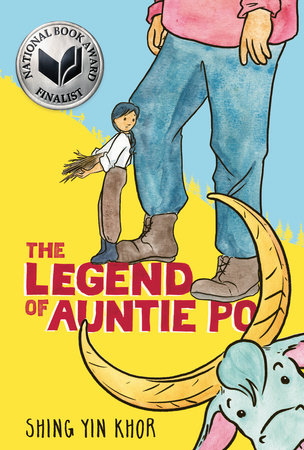
Shing Yin Khor’s Eisner-nominated The Legend of Auntie Po is a fantastical re-imagining of the place that American gods like Paul Bunyan have in our imagination. The story takes place in a logging camp nestled within the Sierra Nevadas between 1885 and 1886 and is told through the eyes of 13 year-old Mei, a Chinese-American girl. Bright and moving, I think everyone could use a big helping of Auntie Po right now.
The Legend of Auntie Po
Shing Yin Khor
Kokila / Penguin Random House
This review is based on the Advance Readers Copy and there may have been changes to the book between this version and the official publication.
From the first hints of this project, I was ready for The Legend of Auntie Po and hooked on the concept of Paul Bunyan retold as a large Auntie. Now, having had the pleasure of reading it, I am so happy that a book like this exists. Amidst a growing oeuvre of creative and academic work that highlights the presence of Asian Americans in the history of the settler United States, Khor’s book is an important entry into this syllabus. In The Legend of Auntie Po, Khor combines reality, fiction, and hope in an important way.

I love every piece of this book. One of my favorite parts is that each chapter page highlights tools used in logging. While it’s a bit strange to be fascinated by logging equipment, I am an archaeologist and I love Khor’s illustrations. Specifically, I love that Khor’s style provides crisp detail in the lines and a softness with the watercolors. Khor breathes life into implements, like the crosscut saw, by giving them enough detail to be specific and recognizable, but with water colors, so they feel soft and alive rather than objectified and sterile. On top of that the pages are informative, providing each implement’s name and purpose, in text, with an example of characters actually using it.
Beyond the delightful and specific research details like that, the story itself is so important. Mei is 13 and lives in a mining camp with her best friend and crush, Bee, a white American girl. Besides working in the kitchens — making the best pies for miles — Mei also entertains the other kids at the camp with tales of Po Pan Yin, or Auntie Po, a Big Auntie with a large blue buffalo name Pei Pei. And while Mei thinks of Auntie Po as just a story, in a time of crisis Auntie Po and Pei Pei reveal themselves to Mei as real, helping out as they can. And while there’s a lot to say about the book, on this initial read through I was struck most by the line,
“I’m angry that I have to make my own gods.”
Mei, our main character, expresses this after the logging company she and her father work for force him out of his job through anti-Chinese policies. Although in the preceding pages Mei expresses her hurt in a unique Auntie Po story, one where Auntie Po primarily yells and stops work rather than helping, Khor places this line in a panel of Mei chopping wood.
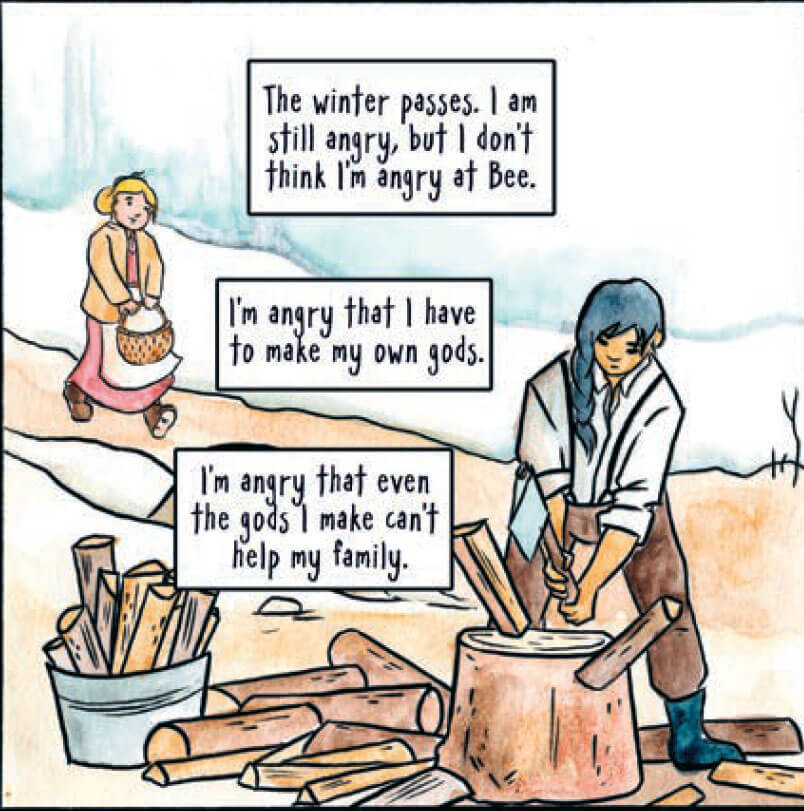
The image embodies how hard Mei works at the camp, even though she earns no wages. And as she works, we get slivers of her thoughts.
In this panel, Khor captures the ways anger just sort of sits with us. We know it’s there as we do our daily tasks. We may not look angry but it’s there, slowly wearing us down. We’re angry, not at the people who try to help us. We’re angry that we have to create our own stories to try to keep us even. And that even then, as Mei points out, even those aren’t enough to keep us safe.
I like that Khor presents these lines as statements of internal monologue with this image, rather than dialogue or in the framework of another Auntie Po story. Because this is not quite pain one can articulate to another person.
Sometimes, as a person of color in the settler United States, it feels like every day, we have to make things for ourselves all over again. We make our gods. We make our customs. We make our place. And even though this settler space was not made for us, we still live here. And we will make that space and those gods.
Whether through stories, or with the hooves of a huge blue water buffalo, we’ll be there, every day. And even when we can’t see the big Aunties out there helping us, the idea of them reminds us to see the people that are trying to help. And for me, that’s what I want to remember about Auntie Po. She’s not a god there to solve our problems for us. She’s a god there to remind us that we can help each other.
