
When Steenz Stewart lost their job at Lion Forge in 2019, they went through a lot of pitches. Taking on freelance editorial work meant reading many scripts, and they quickly came to a realization when it came to the way they were formatted. “Every single script was different!” Stewart explains. “I thought, ‘This is exhausting because I’m spending more time trying to understand the script first, and then I can get into the actual story editorial.'” It led to a single vital question: Why is it like this?
That question quickly coalesced with another thing that Stewart had long been thinking about. “I’ve always had this idea that comics really need to be legitimized through standardization. And back when I was working in comic shops and whatnot I realized that there’s no standardization at all in any area,” they share. “If there are comic shops out there paying their employees in store credit, then it’s not standardized. If there are comic artists and none of them use the same script, that’s not standardized. So how are we going to get further and better and stronger without those standardizations?” A great first place to start, Stewart thought, would be with a Standard Comic Script. Stewart realized that creating a script template could be a way to make a simple, streamlined, and across the board process for writing a script that can be used by veterans and newcomers alike.
Today, Stewart and their collaborator Camilla Zhang present the script/template/key that they hope will be picked up by creators and publishers as a way to begin standardizing the comics making process. Built with input from writers, artists, letterers, and editors, the script template is a brilliant tool for those who have never written a comic before, or for people who already make them and want to streamline the way that they write their own scripts. But for Stewart and Zhang, it has the potential to be something even bigger, a way to legitimize the industry they both love through a standardization that the century-old comics business has never really embraced.

Comics editor and creator Zhang became involved after Stewart began to ask what a great standard comic script would look like in a discord server the pair are both a part of.
“Camilla had great suggestions for actual execution,” Stewart explains. “Rather than just saying ‘this would be nice.'” In Stewart’s eyes, Zhang’s professionalism and skill at executing ideas made her the perfect partner. And for Zhang it was a no brainer.
“Hell yeah! Why aren’t we doing this? Why has this never been done?” she exclaims. However, Zhang was also quick to point out that other people have created script templates before like Andy Schmidt of Comics Experience and Jim Zub. “It’s been a lot of people just going out of their way to try to help folks. But it’s always been like ‘this is how I do it’ and not necessarily ‘this is how we suggest the entire industry does it.'”
Unlike Hollywood filmmaking or television, the comics industry doesn’t have any creators unions or organizations like the Writers Guild of America or the Screen Actors Guild to help build standardization of rates, treatment, or process into the business. It’s something that Zhang is keenly aware of. “They have these large institutions with deep histories, lots of members, with officers who get together and discuss how to move the industry forward,” she tells us. “There’s just consolidation there. And in comics I think it’s only just beginning.”
Because Stewart and Zhang hope the script could become the industry standard, reaching out to all kinds of creators who make comics was key. “That’s one of the reasons why one of the things we did was reach out to more than just comic writers,” Stewart says. “We reached out to comic artists, we reached out to letterers, we reached out to editors, to professors. We wanted to touch different parts of the industry, for them to take a look at it and give their point of view, to give their suggestions. What do they like? What don’t they like? And, honestly, I think that’s what makes this script feel so solid. It’s something that everyone can agree on for the most part, and there’s always going to be some slight changes.”

While there’s things that can be customized, like whether or not you want to number your dialogue balloons, Zhang has strong feelings about the purpose of the template. “I just don’t want people to get the wrong idea that if this template is just a starting point, what’s the point of standardization if I could just do whatever I want to this thing, right?” Zhang says. “Then you run the risk of things just kind of running amok again. So while I think mutability, change, and customization is an important aspect of the template, I also don’t think we should go too crazy.”
The script template already has the support of folks from around the industry, including Whitney Leopard, Senior Editor at Random House Graphic. “At this point in my career I can honestly say that I’ve seen every style of script possible and the idea of having a standardized approach to scripts across the industry felt like a far-fetched dream. Thankfully comics has always been a collaboration and there are always people looking to find ways to make the process as smooth as possible for all of those involved. Camilla and Steenz have created a standardized script that not only would help streamline parts of the comic process, but will also be a resource for new creators breaking in who are wanting to start off on the right foot with their industry peers.”
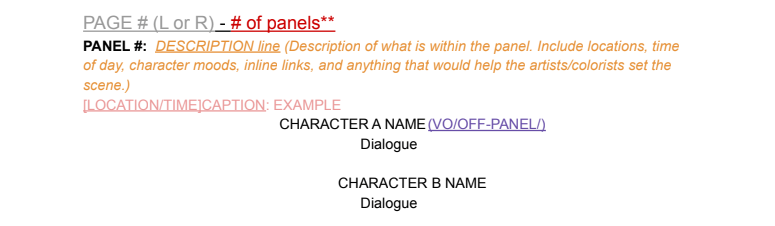
So what are the more specific aims behind launching the Standard Comic Script? “One of the things that I really wanted to get across to people writing these scripts is that these panels should work as moments and that the descriptions need to be something that an artist is going to understand,” Stewart says. “I was on a panel with Dave Scheidt, and he said that the writer writes for the artist and the artist draws for the reader. So that’s a really great way to keep in mind that what you put in the script is not what the reader is going to see.”
“So that’s the first thing that I thought was absolutely necessary,” Stewart continued, “Making sure that the description line was clear enough for people to understand that this is what you want your artists to know. The location, time of day, what the character’s mood looks like, any of that information needs to be in the description line, so that the artist knows immediately ‘okay, that needs to go into the panel.'”

Once Stewart finished their version of the script, they put it into the discord server where they met Camilla and said “tear it apart.” Listening to all the feedback, the collaborative process led to the first communal version of the example script. “From there,” Stewart explains, “we started really looking at each individual piece.” The group discussed caption options, how to explain if something is going to be off panel or going to be a voiceover and much more. They were multiple meetings focused on making sure that what they were creating made sense and worked for each of collaborators. Then they took it to email, getting feedback from all sorts of creators on their script.
“It started off from a collective and has grown as a collective,” Stewart says. “So I feel like I don’t really have too much ownership over the script because it took so many people to get it to where it was to where it is today.”
That collaborative nature is key to comics and what makes the medium so special. And it’s something that the creators of the script hope comes through. “One of the biggest things that I think will come out of this as well,” Stewart says, “is that comics is collaborative on its base level. So collaboration is a huge, huge thing and I really want people to understand that–especially editors–because no one person in a team should feel like it’s all on them to make the comics successful. It’s a team sport, we have to work together.”
Stewart also sees the script template as a way to keep the industry accessible, alive, and thriving. “For me, the thing that’s most valuable is keeping the door open for new creators because an industry will die if there are no new creators,” Stewart says. “If new creators are scared away from the industry, because of lack of standardization, how are we going to make sure that the industry grows and gets better, you know?”

That idea was inspired by one of the most regular discourse in contemporary comics — the struggle some novelists have when translating their books — or their own writing style — to the medium. “My first idea for this was that I wanted to make it so that when novelists do come in and make their comics, there’s no animosity, which there is now because of no standardization,” Stewart explains. “I want to make sure that people don’t feel like there’s no help, because that’s the kind of feeling that you get in this industry when you have questions. Not even just in single issue comics. It’s in strip comics as well. When I first got my gig on Heart of the City they were like, ‘Well, we think we have a template for the Sundays, let’s go and find it.'”
Stewart doesn’t want other creators, especially new ones, to have that experience. “I want to make sure that new creators come in and they don’t feel like it’s just brick walls and walls and walls on how to get forward. Here’s the answer. Here’s how you start. This is a comic script.”
Zhang agreed with Stewart on the notion of creating an accessible space for new creators but she also has a more practical take too. “There’s nothing I hate more than wasted time. So if you’re an artist, generally speaking, a publishing company will give you a template to work off of: where’s the page bleed, where are the crop lines, all that stuff? So why not have the same thing for writers?”
The pair hopes that the script can be a stepping stone to bigger and better change in the industry. “I’m hoping that people see that there are people out there who want to make this industry better,” Stewart says. “And you can do it just by putting the time and the effort into it and really just taking it slow. Everyone really wants this thing to be done today! And I get it. I’m one of those kinds of people. But we started working on this project in 2020. There’s a reason why this sort of thing takes time. If you want it done right you don’t rush it and you wait till people have the time to actually put their 100% focus into it. That’s how you get positive change.”

For now this is very much a grassroots project, a collaborative–unpaid–two year labor of love. While the pair would love to see their script template picked up by bigger publishers, they’re most excited about it being a tool for creators to use to streamline their own process. And if anyone has questions, both Stewart and Zhang are open to them. “If there is an opportunity where someone wants to reach out to us and have us explain the script, we want to be available for that sort of thing,” Stewart tells. “Our email addresses are public if you want to reach out to us. It’s going to be hosted on both of our websites. So you can go to each of our websites and download the template there.”
Finally, Zhang and Stewart were keen to point out that the notion of standardization isn’t about homogenization. “People might say, well, you know, this is just tampering with my creativity,” Zhang shares. “No, no, no. Your job as a storyteller is to tell the story. A script template does not hamper one’s creativity. It allows you to creatively flourish. It allows other people to understand what you’re doing, the story you’re trying to tell, because the story at the end of the day, that’s what matters. And the template is just a framework to help you make that story come to life.”
You can download and read the full the Standard Comic Script here and here.
