

For Stephanie Cohen, a young woman just tipping into her 20s, life is going exactly as planned — according to her parents. She’s breezing through on her way to earning a medical degree which is what her parents have wanted for her since birth, but had she been consulted on what she wanted, Stephanie would be studying the classics, folklore, and mythology. As she takes up her lifeguard post for another summer of gazing bitterly into the crystal blue reflection of a probably well-peed-in public pool, she’s struck with an unexpected answer to her heart’s desires. Turns out, Stephanie’s actually the reincarnation of a cosmic warrior who, along with her six Starward Sisters, are bound to defend reality from Kaos.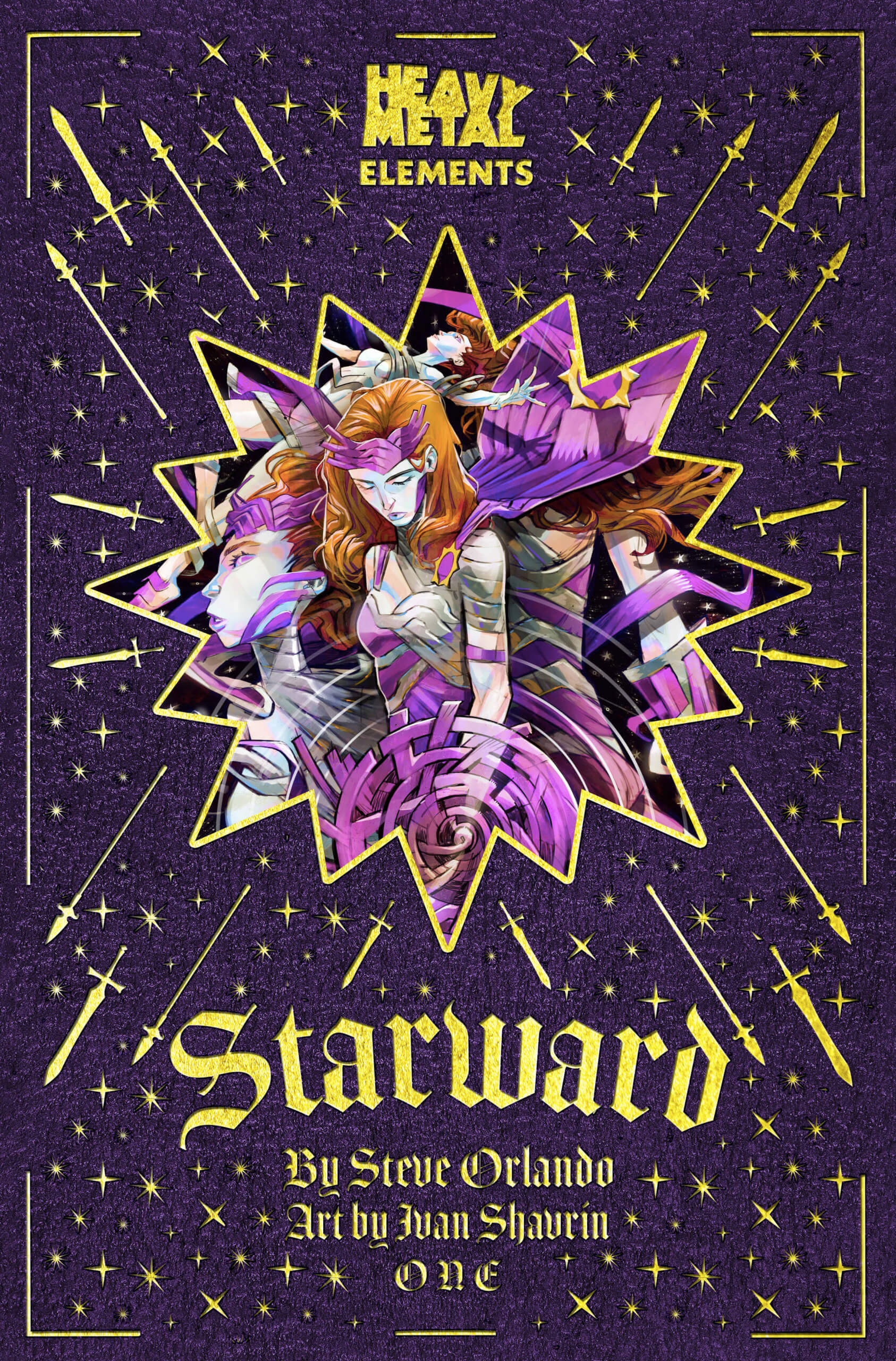
The first young adult-focused series for publisher Heavy Metal, Starward finds its roots in Sailor Moon, a young Wonder Woman, the young leaders like X González and Malala Yousafzai who informed writer Steve Orlando’s work on Supergirl, and Orlando’s own early adult life. The eight-part series, written by Orlando with art by Ivan Shavrin and letters by Saida Temofonte, began its run in Heavy Metal #305 in February 2021. Releasing now as individual comics with extra bonus content, Starward promises a fantastical cosmic ride that still manages to keep things very down to earth and relatable.
At its core, explains Orlando, “Starward is a comic book personification of a very powerful, very impactful phase in folks’ lives as they grow up.” It’s a time full of uncertainty, anxiety, complexity, and lots of emotional chaos that Stephanie handles with as much of the dry, sarcastic humor Orlando himself did at the same age. “Starward to me was a chance to talk about a moment that was formative in my life, that moment on the cusp of adulthood where anything seems possible, and your youth and energy are such that you really feel like you can save the world. It’s the eye of the storm after the restrictions of teenage years and the realities of adulthood! And I think that’s a really special time for folks. I know it was for me. So, with Starward, I hoped to turn that feeling into something cosmic and fantastic.” The difference between himself and Starward’s reality is that Stephanie has the confidence he wishes he could have mustered back then, along with a strong sense of identity. “Stephanie might be based on my life when I was her age,” Orlando explains, “but I don’t know if I’d ever have her courage. I certainly have her headstrong, stubborn nature. But in a lot of ways, she’s who I wish I was then. She’s more ambitious, more true to herself, and more willing to stand up to the expectations of others, tear them down, and live by her own alone. With the idea of having an immortal part of my soul reveal itself after hiding inside me for twenty years, I’m not sure I’d take it as well as Stephanie. But I certainly wish I would.”
For the record, if he could handle it, his costume would be purple. Why? “Well, purple IS the meeting point of pink and blue on the bisexual pride flag. I wonder if that’s a coincidence! The colors would be the same, for sure. But I myself like an elaborate cape, collar, and neck design. I’d need something more complicated and frankly less practical if I was going to feel like a cosmic hero.”
Mythology, which Stephanie aptly describes as “the archaeology of society’s mind,” is an overarching element of Orlando’s story, playing a huge role in her life since puberty, as well as Orlando’s own. “I think it would be hard for any self-respecting student of Grant Morrison and Philip José Farmer to not have an intense interest in folklore, pop culture, and mythology,” he notes, harkening back to his younger days of “reading strange superhero comics and books of Slavic Folktales.” Earlier still, his elementary school days were often spent reading the dictionary, which introduced him to the coolest illustrations of the Greek Pantheon. Of myths and folklore that still resonate with him today, Orlando fondly recalls Vasilisa the Beautiful, who, forsaken by her family, ventures into the terrors of the night and faces down the evil Baba Yaga and her death riders. “She’s accompanied by her only friend, a doll given to her by her dying mother, symbolizing true familial love. Vasilisa is thrown to the dogs by everyone in her life but herself, and the memory of her mother. And it’s this bond that gets them through.” For Orlando, that imagery is as evocative as Cinderella, another story where family “is a source of love, but also a source of struggle.”

“So these characters, be them classic folk myth or the pop culture folk myth of superheroes, had been with me from a young age. And mostly, they were fascinators, distractions from a suburban youth. A portal to the kind of fantastic that’s in short supply in Central New York!” Unsurprising then to see so much of these stories and Orlando’s passionate connection to them manifest so strongly within the pages of Starward. Here, readers will find Greek creation myths in particular shaping many elements of the story and characters, right from the opening pages where we first meet the daughters of Atlas. “But like mythic lineages and influences in The Eternals, we’re playing at characters like Atlas being something even older and more primal than Greek myths, perhaps the beings that inspired them.”
Though Stephanie serves as the lead character, we do get to spend time with the other Starward Sisters, who, like Stephanie, are discovering what adulthood has to offer and what they can offer in return — only to be summoned to an even greater gift and responsibility. “For a time in the characters’ lives when the horizon seems endless,” says Orlando, “Starward extends that wonderful unknown much farther than could ever happen in reality. It takes a feeling of wonder many of us feel around this time in our lives, and truly makes it something unheard of and categorically cosmic.”
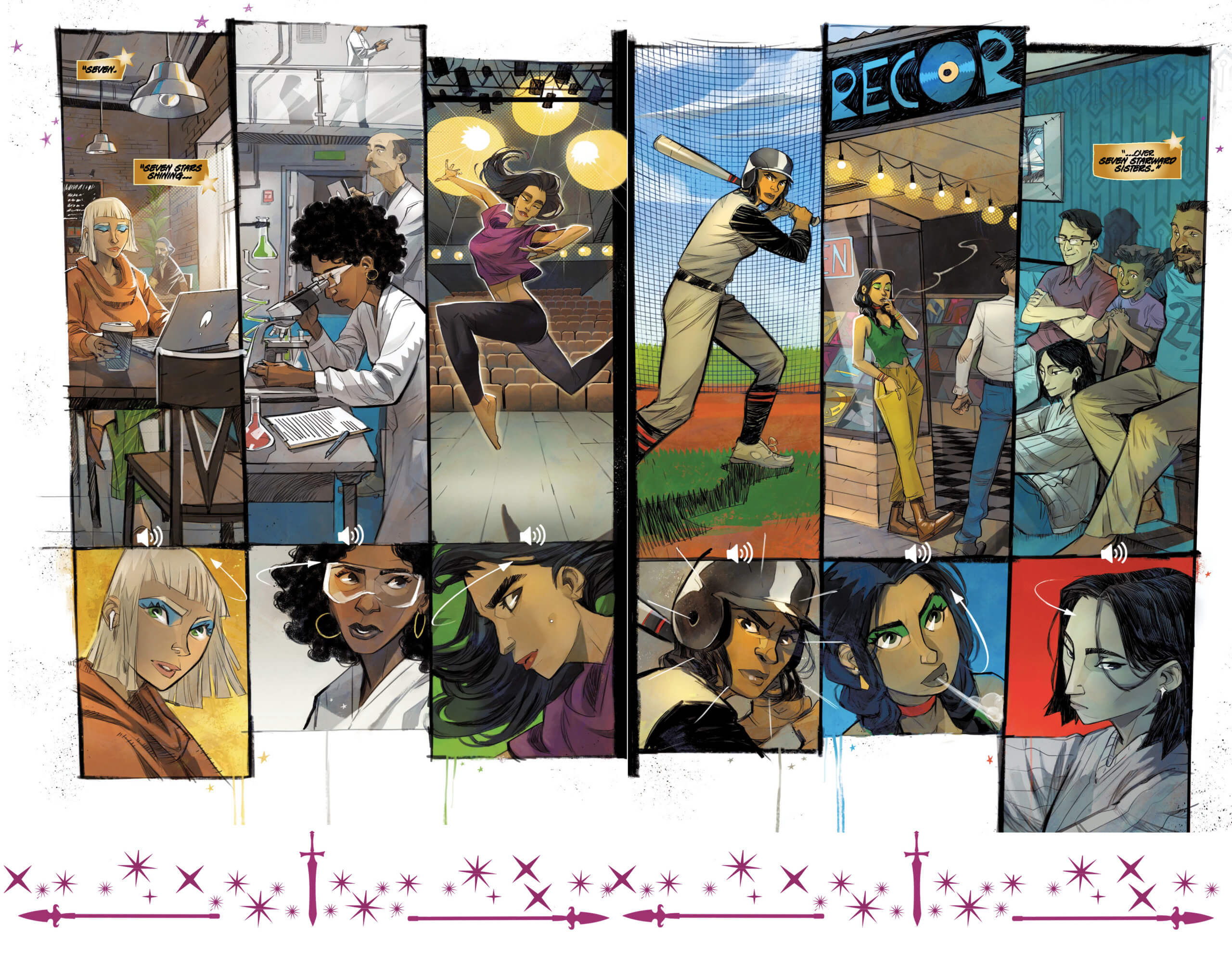
Each of the sisters is unique and the story and characters lean comfortably into representation in so many ways, which is very important to Orlando as evidenced through writing that shapes stories and characters that are far more than the sum total of any intersecting identities. “Remember these characters are representing real people,” he offers as advice to other creators, “and thus, should be as complex as real people. Or at least, of course, should aspire to that. And like real people, they’re not just embodied by one aspect of their life, be it sexuality, gender identity, race, religion, or anything else. We are all complicated webs of many influences, interests, and core aspects. And we’re all to be respected. So too should these characters. Their depiction involves research, it involves humility, and it can’t be done by winging it. What might seem offhand to you could mean everything to someone else, in a good or bad way, and that’s all-important to remember.”
“But also, you can never ensure what you do is going to be on point for everyone. So you guessed it, that’s where the humility comes in. If you do slip up, as I have, as we all do, it’s then the time to listen, learn, and improve, when receiving good-faith critiques. We can only do our best, and work from a place of genuine good intent, but that’s not a guarantee. When mistakes are made, and responses come in good faith, we must then be gracious and find ways to improve. And with that, don’t be deterred; everyone, every creator you know and every creator you don’t, can always be better, can always enrich their skill. And that can only come through learning.”
It’s a mindset like this, shining through in stories like Starward, that make for exciting, but completely relatable reads that truly make any reader feel like they can be part of the story.
Starward #1 is available now from Heavy Metal.
