

Good morning! Today my dog decided to wake me up by shrieking at seagulls.
First, a couple of cool announcements:
- The first annual Bluestockings Digital Comics Fest will be held May 23rd-29th of this year! In addition to doing the sensible thing and hosting their event digitally amidst an ongoing pandemic with an ever-soaring death toll, Bluestockings will specifically be focusing on zines and indie work from queer, trans, and sex-worker perspectives. Mark your calendars! We certainly will be.
- Or maybe you’d prefer to make some comics? Fanbase Press, Frederick Luis Aldama, and Peter Murrieta are opening submissions for the 2022 Outstanding Young Latinx Comics Creators anthology. The deadline for submissions is May 1st, and you can click through to the site there for submission guidelines.
Now for the big story of last week: King Conan #3 dropped on February 16th and featured a new “femme fatale” character created by Jason Aaron with design by Mahmud Asrar. Aaron, for some reason, opted to name this character Matoaka, a name more commonly associated with the historical figure Pocahontas. This went over about as well as you’d think it might, with readers pointing out the cultural insensitivity of using the name in the first place, much less for a character who looks like, well, this: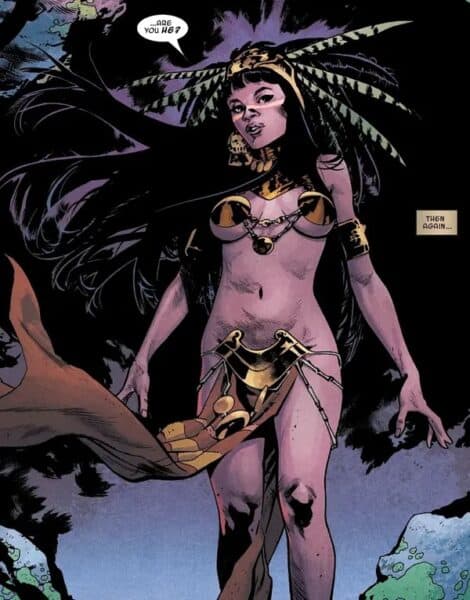
Lest we forget, Pocahontas, the original “Princess Matoaka,” was a child, kidnapped, assaulted, horribly abused, and married off to English men, before dying around the age of 21. The depiction of this fictional namesake here follows an ongoing history of romanticizing the legend of this girl, portraying her as a young woman, falling in love with John Smith, the man who in real life threatened to murder her entire family on at least one occasion. A couple of days ago, Aaron issued this apology:
In KING CONAN #3, I made the ill-considered decision to give a character the name of Matoaka, a name most closely associated with the real-life Native American figure, Pocahontas. This new character is a supernatural, thousand-year-old princess of a cursed island within a world of pastiche and dark fantasy and was never intended to be based on anyone from history. I should have better understood the name’s true meaning and resonance and recognized it wasn’t appropriate to use it. I understand the outrage expressed by those who hold the true Matoaka’s legacy dear, and for all of this and the distress it’s caused, I apologize. As part of that apology, I’ve already taken what I was paid for the issue and donated it to the National Indigenous Women’s Resource Center. The character’s name and appearance will be adjusted for the rest of this mini-series and in all digital and collected editions.
Regarding that apology, I really only have one thing to say: Fellow white people? This apology is not for us. Do not trip over yourselves rushing to accept it, or to praise it (if you think it deserves praise). It’s not for us. We’re not the aggrieved party here. We’re the perpetrators of the four-hundred-year-old history of appropriation of this real girl’s tragic, short life, so that we can tell ourselves comforting stories about how she fell in love. We’re John Smith’s people, telling ourselves these lies about her and so many other Indigenous people so that we don’t have to face the truth of our ancestor’s colonization of the world. Sit back, shut your mouth, and support the Indigenous voices who are speaking up about this.
You too can donate to the National Indigenous Women’s Resource Center, at the link here.
