

“In Anzuelo, the Sea, secretly more complex than anyone imagined, rises one day. The horizon folds as the Sea absorbs the world and transforms everything that’s been pulled inside it. Three kids find themselves unmoored and lost, but brought together by the physical and mental changes wrought by the tides and a desire to avoid harming any living creature.”
Last month, Emma Rios’ long-awaited standalone graphic novel Anzuelo, which she both wrote and illustrated, arrived in print and digital from Image Comics. I had the opportunity to review an advanced reader copy, and after immersing myself in this experiential graphic novel, I was able to articulate some questions about the story for Emma. She shares her thoughts below.
WWAC: Let’s begin with: what’s the origin of this story? As both writer and artist, how did this story emerge for you?
Emma: If I’m honest, what I originally wanted to create was a classic sea-horror story on a boat with weird cursed characters and sea monsters. However, when I started to reflect on the sense of isolation facing the immensity of the ocean, while inhabiting a very tight space with other people, I just got carried away. If you think about it, most of these original elements are still in the book, but even if I consider the result a horror story, the tone changed considerably turning into this pessimistic tale about isolation in nature, selfless love and a somewhat hopeful acceptance of mental and physical trauma in an attempt to find some solace for the characters, and also for myself.
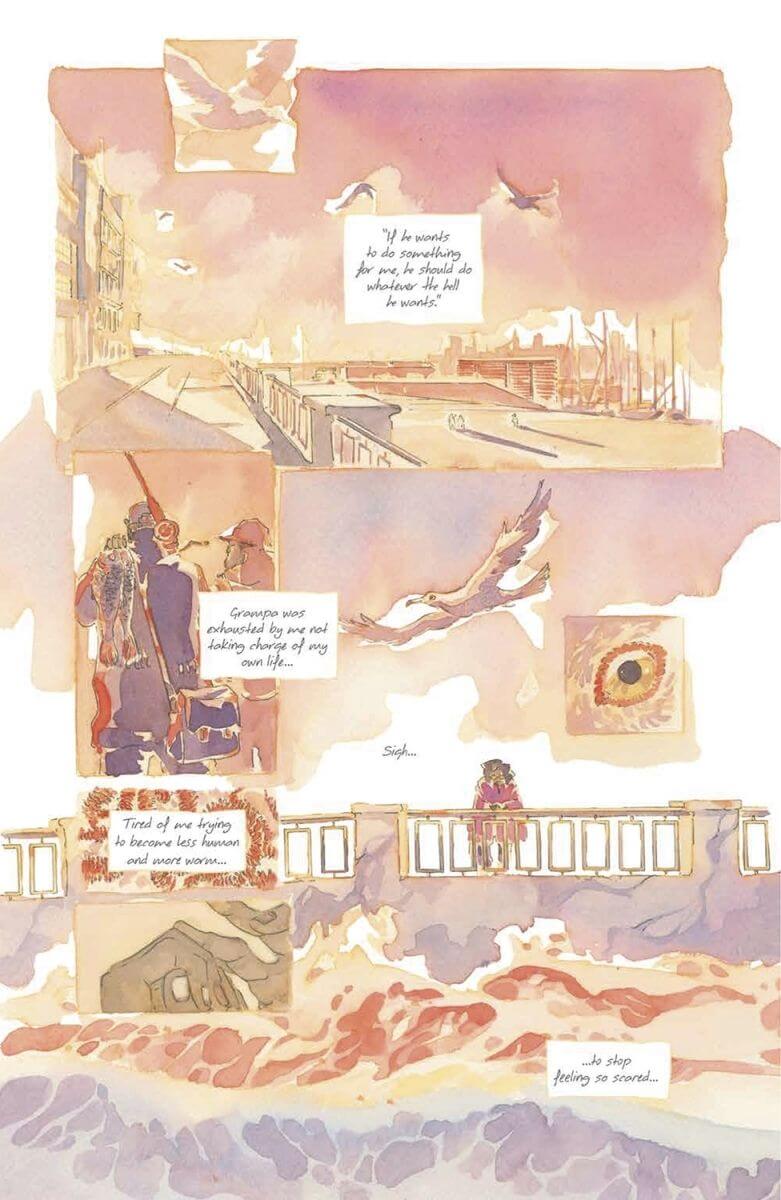
WWAC: The book has such a distinct and muted color palette. How did this become the story’s palette?
Emma: Building the story, I thought that some sense of decay would help the atmosphere feel significant and oneiric, in contrast with how violent the background was going to be. The environment itself needed a lot of presence, but at the same time, I was also considering drawing part of the anxiety the characters go through, instead of literally explaining it, in the hope of finding some complicity with the reader interpreting the images. The final aspect is quite unreal, fluttering, maybe a bit confusing, but also warm thanks to having avoided the classic blue for the sea and other colder palettes. I want to believe all these aspects are rather narrative as they reflect the characters’ emotions.
WWAC: In a similar vein, why watercolor? Is it digital, by hand, or both? It’s a fascinating choice to me because the story is so material and even what would otherwise be gore elements feel soft and ethereal. Things constantly merge together, becoming less distinct. Was this intentional?
Emma: It is all traditional watercolor painting. By hand, yes. The idea of having everything look organic and wet was intentional, it felt appropriate for a story about drowning the whole world. However, the gutters are digitally painted in white in Photoshop because I wanted to keep at least a little tidiness to hold on to, in the overflowing mess expanding physically and also in the story. This was a process that took ages, as the outline needed to be traced manually so the watercolor stains remained natural. For that, I ended up asking my friend and amazing cartoonist Luis Yang for assistance, he was a lifesaver. Luis was also the animator of the book trailer we both did as some kind of anime opening for the book:
It’s been around six months since I sent the last page to Image, and seeing it printed it feels compact and beautiful as an object to me. But I really went through a lot of trauma seeing the difference between the first and final pages, after four years of testing techniques and different papers. It’s an extremely difficult technique, and after 312 pages I feel I could only scratch the surface.
WWAC: I am fascinated by the portrayal of the sea in your book – it’s rare to see it not romanticized. What prompted you to portray the sea like this?
Emma: The Sea is quite a powerful concept where I live, and I had wanted to write about this Sea I know for a long while. Saying “the Sea I know” may not feel accurate if we consider the book’s content, but the overall tone has been heavily influenced by the sense of melancholic darkness and folklore, deeply attached to Galicia and the North of Spain overall. I was also mesmerized by William Turner’s watercolor sailing sketchbooks and soft palettes. I remember seeing part of them at The Tate Britain in London some years ago, they blew me away and gave me courage to try.
The book is embarrassingly romantic in how it addresses nature and loneliness, and also in the perishing and putrescence of things in it. The Sea, being the principal element, also had to go for it.
WWAC: In your end notes to the book, you said: “No matter how carefully you plan a project like this, the work and the creator always transform and adapt due to learning and experimentation. I wanted to write the Sea under my skin and I’m fortunate to have become someone else in the process.” In what ways did this story transform you?
Emma: This story ate me, and spoiled me, for four years. A big chunk of anyone’s life, like, I don’t know, going to college – sorry, I recently joked with my mom about this exactly. I also started working on it on a daily basis in 2020, after finishing Pretty Deadly: The Rat, and went through the pandemic with the two dystopias overlapping each other. I dealt with loss too, hiding in the pages and figuring out ways out of despair for the characters and myself. The book may have giant monsters coming out of the sea, but also deep personal experiences and fears projected in every character, as I write by roleplaying each one of them.
I’m not a big extrovert, so the blessing of genre stories is finding some solace in the metaphors to reflect on life experiences and things that worry me for which I’ll never find an answer.
I started by wanting to have fun, indulging myself to write something really dark and edgy that eventually turned into rather hopeful, from a humanist standpoint. And I think it gained more refinement and weight overall, the book and my own personal thinking.
I have to thank my editor David Brothers for keeping me afloat during the whole process and for making me realize this was happening to me, and also for helping me believe the book mattered and would resonate with some people.
WWAC: How do you hope it transforms the reader?
Emma: Ha ha, I think I would die if I had to think in those terms. If only, it would be nice if someone felt the urge to take a break and go for a walk by the shore after finishing it.
Anzuelo is now available from Image Comics.
