


I am more than a fan of comics. I have made them my career, and I advocate for their importance any chance I get. One of the major reasons why I do so is because of the impact comics have had on me as a dyslexic woman, as well as the potential they have to be academic resources for students who are like me.
Early on, my mother noticed I had signs of dyslexia. Along with it being genetic, there are a few easy giveaways: difficulty distinguishing left from right, spelling erratically, often re-reading paragraphs and sentences, confusing similar words, flipping numbers and letters, trouble focusing (via British Dyslexia Association). Seeing me struggle, my mother went to my elementary school teacher to ask for advice. Unfortunately, that teacher misled my mother.
“Girls have it less often than boys,” the teacher told my mother, “so don’t even bother. Caitlin’s either acting out or needs to try harder.”
This is inaccurate; however, my mother had no reason not to believe my teacher. After all, wasn’t she supposed to look out for her students? A teacher should surely be trained to notice signs of a learning disability, right? And why would another woman make such a bold claim about girls if it wasn’t the case?
I understand why my mom took this teacher’s word at face value. Unfortunately, that led to over a decade of my love for reading diminishing incrementally. That was until college, where I read my first comics, Captain Marvel, Hawkeye, and Black Widow.

While I read manga and adored superheroes, I didn’t read American comics at first because I assumed they were not for me. With one comic shop back home that was a hub for men who had no issue quizzing teen girls, and comics like Red Hood and the Outlaws making me insecure about my developing body, I avoided American comics. It was only in my young adulthood that I learned comics have been and always should be for everyone. Not only that, but they are the most accessible form of storytelling I’ve read as a dyslexic woman.
Why Are Comics Great For Dyslexic Students?
There are numerous reasons why this is, like the font often used in comics. Certain fonts are more accessible to people with dyslexia (via University of Michigan). More specifically, fonts that differentiate their letters are more readable for people with dyslexia. For example, letters like “b” and “d” are confusing in fonts like Times New Roman because they look similar. Along with that, the writing looks less crowded in certain fonts. For these reasons, fonts like Comic Sans and Arial are easier to read for people with dyslexia (via British Dyslexia Association), and it’s these fonts and similar fonts that are used in comic books.
Another reason comics are accessible for dyslexic readers is because of how the writing is spaced out. Unlike prose, which is a wall of text, the dialogue in comics is broken up into bubbles and caption blocks. Because of this, I run less of a risk re-reading sentences and paragraphs with comics than I do with prose. Alongside that, there is the visual storytelling of comics. Unlike prose, which establishes everything through the literal writing, comics have the benefit of an artist. This visual aid also makes comics more digestible for a dyslexic reader than prose.
Furthermore, comics have proven to help with reading comprehension at large (via Yale and Dyslexic Advantage). From my own personal experience, too, this has been the case. Throughout my educational career, my struggles with dyslexia made reading a slog, so much so that I gave up on the latter almost entirely. Meanwhile, in the classroom, I had to put in twice the work, if not more, just to maintain appearances as a good student.
Bitch Planet, Bad Feminist, and Comics in the Classroom
When I picked up comics at Lewis & Clark College as a Rhetoric and Media Studies major, that reignited my love for reading. I also learned that comics could be applied to my education. One professor, Melanie Kohnen, let us use several comics as academic sources, and that was game-changing. In her Media Studies course, one such comic was Bitch Planet.
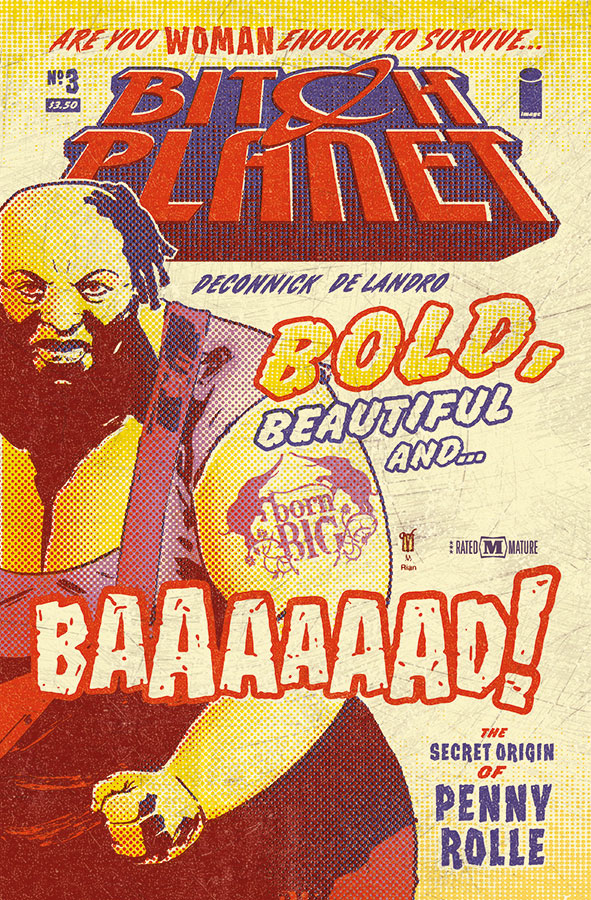
Bitch Planet issue #3 in particular applies concepts from Roxane Gay’s essays featured in Bad Feminist, deconstructing the concept of the male gaze from a Black woman’s perspective. In this issue, Penny Rolle—a fat Black woman—cannot fit into the expectations of the male gaze because it centers around whiteness. While Gay’s essay on its own does an excellent job deconstructing the concept of the male gaze and how this concept was initially conceived without taking into consideration the perspectives of women of color, Bitch Planet sees said analysis fleshed out in a more personal way.
Bitch Planet is an entertaining, accessible academic aid as readers see the very human Penny Rolle go through exactly what Gay’s essay theorizes. Where Gay lays out the media analysis, Bitch Planet applies it to an individual’s experience.
Together, these written works perfectly complement each other, with Bitch Planet taking the theory to another level for those with dyslexia like myself. Unlike a traditional essay, the formatting of a comic like Bitch Planet, as well as the art and personal story interwoven throughout the issue, make processing the original academic essay more understandable.
If comics were available to me as a student earlier, I can assume what a relief that would have been. Unfortunately, comics in the classroom were uncommon in every school I attended until college. Even then, it was just Professor Kohnen who used comics in the classroom.
Are Comic Books Allowed in Classrooms?
This is not a surprise given the stigma against comics, which goes back decades. In the 1930s, there was outcry over comics from educators who believed comics were detrimental to students’ reading abilities. Meanwhile, church and civic groups had their complaints, this time in regard to the “immoral” content in comics.
This led to the infamous Comics Code Authority, which fizzled out toward the end of the ‘70s before coming to a proper end in 2011 (via The Comic Book Legal Defense Fund). Despite this shift, some still oppose comics and ignore the significant impact they can have on students, as seen by some graphic novels, like Maus, still being banned to this day (via CBR).
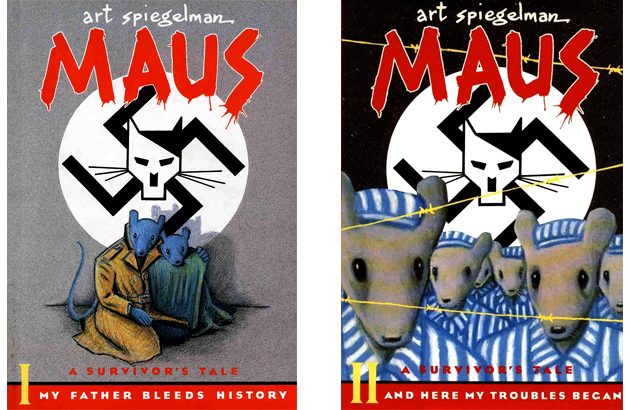
Banning comics in the classroom is counterproductive to a well-rounded education. It denies students like me a game-changing resource that improves reading comprehension and instills a lifelong love of reading. Furthermore, comics are more than just entertainment. Yes, there are thousands of fiction comics; however, there are also historical comics. These can be used in classrooms like traditional textbooks.
Unfortunately, it wasn’t until my junior year of college that I had an educator integrate comics into the curriculum. In Media Theory, Professor Kohnen wanted to focus on contemporary and diverse voices. Along with that, she wanted us to go beyond traditional essays, journals, and textbooks. Comics were the perfect solution for this. After all, we studied media, so shouldn’t we look at media—like comics—directly, as opposed to just reading articles about it?
This inclusive approach opened my eyes even more to how comics could be a resource in the classroom. I wish my elementary teacher had been like Professor Kohnen, creating an environment where students with learning disabilities have alternatives to turn to. Comics are more than just entertainment, especially for dyslexic readers. Comics are a necessary resource in the classroom and beyond, especially when you’re growing up with undiagnosed dyslexia.

