

We’ve got a really interesting breadth of recommendations in this month’s WWACommendations. Louis has a comic for you focused on mental health, I read a fictional manga about ace identity, Kathryn’s here with some non-fiction by a regular Nib contributor, Masha picked up some sci-fi, Carrie did NOT read manga this time and instead found an affirming blast from the past, and Emily’s got a kid’s comic! It’s always funny to me when we align — I am aware that we recommend a lot of manga in these roundtables — but I love to see the variety of comics that people read, too. There is such incredible diversity in comics, and I’m happy to deliver you a WWACommendations that covers many different styles and genres.
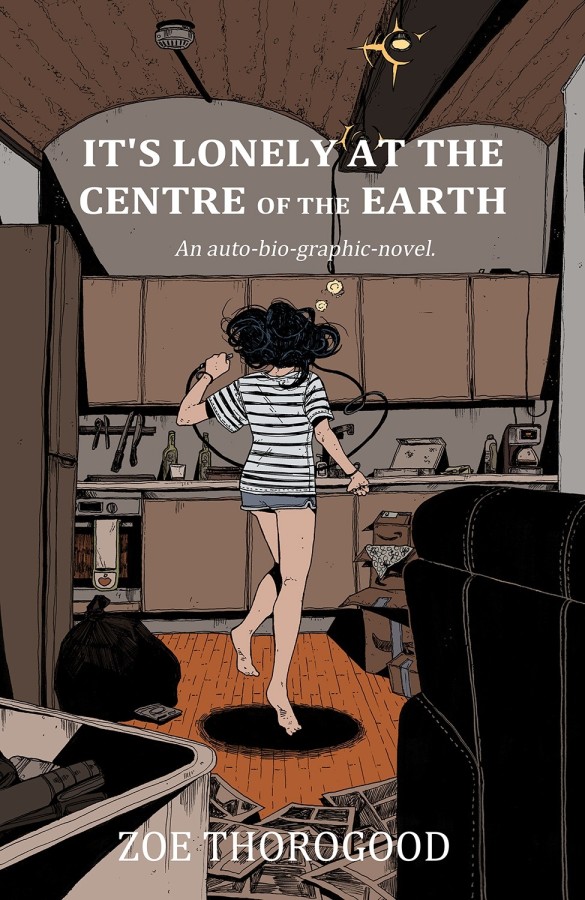
Louis Skye: I chanced upon It’s Lonely at the Centre of the Earth by Zoe Thorogood on Hoopla and devoured it. In it, Thorogood records a period of her life when she was deeply depressed. Not exactly easy reading.
And Thorogood is extremely harsh on herself—depicted via avatars for her various feelings. Some of these look like realistic renderings of herself, others like cartoons, and others like Studio Ghibli monsters. Thorogood’s writing is raw and will kick you in the guts. Her self-doubt and imposter syndrome are unbelievably real; I often felt like she’d read my mind. It was uncomfortable but also a massive relief to read some of my thoughts in someone else’s work.
While the writing is powerful, Thorogood’s art is astounding. She uses multiple styles to depict her varying environments, emotional states, and relationships. Every page is stunning and takes the reader through an emotional journey. Again, it’s not an easy read, but it’s such an important document. I want to put this book in the hands of anyone who dismisses mental health concerns. An extraordinary read and stunning art, but proceed with caution.
Alenka Figa: I spotted Is Love the Answer? by Uta Isaki on the return cart at my library, picked it up, and ended up reading it over my lunch break. There seems to be a slow uptick in ace narratives and stories occurring which is heartening to see, and this manga does a particularly good job of capturing the ace struggle for self-determination. The story follows Chika from high school to college as she confronts feelings of alienation that result from her inability to understand others’ obsession with love, lust, and relationships. Slowly, through conversations with friends and mentors, Chika is breaks down toxic societal expectations and assumptions about what love “should” be and what relationships “should” look like. She finds true friends and confidants and begins to set that toxicity aside to define her identity and relationships with others for herself.
I honestly found this story a lot more effective than some non-fiction I’ve read about ace identity. I’ve been drawn to these books lately as I grapple more with my own ace-spectrum/demisexual identity, and I’ve found a lot of non-fiction lands in a nebulous place of, “well, lots of people are ace in different ways, and it’s just a thing you figure out.” (I’m not knocking this conclusion! The ace umbrella is vast, and all queer identity is complicated.) Chika’s story had reflections of that — she eventually has to accept that her feelings and desires might shift somewhat as she ages, and friend, let me tell you, aging as a queer person is indeed a wild ride — but her journey was also very relatable and, thus, comforting. Chika is earnest, impressionable, and easy to root for, especially as she finds ways to confront straight friends who’ve unintentionally harmed her. I think this story will help a lot of ace people feel seen and, hopefully, make a lot of allo people think twice about their assumptions. One content warning: there is a sexual assault shown briefly at the beginning of the manga.
Kathryn Hemmann: American cartoonist Dan Nott is a regular contributor to the sharp and stellar non-fiction comics venue The Nib, which will be sorely missed after it ceases publication later this summer. I’ve always appreciated Nott’s comics illustrating the workings of various social and political systems, and his newest piece investigating the implications of AI-generated graphics in the “Future” issue of The Nib magazine is an absolute banger. I was excited to be able to spend time with Nott’s first book, Hidden Systems: Water, Electricity, the Internet, and the Secrets Behind the Systems We Use Every Day.
While Nott’s historical contextualization of electric grids and sewer tunnels is fascinating, I was especially intrigued by the everyday practicalities of the internet, which is a series of tubes. Nott’s clean and accessible comic style helped me understand what this looks like, as well as the foundations of the infrastructure that supports the fiber-optic cables in our walls, under our feet, and deep below the ocean’s surface. To give an example, you know those unmarked buildings at the edges of cities and suburbs that seem abandoned but are always completely clear of litter and overgrown grass? That’s where telecommunications companies keep the giant banks of server computers that power the internet. Thank you, Dan Nott and Hidden Systems for solving a mystery that has plagued me for the past decade.

Masha Zhdanova: I love Dan!! He was my professor at the Center for Cartoon Studies and he’s so smart and nice!! Hidden Systems is great!!
I finally went to a comic shop a friend told me about called Final Boss in Lawrence, NJ, and it’s awesome! The owner is super nice, they’ve got a good variety of comics, merch, and games, and they do a book club thing with a different graphic novel every month. I got the book for June, which was Mindset by Zack Kaplan (writing) John J. Pearson (art), and Hassan Otsmane-Elhaou (lettering). It’s a limited series about some guys who discover mind control and make an app to get rich with it. I thought the art was interesting— it reminded me of Joe vs. Elan School somehow. I wish there were some back matter about the artist’s process because I couldn’t tell if it was digital or traditional. The white-paper-cut-out gutters were unusual. The story felt… like it needed to be longer. It moved too quickly for me. I couldn’t understand what the app was doing or what the point of it was. What was supposed to be a deconstruction of silicon valley seemed more like a standard sci-fi thriller. But the art was cool, and the store I got it from is nice so if you’re ever in Central Jersey, do check it out!
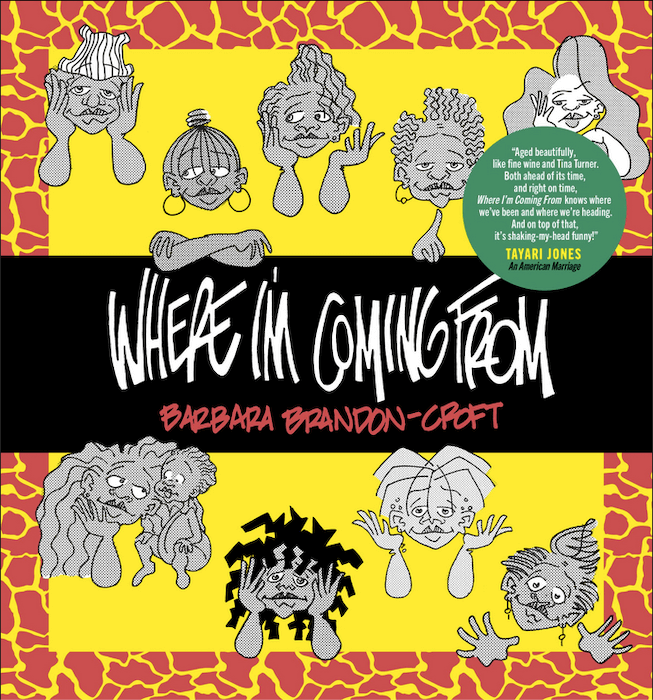
Carrie McClain: While I recall having more local newspapers at home growing up, I mostly read the national newspapers at school and the libraries I visited, growing up. I vaguely remember seeing Barbara Brandon-Croft’s comic strips when I was younger and was excited to see the Black women she drew in the paper. Yet I could never keep up with them consistently as a child in the 90s. I finally got my hands on a copy of the comic artist’s Drawn & Quarterly collection, simply titled Where I’m Coming From, sharing the same name as her trailblazing comic strip that I laid eyes on so many years ago.
Opening up this book transports me back to being a little Black girl and seeing that group of Black women in Brandon-Croft’s comic strips comforting each other, roasting each other, and having big opinions and voicing them all.
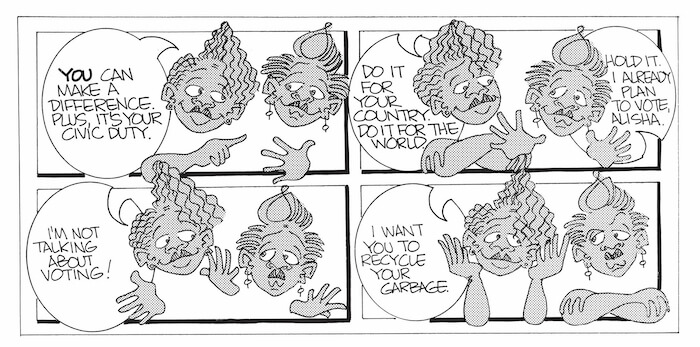
I feel the same admiration I had when first seeing her comics as a kid. Now, there is a deeper appreciation for her work as I have a better understanding of the Black womanhood and Black kinship that her characters cared so much about. Barbara Brandon-Croft, the first African American woman with a mainstream syndicated strip, had a cast of Black women characters that officially ran from 1989 to 2005. She’s a pioneer and I think about the foundation she made for other Black cartoonists whose work I later came to love, including Aaron McGruder (The Boondocks) and Ebony Flowers (Hot Comb).
This grand collection of her work feels timeless, so many panels and pages would feel at home today in a newspaper. Croft tackled gun violence, colorism, motherhood, and other topics in strips that have so much weight today along with jokes and commentary on dieting, new hairstyles, and on-and-off-again boyfriends. I know I relate most to Where I’m Coming From’s Cheryl, who tells it like it is, and Lekesia, the group’s feminist. Yet, I’m also the quiet observer in the group like Judy. Getting to know these hilarious and multifaceted Black women again makes me feel so seen and present on the page when I’m living through a time where I often feel silenced because of my race and gender. I’m here for being able to give Black women their flowers, and Barbara Brandon-Croft’s work here is a treasure trove of comics that I recommend to anyone who reads comics and honors female creators in this space.
Emily Lauer: I just read Things in the Basement, an adorable standalone graphic novel for kids by Ben Hatke! I laughed aloud twice and teared up once in the hour it took me to read it.
It tells the story of Milo, who has just moved into a new house with his mother and two new baby siblings. His mom asks him to retrieve a baby sock from the basement, which turns into a heartwarming epic quest into deeper and deeper realms. As always with Ben Hatke’s work, I love how much he acknowledges classic children’s portal fantasy: the main character is named Milo, like in The Phantom Tollbooth, and he meets a ghost girl (spoiler: she turns out to be friendly) who asks him, “Boy, why are you crying?” just as Wendy asks Peter Pan on first meeting. There are also clear references to Alice in Wonderland as he uses keys to unlock new spaces underground, and to The Wizard of Oz, as he makes friends along the way and they work together to rid the underground realms of a problem.
At first, Things in the Basement is nearly wordless. While the dialogue does pick up as Milo makes friends underground, some of the creatures down there consistently speak in emoji, a clever conceit that makes them feel foreign yet comprehensible and keeps the overall word count low. The color work by Zack Giallongo is fabulous. It adds a lot of atmosphere to Hatke’s engaging art style because the underground realms are dark and dramatically lit by single light sources like a candle. Giallongo illuminates them all differently, emphasizing the range of environments Milo travels in, which will help young readers keep track of when Milo returns to already-visited areas. Hatke thanks Giallongo in the acknowledgements “for adding a shifting jewel-toned rainbow to these pages” and that seems pretty accurate to me. Published by First Second, Things in the Basement will be available August 29 and is recommended for kids aged 6-9.
