

(or you are that roommate)
The transition of a webcomic to print is always exciting for me; it often showcases how a cartoonist’s skills have improved over time, be they narrative, visual, or both. Even for veritable pros in comics, the tangible progression of a collected series shows off how artists experiment with new techniques, get more fluid in their formatting, or try out some bigger stories. I’m happy to report Benji Nate’s Girl Juice shares that sense of progression while still managing to keep to its great core theme of “being hot and slutty is fun, actually.” Rarely does a comic come along that not only features a cast of fully realized women who are allowed to be horny but is also for women who are horny and want to laugh out loud.
Girl Juice
Benji Nate
Drawn & Quarterly/Online
May 23, 2023
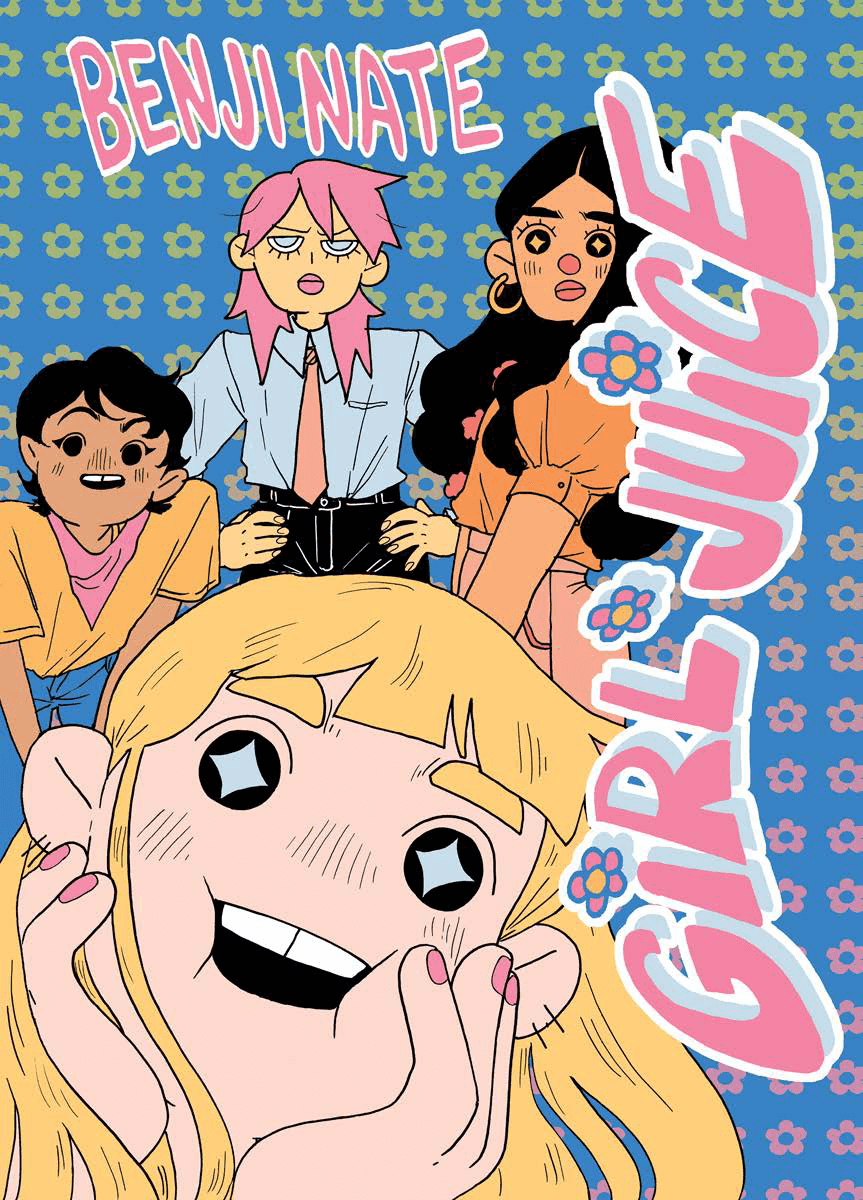
Originally released on Instagram and Nate’s Patreon, Girl Juice follows four roommates — Sadie, Tallulah, Nana, and Bunny (and Bunny’s dog Britney) — through many slice-of-life stories and misadventures. Sadie is serious, career-driven, and responsible; Tallulah is a #influencer, loves attention, and is dating Sadie; Nana is an artist and is sexually attracted to clowns; and Bunny only has room for thoughts about God and sex in her brain. In scenarios often directly related to Bunny’s sex life, we learn more about the underpinnings of each of the five girls (Britney is the fifth) and slowly build a better understanding of how messed up their lives truly are.
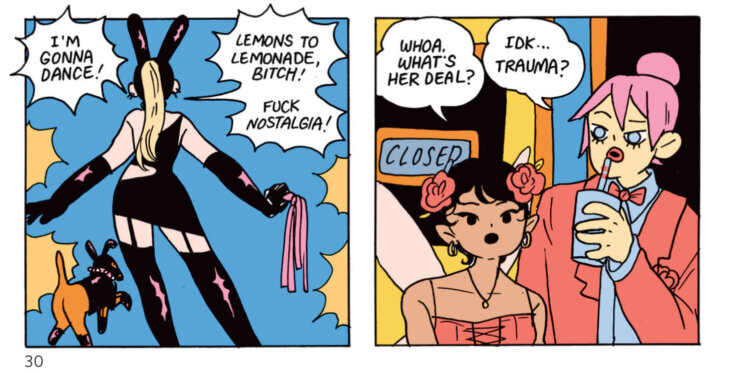
Early strips comprise of six panels, an easy format for a webcomic and one that translates well to print, with each strip taking up a page. It’s a structure that works well to ease readers into the lives of each character while still making sure a joke or quip lands. Seeing Bunny start dressing in fetish gear in one strip, then casually having her in a latex bunny hood in the next is the kind of payoff that does nothing for the punchline of the next series of panels but does reward readers who are keeping up with the comic regularly (and is funny in its own right as a running gag).
Girl Juice develops into more drawn-out storylines — arcs take six strips on the shorter end to twenty separate strips on the longer side — that gives the reader a chance to see different versions of the cast. How would Bunny react to going camping, getting rejected by a boy for a change, or having her conservative mom visit? This kind of narrative progression goes hand in hand with improving visuals, and we start to see the lettering get more spaced out and more varied backgrounds.
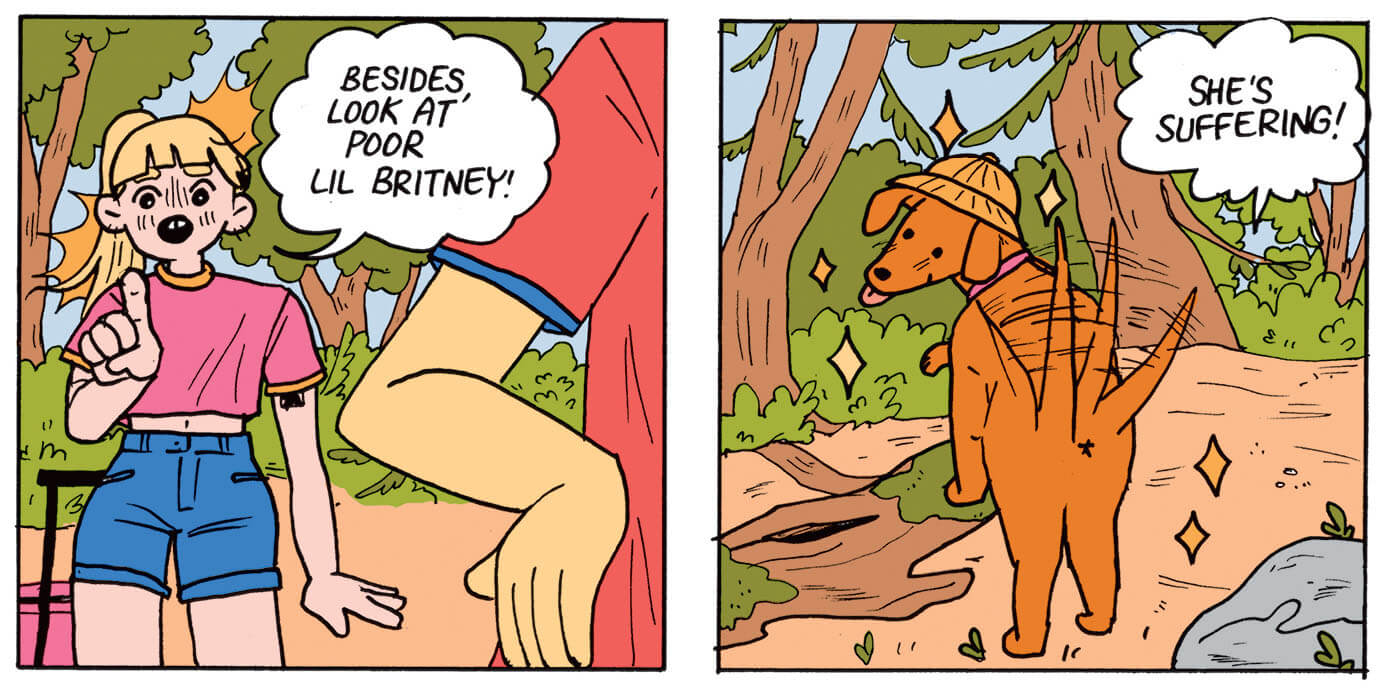
On the subject of backgrounds, Nate does a great job of packing in detail into each panel without feeling too cramped. The amount of color contrast used in any given scene and for each character’s wardrobe make it so there’s never an issue with picking out what’s in the foreground versus a background detail, and both get to stand out quite nicely. Even where there are single-color backgrounds, pops of blue, pink, or orange (with only an occasional black background for dark scenes) behind close-up faces make those backgrounds feel like just another part of the space that each character is in to great effect.
If I have one complaint about the series, it would be how Bunny is essentially the main character of Girl Juice, and the rest of the cast is mostly there to respond to whatever’s happening with Bunny. This isn’t inherently a problem, but it does get a little tiring when the joke is just “Bunny is mean to this person” again. However, this is nicely resolved in the back third of the book with a unique story, “Tallulah’s Demon,” centered around Tallulah for a change.

Without spoiling the story, “Tallulah’s Demon” clearly shows Benji Nate’s chops as a cartoonist and what she can do when not restricted to a social media grid format. Panels aren’t exclusively restricted to six squares a page and there’s more room to play around with the gutters and panel structure to tell a story that can only be told through the language of comics. Having that dedicated space for a longer narrative with these characters makes it much more engaging, especially after getting a sense of what Nana, Sadie, Tallulah, and Bunny are like across these other stories.
Maybe the biggest accomplishment of Girl Juice is more indicative of the comic industry at large, but just having a comic about four adult women sharing space together, occasionally being horny and stupid but still having a great time living their own lives is…So much of the space reserved for comics about and/for women is typically in the form of young adult graphic novels and maybe memoirs or autobiography.
Considering that the majority of best-selling graphic novels, especially those centering women, feature pre-teens or teenagers, comics where women can be fully actualized, have sex, be horny, and be funny — while not having sex be the sole focus — are truly a rare breed today. It’s a common enough practice in publishing where comic publishers take a chance on what is seemingly a market that isn’t as stable, like comics for older audiences, then claim that the market doesn’t exist when the publicity behind said comics didn’t reach those people! We know that the Internet and 2000s webcomics have so much to do with inspiring more USians to read comics when mainstream pubs weren’t putting out that work, and still aren’t in many ways! With a market where comics for adults aren’t promoted to the audiences that want them, Girl Juice is a refreshing change of pace and something I can’t wait to see more of.
