
Carmen is an auspicious name. Not just because it’s my mother’s name, but because it’s the title of one of the greatest operas of all time. Filled with drama and passion, it is the story of the downfall of Don José. He is a naïve young soldier in the 1830s who abandons his childhood sweetheart when he falls for the fiery Romani temptress known as Carmen, only to lose her to the glamorous Escamillo and his own jealous, violent rage. Based on the novella by Prosper Mérimée, Carmen is a four-act opera composed by French composer, Georges Bizet, with the libretto written by Henri Meilhac and Ludovic Halévy. When it first debuted on stage on March 3, 1875, performed by the Opéra-Comique, audiences were scandalized by its boldness in breaking conventions.
There have since been many screen and stage adaptations of Carmen, including 1954’s Carmen Jones starring Dorothy Dandridge and Harry Belafonte. “There’s a reason that Carmen remains one of the most frequently performed operas,” says opera singer and director, Alek Shrader. “Themes that were fashionable in Bizet’s day still captivate audiences. There’s a power struggle between the sexes, a meditation on the question of freedom versus fate, and a stark contrast between the exotic Roma lifestyle and a repressed society. And, of course, everything is set to some of the most gorgeous and tuneful music in all of opera.”
For 2022, the Arizona Opera brings Carmen to an entirely new stage: comics. Written by Shrader with layouts by P. Craig Russell that are finished, illustrated, and colored by Aneke, and lettered by Hassan Otsmane-Elhaou, this graphic novel adaptation — now on Kickstarter — promises an epic 90 pages, as well as a series of beautiful collectible prints from Colleen Doran, Erica Henderson, and Marguerite Sauvage. The Arizona Opera has also commissioned three additional prints from Natacha Bustos, Erica d’Urso and Marissa Louise, and Ana Mirallès for Ariadne Auf Naxos, Tosca, and Magic Flute — operas to be featured in their 2022 season.
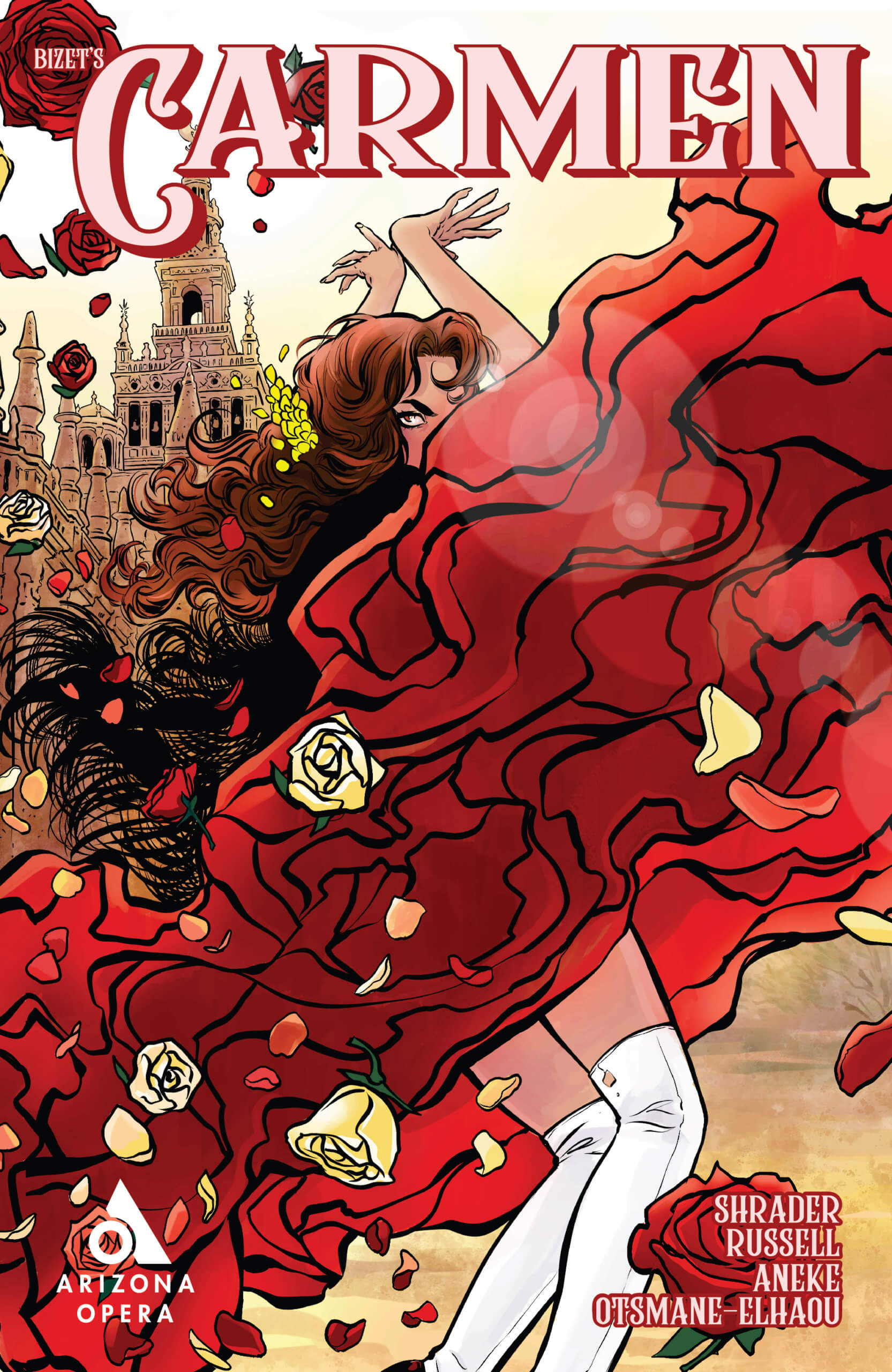
Though Shrader jokes that the idea for Carmen: The Graphic Novel was entirely him, it actually originated through Arizona Opera’s OnPitch Business Challenge, which Shrader’s sister brought to his attention. “We are both raging creatives, and she was sure I’d have *something* to submit,” he explains. “I bounced a few ideas around with her, and she felt a comic book adaptation was both appealing and achievable for an opera company. I wanted to create an opera you could hold in your hands, that you could interact with in a way other than listening (or in addition to listening).” Despite having no prior knowledge of the financial and logistical details of comic making, “a Google-dive into the nuts and bolts of comics” helped Shrader draft a solid pitch, complete with a timeline and marketing plan and an amusing video of his personal comic book collection, all under the tagline: “The Highbrow of Opera meets the Lowbrow of Comics – Unite the Brows! (Monobrow).”
Arizona Opera accepted the pitch, and, although certain audiences might still uphold that opinion of comic books, Carmen: The Graphic Novel will work to bridge that gap, crossing the streams with audiences that might not be familiar with the powerful storytelling that comics are capable of, while simultaneously introducing some comic fans to the world of opera.
Now Shrader is stepping onto a very different stage that offers up “a completely new form of terror,” he says. “Singing in public is harrowing, but this thing will live forever. I want to get it right, I want it to be perfect, I want it to be universally loved. But then again, as an artist, I know that nothing is perfect, and just the fact that the creation exists is all an artist should ever really hope for. Adapting the opera into a comic book script was an immensely fun, wish-fulfillment experience, but there is no way I could have done it without the expertise of P. Craig Russell and Aneke.”
Shrader candidly admits that he reached out to both Russell and Aneke through social media, apologetically explaining that he’s “just some guy who sings and directs opera.” With over 30 years of experience in drawing operatic adaptations, reaching out to Russell simply made sense, but Shrader was shocked to discover that Russell would actually want to be involved in the project. “I first contacted him because I wanted advice from the master, and in his generosity, he offered to do the layouts himself! I couldn’t believe it.”
They are joined by Spanish illustrator, Aneke. “What appeals to me most about Carmen is the strength of her character,” said Aneke in the Arizona Opera press release. “Her timeless appeal to audiences transcends time, politics, and societal change. Through her strength, we see her vulnerability, passion, and sexuality exude from the stage. Through a graphic novel, new audiences can be introduced to one of the most well-known, fearless women in opera.”
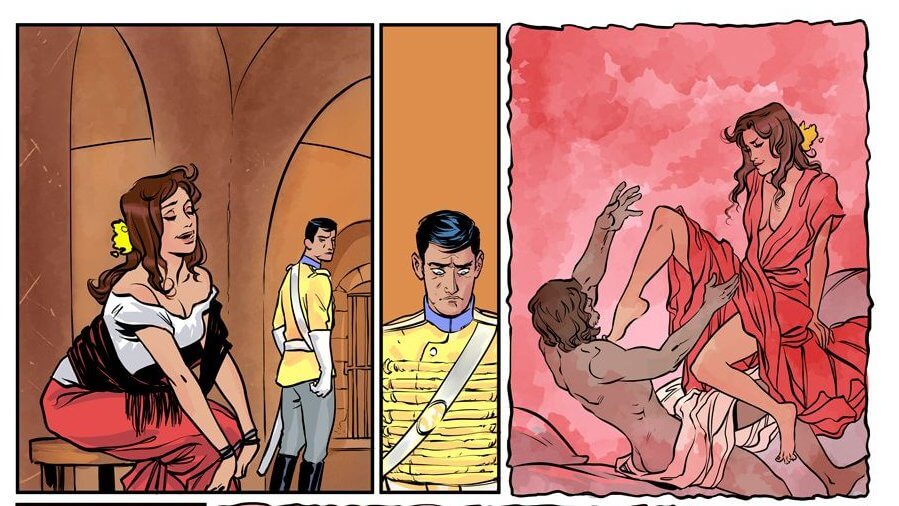
“Aneke is the perfect artist for this book about a young Spanish woman,” says Shrader. “Besides creating gorgeous art, it’s fitting that she gets the final word in how the story is depicted — the novella was written by a man, the opera was created by three men, this comic was adapted by two men… Aneke’s perspective is vital.”
The three share a love for an experience with music that shines through in the story. “Opera is storytelling, but it has the stigma of being exclusive or antiquated. It’s not. Craig is a lifelong opera lover, and Aneke was very familiar. But we all knew the value of music– vibrations that communicate. I based everything in my script on the drama of the opera, and Craig knew how to enhance all of it. Then Aneke finished the art with lyrical, symphonic, musical finesse, and we have a book I am so happy to show everyone.” Otsmane-Elhaou’s always stunningly thematic letters are the perfect final note for each page.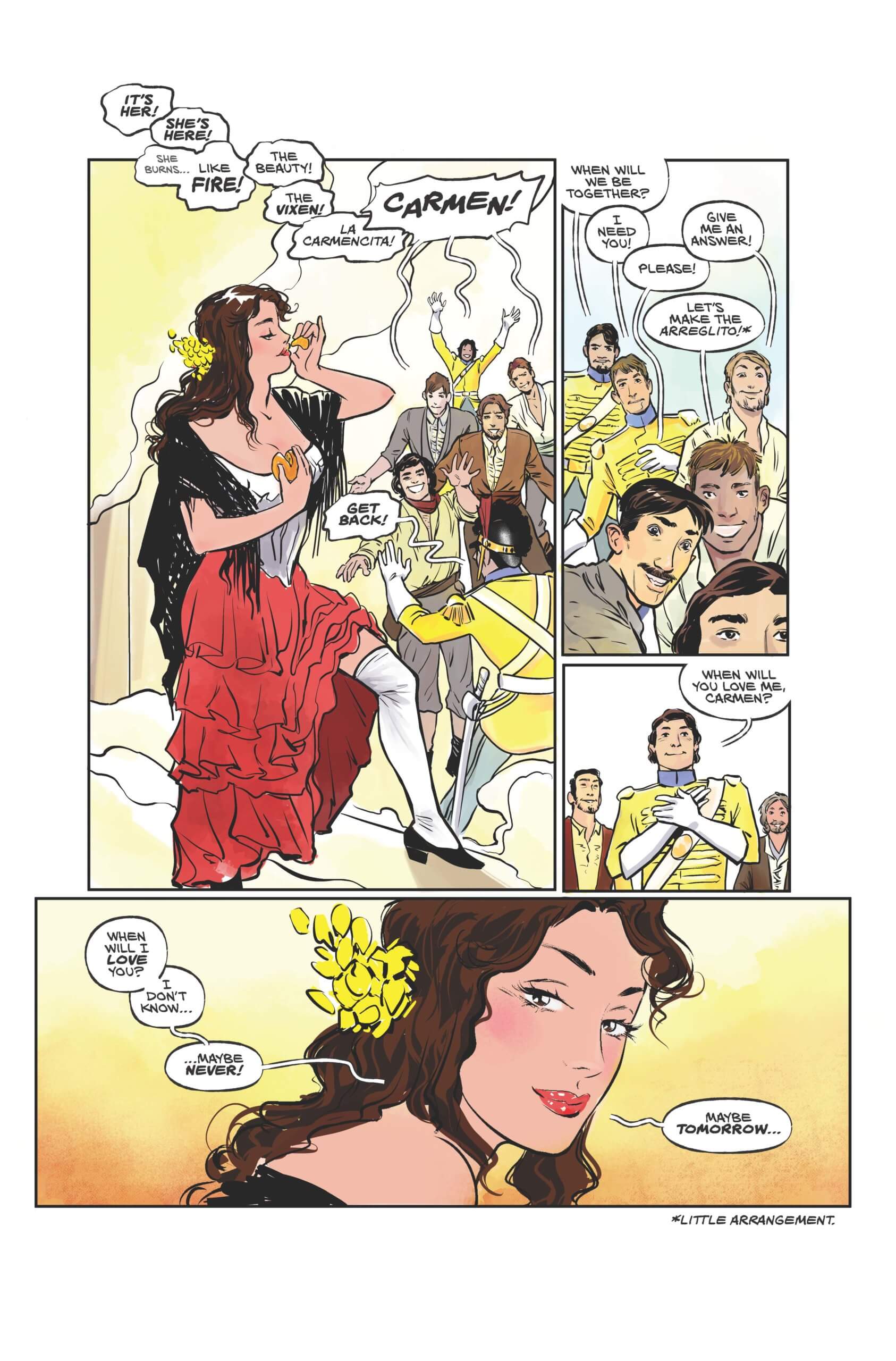
“The biggest challenge was fitting everything into the page count,” says of the experience. “I FOOLISHLY originally pitched a much smaller page count for the full adaptation and I’m too embarrassed to tell you. So we expanded the adaptation to 90 pages, which was still a struggle to give everything enough time/space on the page. These big operatic moments have a certain calculated impact in the performance, including pacing and dynamics. In adapting those moments, much had to be adjusted. Also, I’m a completist but I eventually had to decide which moments were more important to the story.”
Despite many critically acclaimed performances himself, Carmen has not been on Shrader’s list of operatic accomplishments until now. Still, he would love to direct it one day. “But it would absolutely not be an updated/modernized version. That’s why this comic book adaptation stays very true to the original sources. To me, the beauty of Carmen lies in the reality of it all– the young woman living her life in a manner according to herself, with her own autonomy and struggles. That’s a story which is very relevant today, and we don’t have to update it at all to tell it.”
The Arizona Opera’s kickstarter for Carmen: The Graphic Novel is now live.
