
One of the things I love about getting to read indie comics en masse — about going to a zine or comic festival and picking up a million little things and devouring them later — is the wide variety of art styles and perspectives. Engaging with art means I get to see the world through someone else’s eyes, a process that is fascinating and surprising and wonderful. Hourlies — the comics people draw for Hourly Comics Day on February 1st — are the ultimate indulgence, flooding my Instagram and Twitter feed with this variety. Even more thrilling, some artists who normally don’t do autobio sometimes do hourlies! I expend almost zero effort and get to be a voyeur, seeing someone else’s world through the intimate perspective of a single, specific day.
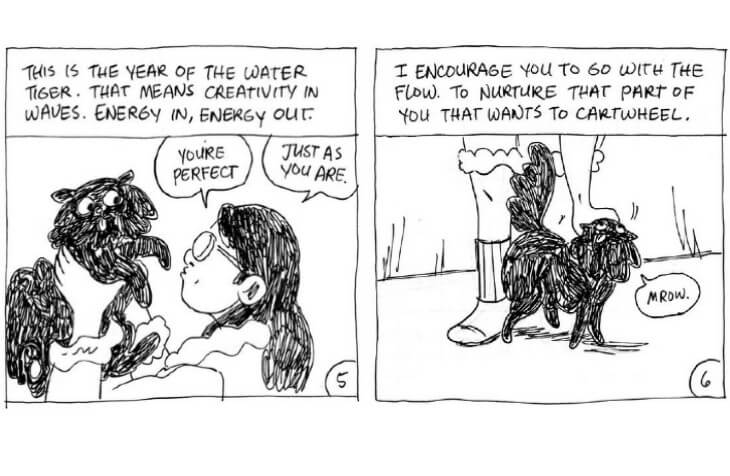
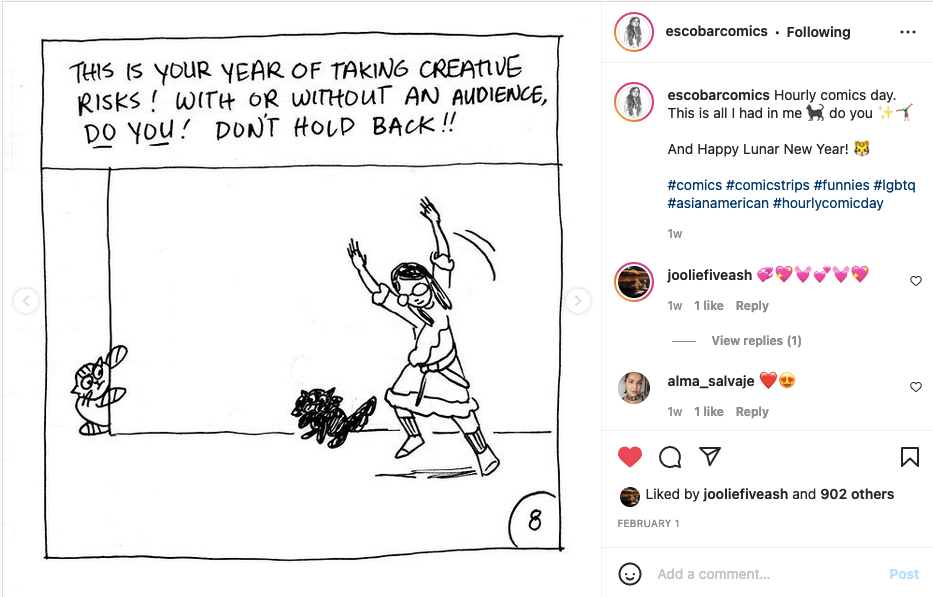
I’m not an artist, and the perspective missing from this interaction is the “why.” Why do hourlies? Why interact with readers through this framework? Is it also a simple indulgence for the artist? Is it cathartic? By making hourlies, are you engaging with art on your own terms, as Trinidad Escobar advises in her non-hourly hourlies? Are you holding back?
As a voyeur, sometimes I feel safe in my feeling that yes, this is a mutually beneficial exchange. Reading Sage Coffey’s hourlies, kicking off with the declaration that they’d recently been cleared to draw as they recover from top surgery, felt like interacting with a gentle, open moment of joy. What a privilege to be invited to such a moment!
Hourly Comics Day 2022 (START) pic.twitter.com/sWwkigkzud
— Sage Coffey ?☕ (@SageCoffey) February 1, 2022
Jessi Zabarsky draws herself as a tiny bunny in her hourlies, and the distance that creates feels like a safe boundary between artist and reader. I’m pretty sure in real life Zabarsky is not a bunny, thus privacy is maintained.
It’s Bun Hours again, folks pic.twitter.com/Jh6EA60BDV
— Hugbox ? (@jessizabarsky) February 1, 2022
With Archie Bongiovanni, there was a helpful line drawn in the introduction to their hourlies. Their “Fuck it, let’s do this until I’m bored,” indicates a desire to engage solely on their own terms. Of course, we all engage in social media in a somewhat performative way, so I could be lying to myself — but this reward of a sweet, silly moment in which Bongiovanni dances with their senior dog is so delicious, I want to delude myself.
10pm : pic.twitter.com/i5mFWmHbz1
— Archie Bongiovanni (@grease_bat) February 2, 2022
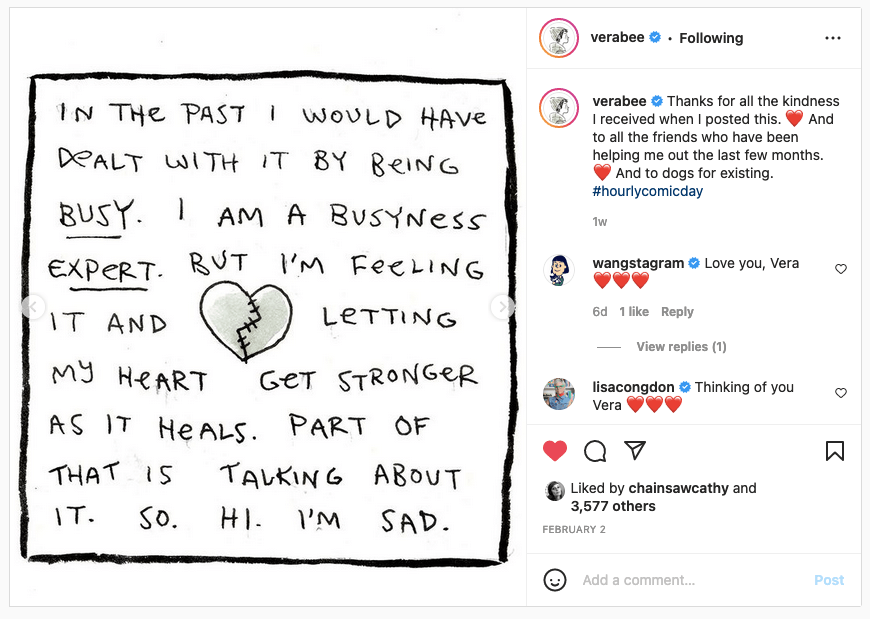
It can be cathartic to cut yourself open in a public forum. I experienced this once in a very personal way when I participated in a zine reading at the now defunct CHIPRC, and I hope this is what an artist like Vera Brosgol felt as she shared a bit about her breakup and moving forward by letting herself feel the hurt.
I hope, too, that there is catharsis and a helpful forging of connections for Shivana Sookdeo, who drew pieces of her day as she acclimates to a new medication. It’s easy to relate to the demands of a cat who doesn’t care about changes in your life and routine, and I appreciate the look at what the process of acclimation can be like. It’s not something I’m experiencing personally, but something loved ones have experienced in the past and might experience in the future.
i’ve been super sleepy and only belated realized i could do zoloft-colored spot for #hourlycomicday but better late than never right#HourlyComicsDay2022 part one: pic.twitter.com/D131z48e8K
— shivana, still (@toastasaurus) February 3, 2022
Maybe hourlies are a practice in attention, as Sarah Mirk learned when she was pleasantly surprised to find herself paying closer attention to the small moments of her day. And maybe I get to feel less guilty creeping on someone’s day when I also fund their Patreon? If I contribute financially to the work in some way, am I less or more of a voyeur?
A few hourly comics I drew for #HourlyComicsDay2022 this week. This was a fun practice in paying attention. pic.twitter.com/DA3vRnE0zH
— Sarah Mirk (@sarahmirk) February 3, 2022
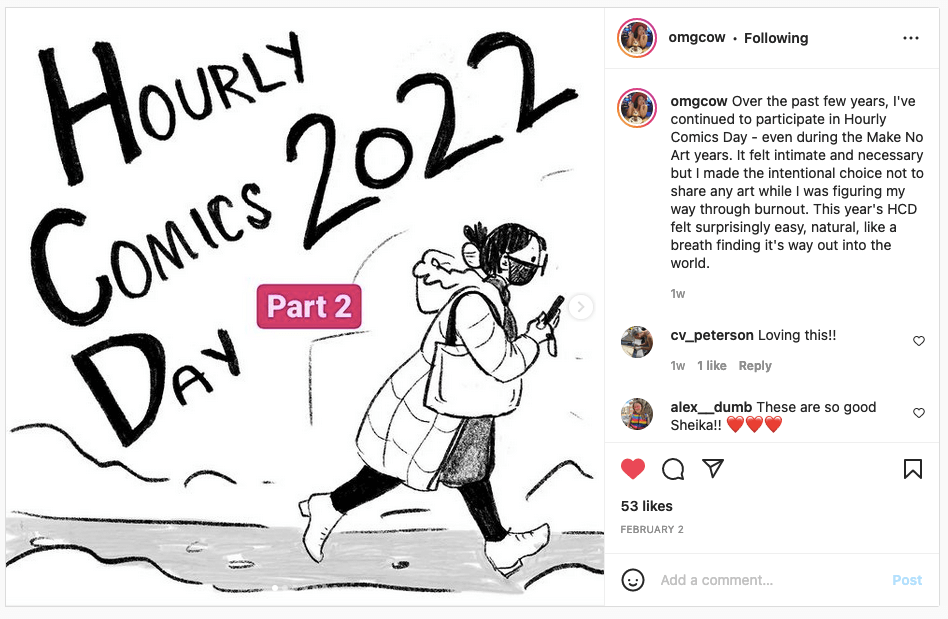
Ultimately, perhaps hourlies are just a tool. For Sheika Lugtu, making hourlies for herself and not sharing them aided her in a time of burnout, bringing her to a point where sharing openly this year felt natural.
But can any artistic exercise be just a tool when there is a whole community participating, creating pressure to participate? Can they be useful for reaching for catharsis when they prying eyes of readers are following the attempt?
There is a familiar lament from cartoonists regarding the time it takes to make a comic contrasted with the time it takes for a reader to read it — years versus mere minutes or hours. I am a fast reader, and I often miss details. But how much work goes into those details? How much thought and emotion is present even in the looser, quicker lines of a day’s worth of autobio?
I’m sorry to be nothing but a self-indulgent voyeur, but as the isolation and trauma of the pandemic wears on, I am especially grateful for your hourlies. The time it takes to read them doesn’t equal the time it takes to draw them, but they still mean a lot to me.
Thank you for your art.
