

If you’re looking for a comic that examines day-to-day relationship realness, Sara Valta’s got you with Polyamory Comics. This sweet and funny collection of short autobio comic strips offers a glimpse into Valta’s life with her boyfriend and his boyfriend, their dreams for their life together, and her adventures in polyamorous dating and self-discovery.
Polyamory Comics
Sara Valta
Dragonhide Studios in collaboration with Digicomix Oy
2022

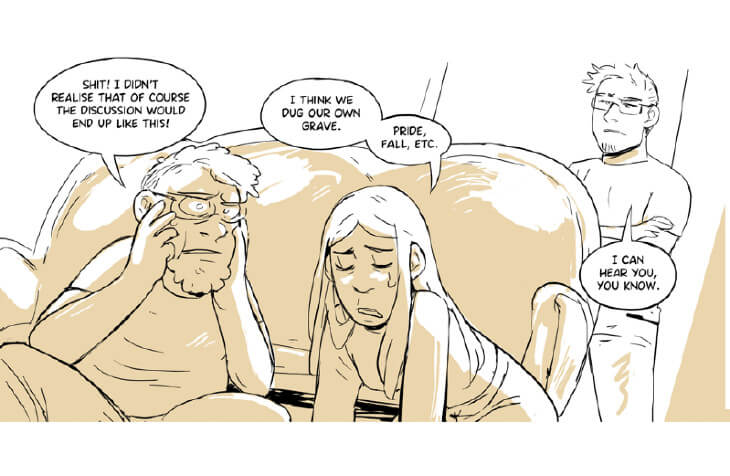
The strips in Polyamory Comics typically feature Valta, her partner HP, and his partner, Paju. All three live together in polyamorous harmony, roasting each other, filling their home with way too many plants, and having deep, serious conversations about what they want their lives to look like long term. If you’re interested in polyamory, this comic will answer burning questions such as: Do polyamorists take down their holiday decorations on time? How many polyamorists does it take to remember cooking advice? Do people in polyamorous relationships date just so they can form D&D groups, or does that happen by coincidence?
Polyamory Comics doesn’t follow a linear story, but the comics are well-organized and have a nice overall flow. Valta includes many flashbacks and reflections on how she discovered her bisexuality and interest in polyamory, and those memories are sprinkled throughout the book in a succession that allows us to see how she’s grown over time. The tone is usually light, even when she discusses her values and identity struggles. Most of the collection feels a bit like a sitcom, if sitcoms included more than one token queer person and always nailed the punchline. The recurring cast of silly characters includes Sara, the plucky but anxious protagonist, HP, the confident but quirky plant guy, and Paju, the quiet one who loves shenanigans.
Valta uses a style useful for short autobio: simple linework that is elevated by unique character silhouettes, sparing use of backgrounds, focus on body language and facial expressions, and a limited color palette. The focus on body language and facial expression in particular gives the comic its humor; following the pattern of Sara being a bit of a doofus, Paju being stoic and reliable and HP being bombastic and extroverted, Sara usually has the silliest, most intense facial expressions, HP often looks incredulous (at Sara’s behavior) or self-assured (because he knows he’s right about Sara) and Paju calm and empathetic as the comedic straight man (except no one is straight.)

The comic’s colors create a very smooth reading experience, allowing readers to move easily from comic to comic even if their themes aren’t connect. The cover is a bit of an exception with its wild explosion of pastels, showing Sara, HP and Paju twisting upward out of their living room and floating toward the ceiling. The endpapers then segue the reader into the comics themselves with a still-colorful softness. They’re covered in neat illustrations of leaves, and each leaf is roughly filled in with the books’ most significant colors – blue, purple, and pink, all on a khaki background. In the interiors, each comic is black and white with one of these colors used as spot color and shading, giving them a visual depth that makes the reading process even smoother. While this a very personal comic collection, it’s clear Valta’s main emphasis is on keeping things light and funny. This isn’t a textbook or a somber memoir. It’s a celebration of her sweet, silly polyamorous life.
In the final third of the book there are three comics that serve as exceptions to this setup, because they are fully black and white and they’re fully serious in tone. I want to single out one of these, because it has a strong impact and reveals Valta’s skill with longer stories and narratives. Polyamory Comics is a very funny and charming collection, and it’s easy to walk away having learned that Valta has a great sense of humor and uses that to share personal stories. However, her more serious work is exceptional. It made me think about the Quick and Easy Guides, which are informational but not boring thanks to the use of solid cartooning, humor and personal stories. Valta strikes that balance as well – in fact, maybe a publisher should tap her to illustrate a guide?
The strip I want to single out is a reflection on asexuality. In many earlier comics Valta discusses being asexual, but in this particular comic she reveals that she no longer identifies as such. The first panel shows Valta lifting one of those earlier pages – pink spot color and all – over her head, clearly in the process of setting it aside. As we leave the color and thus the sillier tone behind, Valta introduces a character who at first is seen in vague profile, looking like a normal person. That person is sitting at a café table with Sara, bombarding her with stereotypes and offensive takes on why she is moving away from the asexual label. Their arm becomes coated with dripping black inks, and on the following page we see that they’re not a person, or have ceased to be one. They have become a ghastly, expansive shadow, banished only when Valta debunks their claims and calls them out as a bad faith actor.

The comic moves on without this figure and digs deeper into Valta’s experience of attraction, and how biphobia, teasing from her peers, sexual objectification and assumptions around what “normal” attraction must be pushed her to disconnect from what were, in fact, normal and fine kinds of attraction to feel. Those heavy black inks return in a couple panels, again giving a visual form to all these forces that, for Valta, turned into self-hatred. Our current-day Valta was able to banish that creature, but the Valta in the flashbacks cannot – she’s surrounded by it, subsumed by it.
While this comic is an emotional read, it is one of my favorites from the collection. The initial visual of Valta setting aside an earlier comic prepares the reader to know that we’re about to dig deeper – it’s like a visual content warning that doesn’t break the reader’s flow. Valta’s visual metaphors (the heavy inks) match perfectly with the text, and she also uses several simple, familiar images – magazine covers of hypersexualized 90s era pop idols, images of manga and anime that she loved but felt shame about loving – that keep us anchored in the very specific era and culture in which she experienced this trauma. Even if I didn’t relate to much of her experience – and I will admit that I do despite being monogamous – I would have a very easy time understanding this deeply complex experience. I’m grateful that Valta shared this, and that she’s done so in such a skillful and accessible way.
If you want to laugh, reflect on identity and relationship dynamics, and see some throwbacks to early ‘00s fandom that will really take you back (Howl’s Moving Castle was very formative for Valta!) check out Polyamory Comics. The English version is available in PDF form on Dragonhide Studios’ itch page, and UK purchasers can get a physical copy from Dragonhide Studios’ store.
