

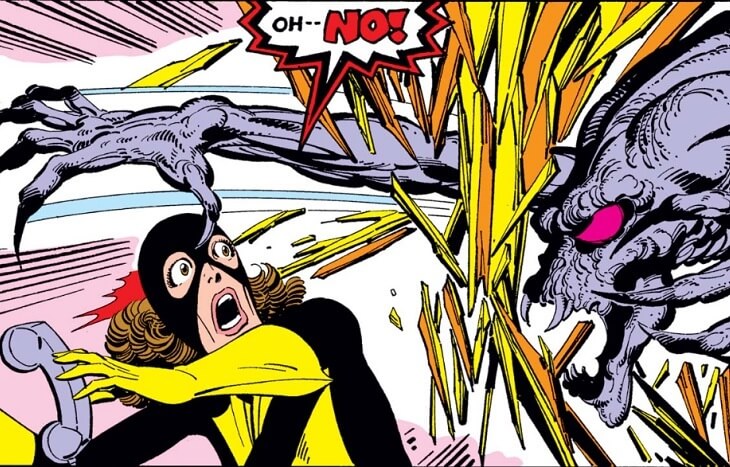
In Chris Claremont and John Byrne’s Uncanny X-Men #143 (1981), Kate Pryde’s Judaism enables her to undertake a series of Home Alone-style shenanigans when the rest of the X-Men leave to visit their families for Christmas. But the role of Kate’s Judaism in this story goes beyond serving as the plot device that leaves her alone in the mansion. Kate’s victory in Uncanny X-Men #143 is the equivalent of a B’nai Mitzvah, a rite of passage that marks a young teen’s acceptance into the adult community (B’nai Mitzvah being the gender neutral term for what is more commonly known as a Bat Mitzvah or Bar Mitzvah). While alone, Kate (at the time known as Kitty) is attacked by a demon from a species called the N’Garai. She uses her training as an X-Man to defeat the demon, wrecking the Danger Room and much of the rest of the mansion in the process. Finally, the X-Men return home, along with Kate’s parents, and celebrate the holiday and Kate’s triumph together. The story of the comic both follows the structure of a B’nai Mitzvah, and carries similar symbolic weight: Kate’s victory demonstrates her readiness to join her community as a full member.
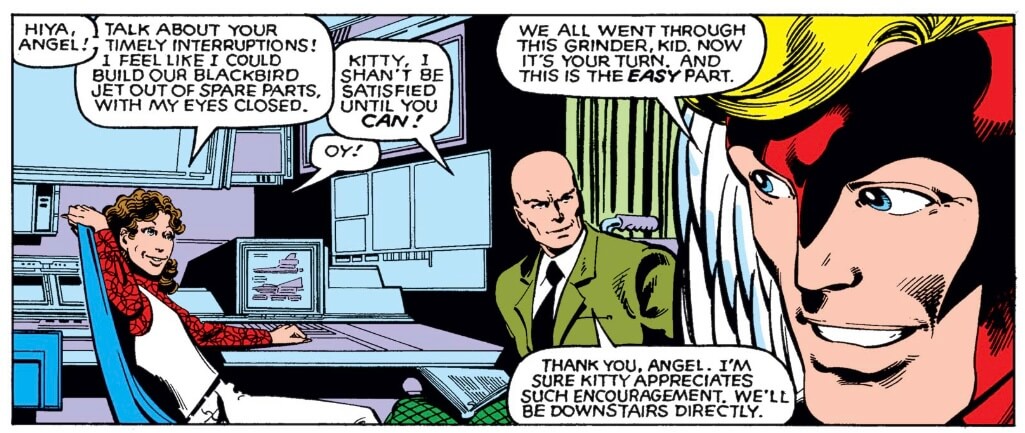
The first step in every B’nai Mitzvah is preparation. While preparation is different for every teen, it typically involves them working with their Rabbi, or another qualified member of their congregation, to practice their Torah reading. Some look to memorize it, but the teen must be at the very least able to perform it flawlessly. Uncanny X-Men #143 has this covered. At the beginning, Kate is studying with Professor X, the closest thing the X-Men have to a Rabbi, the leader of the group and the one most knowledgeable on all things Mutant. At one point, Kate states that she feels she could build the Blackbird (the X-Men’s jet) “with my eyes closed.” To this, Xavier replies, “Kate, I shan’t be satisfied until you can!” When I was preparing for my own B’nai Mitzvah, I voiced a similar sentiment of, “I could practically do this with my eyes closed,” to my Rabbi and I too received a reply of, “I won’t be satisfied until you can.” The way Xavier is preparing Kate to be an X-Man is strikingly similar to the way a Rabbi prepares a teen for their B’Nai Mitzvah.
After the preparation comes the actual B’nai Mitzvah, which for Kate is her fight with the N’Garai. The main elements of a B’nai Mitzvah service are the reading of the Torah, and the D’var Torah, a speech given by the teen in which they analyze the message of their Torah reading and explain how it applies to the real world and their life. While Kate doesn’t read from a Torah or give a speech, she does take actions while fighting the N’Garai that demonstrate this same progression, from mastery to analysis. The reading is pure recitation of a specific practiced skill that can be perfected through memorization. Kate performs this when the demon first arrives. She runs and phases through walls using her phasing powers, just as she was trained to do. It is a challenging, yet routine, task that demonstrates mastery of a specific skill set, the same as a Torah reading. She performs the second task when she defeats the demon using the Blackbird. She analyzes the demon’s strength and fighting pattern and determines that she needs to use alternative means to take it down. She adapts and improvises a creative use of the Blackbird. Here, she takes what she has learned, analyzes it, and applies it creatively to her real life, just like a B’nai Mitzvah does in writing their D’var Torah.
After the service, the last step in a B’nai Mitzvah is the celebration. While this can take many forms — a lavish party with many guests or a small gathering of friends and pizza — it typically involves family, kiddush (a blessing recited over wine or grape juice during the Sabbath and other holidays to acknowledge the sanctity of the day), and everyone telling the B’nai Mitzvah how proud they are. The final part of #143, contains all of these. First, Kate’s parents arrive, and tell Xavier that he “couldn’t have kept us away.” Then, the X-Men are pictured drinking a red liquid, punch or wine, together, which resembles a kiddush. This might seem unassuming, but how often do superhero fights end with a sangria bowl?
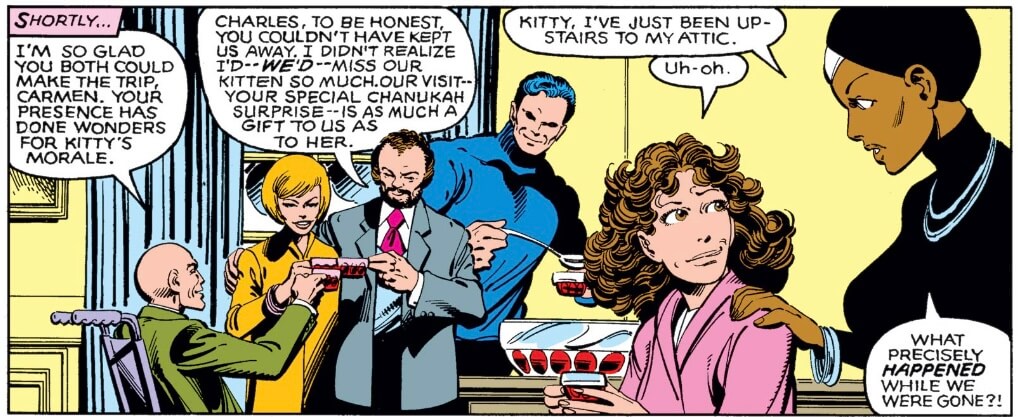
Lastly, Kate explains part of what happened to Ororo and asks if she is angry, to which Ororo replies, “I’m not quite sure. But from the sound of things, I’m fairly certain I should feel terribly proud of you.” The sentiment of, “I’m not sure what just happened, but I’m proud of you I think,” is common from non-Jews after witnessing a B’nai Mitzvah and one I heard from my non-Jewish friends after my B’nai Mitzvah. Between the family, the drinks, and the pride, the last page of #143 is the perfect picture of a post-B’nai Mitzvah celebration.
Kate’s fight with the N’Garai is also symbolically similar to a B’nai Mitzvah. B’nai Mitzvahs are difficult, and a very challenging endeavor for many of the teens who take them on. Some kids struggle with public speaking, or even being in front of a crowd at all, making their D’var Torah an issue. Some kids with less Jewish education might struggle to read Hebrew and have to memorize everything they have to read. Very few kids describe their B’nai Mitzvah as easy. Most describe it as a difficult, but ultimately rewarding journey. Kate Pryde’s fight with a demon is a physical manifestation of the way many Jewish teens experience their own B’nai Mitzvahs as fights with demons of their own.
The B’nai Mitzvah serves as a rite of passage for Jewish teens which allows them to join the Jewish community as adults. Kate’s fight with the N’Garai is even explicitly described as such on the final page: “Alone on Christmas Eve, Kate underwent a rite of passage.” Kate’s fight with a demon serves the same purpose for her as a B’nai Mitzvah does for those who undertake them, allowing her to join her community as an adult. Instead of joining the Jewish community, she joins the X-Men. The X-Men are, by this logic, Kate’s community, and even family.
Comparing Kate’s fight with a demon to a B’nai Mitzvah can also illuminate where the X-Men fail her. In a B’nai Mitzvah, while the reading and D’var Torah are up to the teen, their family and the Rabbi will be up at the Bimah with them, ready to help them if they forget what comes next or what to say. However, Kate does not get this support, being abandoned to fight the demon on her own. This key difference from a regular B’nai Mitzvah exemplifies how the X-Men do not properly respond to Kate’s religious difference. When Christmas comes along, they abandon her, assuming she has no interest in it as a Jew. Ironically, while it is Kate’s religious difference that alienates her from the X-Men, it is also what creates the opportunity for her to prove herself to them, and to herself. The X-Men fail to properly support Kate, but in doing so they give her the opportunity to save herself.
When I read the words “right of passage” I instantly saw the parallel between the events of the comic and a B’nai Mitzvah, which allowed me to reexamine the importance of what had just transpired for Kate, and what it meant for her role in the X-Men, something that non-Jewish readers would have missed. B’nai Mitzvahs serve as a right of passage into the Jewish community and are an integral part of the Jewish identity. By comparing Kate’s right of passage here to a B’nai Mitzvah, it suggests the X-Men are not just Kate’s occupation, work, or school, but a community, and an important part of her identity. While this may seem a little far-fetched for the time when the X-Men were just a small team operating out of Charles Xavier’s mansion, it aligns with the current arc of X-Men comics where the mutant identity is what unifies the whole nation of Krakoa.
The events of the night serve as a rite of passage for Kate, allowing her to prove herself and join the X-Men as an adult, and parallel the struggle Jewish teens face during their own B’nai Mitzvahs. This issue serves, without a doubt, as Kate’s superhero B’nai Mitzvah. Mazel Tov, Kate Pryde!

