

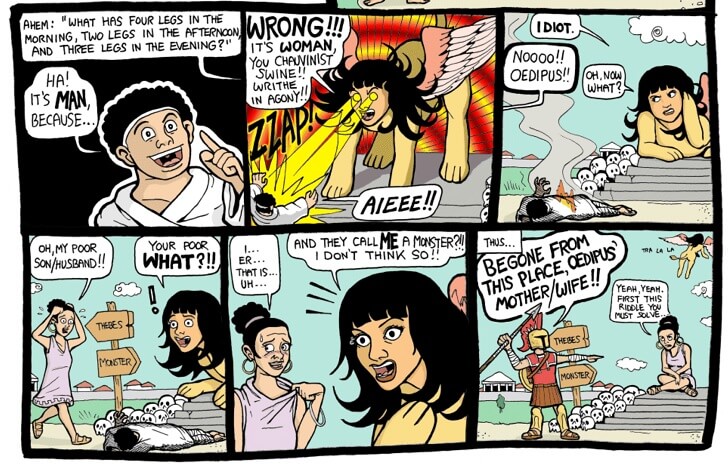
The first thing you need to know about Winston Rowntree’s webcomic Subnormality is that there’s a lot of it. Rowntree began posting in 2007, and as of this writing, there are 231 installments. And many of those 231 installments are gigantic infinite-canvas extravaganzas that can take the better part of an hour to read. It’s a vast and varied comic, including everything from slice-of-life stories and fables to hard science fiction and painfully silly jokes. So for those who haven’t read it before, and maybe even for those who have, I want to take a look back through its archives and explain, once and for all, what Subnormality is about.
![Excerpt from a Subnormality comic in which a character describes "a comic strip [that's] unbelievably brilliant and inspiring"](https://womenwriteaboutcomics.com/wp-content/uploads/2022/07/barbecue.jpg)
Perhaps the most distinctive aspect of Subnormality is its appealing visuals. To put it simply, Rowntree’s art is fun. His style is bright and colorful, with slick, varied linework that feels very solid. The characters are rendered well, and Rowntree has a rare knack for costuming. His characters’ clothes are drawn with impeccable detail, every outfit designed with clear forethought and observational knowledge of what people actually wear. His environments, likewise, are crammed with detail, a mix of believable scene-setting and Futurama-esque background gags. (There are some definite parallels to the Where’s Waldo school of detailing here, so it’s not surprising that Rowntree has in fact drawn a Waldo-style book, the hilariously premised Finding Jesus.) Visual density is inherently compelling, and to look at a Subnormality comic is to want to read it.
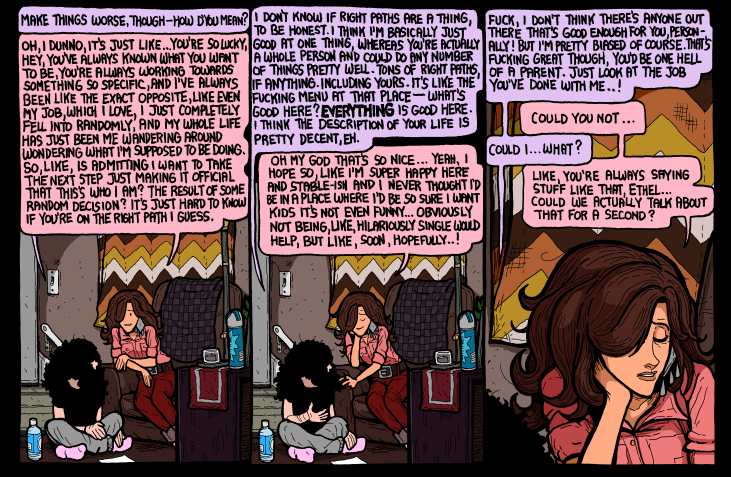
But reading Subnormality is a unique experience, as the strip’s tagline, “Comix with too many words,” is not entirely tongue-in-cheek. While there are plenty of installments with fewer words, and even some that are silent, the quintessential Subnormality strip is one in which at least one panel is crammed with more text than you’ve ever seen in any comic. It’s a strange thing to see. Since most comics are designed to move along smoothly, it’s disorienting to be presented with a single speech balloon that will take you five minutes to read. Whether this is a fun novelty or a tiresome excess is down to personal opinion, but in either case, it’s not a technique one is likely to see anywhere else.
It’s also worth noting that Rowntree takes full advantage of the infinite canvas in a way few others have. Subnormality is the kind of webcomic that is comfortably native to the internet, never beholden to some hypothetical print run that might not ever come. (Though many of the strips, including oversize ones, are in fact available in print–in the form of posters.) A given strip may travel downward for a while and then, partway through, begin moving horizontally. It may have parallel stories that start at different points in space and travel towards each other. Others take a sort of diagrammatic approach, placing additional visual aids alongside the panels to emphasize or illustrate things the characters are saying. It feels completely natural for digital comics to be structured this way, and it makes Subnormality distinctly different from the traditional page-by-page approach.
Individual Subnormality installments fall into several distinct “subgenres.” The most iconic of these is what I’ll term the “main storyline.” Despite its freewheeling structure, the comic does have a chronological narrative of sorts, and it revolves around a small handful of recurring characters of varying degrees of significance. Some of them, in particular the Sphynx and a person known only as Pink-Haired Girl, have been fixtures of the comic from the beginning. Others, such as Ethel the aspiring horror writer and General Pete (lead singer of a “novelty rap-metal band”), began inauspiciously as components of one-off jokes, and then just kept coming back.
Strips in the main continuity are generally realistic, dealing with the quotidian and emotional concerns of the characters involved. But there’s always a chance that a given strip may take a left turn into surrealism, which is perhaps inevitable given that one of the main storyline’s characters is the Sphynx, a literal monster of Greek myth who speaks quite openly about her diet of human flesh. This is not as incongruous as it might sound: the Sphynx, like the human characters, has surprisingly mundane problems; her appearances often revolve around her attempts to accomplish basic tasks like catching a bus or getting her heat turned on. All of the recurring characters are driven by such tribulations, and the arc of the main storyline is the slow accumulation of these events. Pink-Haired Girl, despite not having a name, has gone from being the butt of the joke in strips about retail consumerism to becoming one of the most richly-developed characters in the strip, and along the way we’ve seen her build herself up from a hapless twentysomething to an accomplished career woman. Having run for as long as it has, Subnormality has had a unique opportunity to flesh out its recurring characters, and in the main storyline it does exactly that, and in spades.
Another of Subnormality’s most noteworthy subgenres is one that I’ll call the Great Epic. These are one-off short stories with one-off characters, and utilize the infinite canvas format to the fullest extent possible. For example, in the strip “Message 652,” the infinite canvas allows Rowntree to create a quilt-like spread of disparate moments, vignettes, and juxtapositions. Panels representing different time periods nestle beside each other, and the layout is able to shift from grids of small, staccato panels to vast establishing shots as needed. Print comics often use the convention of placing surprising visual shifts after page turns for dramatic effect, and a similar principle can be seen with the infinite canvas; in this strip and many others Rowntree utilizes large gaps in his layout to push significant moments further down the “scroll”. In these instances, scrolling through the gap and into the reveal feels like the curtain rising on a stage, creating beautiful transitions that are far more organic than one hidden behind a “next” button could ever hope to be. The Great Epics are sprawling and expansive to such a degree that even to call them “short stories” seems misleading: indeed, one of them has even been printed as a graphic novel, and weighs in at 80 pages in that format.
Where the main storyline is mostly grounded in reality, the Great Epics are usually science fiction. This sometimes includes familiar sci-fi tropes (a time traveler’s log of years spent living in the preindustrial past), but other cases go for a more subtle magical-realist approach (a mysterious old house that seems to produce its own neologisms).

The best of the Great Epics have a spark all their own, with Rowntree’s penchant for detail and complexity giving rise to something truly remarkable. In “Anomalies,” (seen above) a college student is drawn into the thrall of an eccentric professor dedicated to the study of inexplicable flaws in architecture. In “Watching,” an observer from the far future frequents a 21st-century hospital to try to understand the concept of illness. In the eerily prescient “I Can Hear You” (published in 2017), a couple quarantine in their house to protect themselves from a Lovecraftian menace that’s drawn to noise. These are fantastic pieces of comics art; beautiful, unique, and memorable. “Anomalies” in particular I have loved since the first time it appeared. Its premise is intriguing and feels strangely genuine, and its story unfolds at a gentle and contemplative pace. And its conclusion brings a very satisfying twist, one that feels simultaneously surprising and inevitable. (And I’m not the only one who admires it–Rowntree’s FAQ mentions that it’s been optioned for an adaptation of some sort.) The Great Epics contain some of the most engaging and unusual work I’ve ever seen in webcomics. If you only read one installment of Subnormality, make it one of these.

There is another recurring subgenre that is, to me at least, much less successful. Call it the Elaborate Visual Metaphor. These are often not comics at all, but rather large spreads that utilize contrived visual devices to describe some aspect of life. In “The Maturity Climb,” cartoony mountain goats embody character traits, with the goats at the bottom of the mountain representing immature traits (“assumes the worst of everyone”), and those at the top representing the mature counterparts (“assumes as little as possible”). More than anything else, these installments remind me of newspaper political cartoons, with little labels on everything in an attempt to convey some sort of preachy moral–and strangely, the moral is almost always some variation on “live life to the fullest.” These strips feel as if they’re meant to convey great wisdom, but in practice, they’re about as insightful as the vague platitudes of your average self-help book. Some people seem to like them, but to me, these are the weakest links in the Subnormality chain.
Finally, no discussion of Subnormality is complete without a nod to its gag strips. The frequency of these has tapered off, but especially in the early years there were many strips that had no aspirations beyond being funny–and they were funny, make no mistake. Many years after its original publication, I still can’t read the one about an invincible robotic Frank Sinatra without laughing. Likewise, the Sphynx landing an acting gig in a commercial, and Shango the Atomic Cowgirl’s run-in with disrespectful townsfolk. If all you want out of Subnormality is a few laughs, you’ll get them.
But, genres aside, what is Subnormality about? Despite not being a continuous narrative in the traditional sense, Subnormality is unified by certain recurring themes and motifs that are consistent even across its most disparate installments.
The most noticeable and consistent of these themes is a plea for empathy. Subnormality’s recurring characters are a largely downtrodden lot, most of them young people drifting through cycles of menial work and unemployment. Some are trying to make it as artists, others are just trying to get by. These are lives that many of us have lived, and it’s comforting to see them depicted with such pathos and understanding.
Consequently, Rowntree’s ire is reserved for the people who make life more difficult for others. He is not at all subtle about his hatred of “jerks,” bad bosses, and the self-absorbed. This hatred manifests in the form of sarcastic vitriol that can, at times, be downright uncomfortable in its intensity. Rowntree’s villains are never well-rounded characters in the way his protagonists are; they are depicted as inhuman and monstrous, existing solely to make others unhappy. It’s surprisingly superficial given the amount of nuance that he affords to other characters, but it can also be cathartic and, to be fair, pretty funny. But these heavy-handed depictions are balanced out at other times, when the comic acknowledges that some cruelties are unintentional, and that some jerks might be decent people having a bad day. In the end, the message is consistent: people are people and deserve mutual respect.

But Subnormality is also aware that we have a long way to go, because its other most consistent theme is social alienation. Its characters are largely isolated, more in touch with their personal demons than they are with their fellow humans. They are consistently confused not just by the mysteries of human interaction but by the modern world more generally. Even the strip’s most enduring friendships are burdened by the characters’ self-doubts and insecurities. This isn’t as grim as it might sound, though. The confusions of the world are often played for comedy, and even the darkest installments generally are tempered by an optimistic resolution. Ultimately, Subnormality is an uplifting comic, even when its subject matter often delves into darker topics.
Reading Subnormality is a unique experience. It’s distinctly different from most comics in some very unusual ways, but its appealing style, silly humor, and genuine pathos prevent it from becoming an austere experiment. The sheer scope of it, both in terms of its large backlog and the generous length of many of its installments, rewards rereading. And through all the walls of text, meticulous detailing, and extreme silliness, it’s built on a foundation of deep and sincere humanity. Subnormality has its flaws, but Rowntree wouldn’t hesitate to remind you that we all do, and the world is richer for it.

