

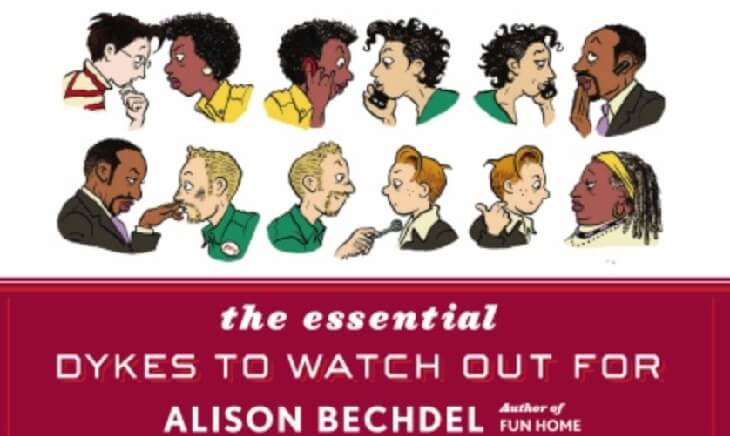
Last year, I realised I was a lesbian.
Fresh out of one of the many closets I’ve occupied, I immediately began to search for a ‘culture’ of sapphism. This meant for me listening to a lot of Kate Bush, reading Susie Bright, and finally picking up a copy of Dykes to Watch Out For by Alison Bechdel. It felt sprung from the queer imaginations of my teenage years spent on the internet — a local bookshop at the heart of a community of lesbians, all participating in political action, and having love affairs.
Dykes to Watch Out For is a quintessential sapphic story, one that captured the hearts of many over the years; it served as a perfect intersection of my newly found lesbianism and lifelong comics fandom. It rekindled an adoration of the comic strip as a medium, the wider story rolling nicely but each strip offering these humorous, emotive vignettes. As I read the characters’ arguments on the label “bi dyke” and merits of gay marriage, along with their astrology nights with vegetarian cooking, it was comforting. Lesbians do have a certain set of values and ideas, ones I could feel a kindred spirit with, and as much as things change the more they stay the same.
Of course, there is a glaring omission to my romanticised view of the strip: as it ran, it developed a position on trans people. From the entrance of Jillian in her “Transsexual Menace” T-shirt, to Jerry’s addition in their community, to Lois’ tongue-in-cheek chemically enhanced butch approach via jokes of starting testosterone and drag kinghood. The protagonist Mo goes through a variety of complicated feelings about trans people. By its ending, Mo’s feelings have matured, largely represented by the strip’s broader acceptance for the trans child Janis.
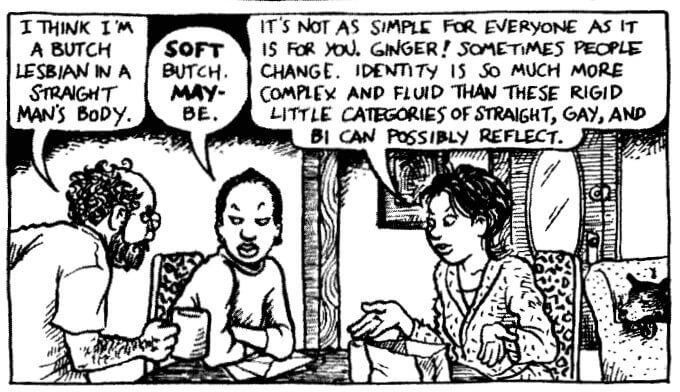
But this piece centres on the above panel specifically, and the character in question: Stuart. He is the father of Jiao Raizel and partner of Sparrow, who is broadly recognised as a bisexual (or in her words: a “bi dyke”) woman. Immediately on reading this strip, I empathised with Stuart immensely. Whilst “trapped in the wrong body” narratives are generally used for cissexist appeal, it does, as a phrase, emotionally capture the frustrations of being trans, of feeling dysphoric in a transphobic world. As a teenager, I wrote love letters, read poetry, and sighed about how I couldn’t be lesbian. How that would be more acceptable than being “fruity.”
Other trans people have expressed similar feelings; these “egg moments,” where our sense of self reflects back to us from pre-transition experiences. And I’m sure many gender non-conforming trans women really feel this sentiment, problematised though it can be. On that problematic feeling it evokes, when reading this panel initially, I sent a photo to friends.
I lovingly captioned it with “Stuart’s an egg,” which can be an endearing term for trans women (and trans people more broadly) who have not yet come out. However, other lesbians didn’t necessarily agree with my assessment. To them, this phrase evoked a particular brand of straight man obnoxiousness. It was the very sort of thing Drake rapped about last year that sent shivers down many people’s spines. And now I was left feeling conflicted in how I viewed this simple moment from a strip. It presented me with a crossroads in my feelings toward my reading.
There seemed to be a question of assumptions; that this couldn’t possibly be someone pre-transition, instead just another man appropriating lesbianism. I do not think that’s the authorial intent at all, to clarify. Stuart is known on the Dykes to Watch Out For website as “more lesbian than some lesbians”. All of this reflection on assumptions brought me back to another, often quoted, moment from the strip. It features trans character Jillian defending Mo in a bathroom, pointing out the irony in Mo’s discomfort sharing facilities with her. It is assumption that often keeps trans people from ever coming out; this is particularly true for transfeminine people, as Julia Serano explored in a recent essay.
Alison Bechdel published this comic 24 years ago in 1995. But sure, trans bathroom panic is a new problem. pic.twitter.com/8n1sR6GW84
— 🏳️🌈 Jocelynephiliac 🏳️⚧️ (@Twippedtronic) March 31, 2019
But perhaps this speaks to the complexities of real life rather than the confines of a weekly strip. That our gendered histories and experiences can lead to different assumptions when it comes to sexuality. Naturally, I was left with one option: to carry on reading. The story developed, showing Stuart’s former girlfriends marrying one another, and how he ended up with a bisexual woman. His narrative shows him as always adjacent to women loving women, despite his gender.
Returning to this panel specifically, the flippancy in the response intrigued me. “Soft butch maybe,” replies a housemate. There is no outrage, just a simple tongue-in-cheek response. One wonders if this moment is based on Bechdel and the lesbians who moved in Bechdel’s circles’ experiences. Perhaps it is. That a generation of trans women, particularly non-feminine trans women, had found community amongst lesbianism without ever having come out. This idea feels contradictory, along the transphobic lines regarding “men in lesbian spaces” that are often said by trans-exclusionary feminists. More broadly too, it can be difficult to discern trans butch identity, as it is seen as a ‘failing’ in a cisgender society to not transition to conventional femininity. Butch trans women challenge all of these ideas in a way that arguably is unsettling for the expectations of trans women.(1)
Trans people can see patterns that are missed in a cisnormative world, even as the story itself develops into a stance of open trans inclusion. While there is certainly a period of transition in the lexicon and understanding of gender as the strip evolves, we seldom have a voice for transfeminine people and their experiences. Janis as a child is still in a constantly learning phase, and rarely is Jillian given a voice across the strip. One wonders if a conversation between Stuart and Jillian could have been a tipping point for him.
There is no clear answer, but it leaves with a good question or two; did Alison Bechdel know a lot of eggs back in the 1980s? And did they ever find the same solace I’ve found, exploring lesbianism, and finding resonance and pride in being a woman? Or perhaps simply, they were pioneering bi wife energy men. But this is exactly why everyone should go and re-visit such a strip like Dykes To Watch Out For – for new readings to enhance and layer it with new perspectives.
1. Hannah Rossiter (2016) She’s always a woman: Butch lesbian trans women in the lesbian community, Journal of Lesbian Studies, 20:1, 87-96, DOI: 10.1080/10894160.2015.1076236

