

Laura Thompson’s chronicle of the lives of wealthy heiresses and debutantes throughout the ages promises to be a quick, witty romp but ends up dragging tiresomely onward.
Heiresses: The Lives of Million Dollar Babies
Laura Thompson
St. Martin’s Press
February 1, 2022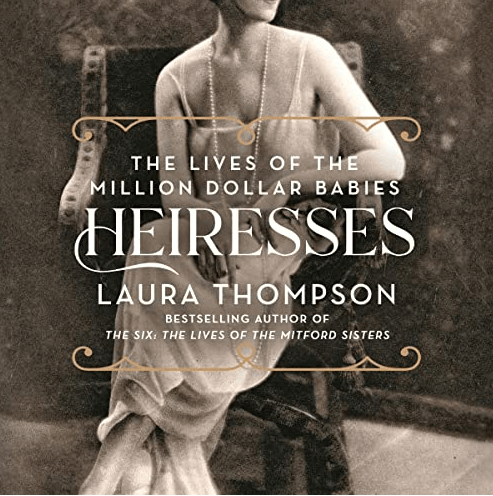
There’s one thing that money can buy: a good editor. Sadly, Laura Thompson was denied this for her book, Heiresses: The Lives of Million Dollar Babies, and what starts out as a fascinating cook’s tour of the rich and often maligned young women who inherited their wealth over the centuries quickly devolves into a disorganized mess.
The book flits from life to life and time period to time period, beginning with heiress Mary Davies, an 18th-century bluestocking who inherited some prime London land and then dealt with a court case surrounding a sudden, dubious marriage that would make her property her husband’s. It then pan-whips through the ages, pausing in the 1800s, the 1900s, and moving quickly forward and backward. Along the way, we meet with other well-covered heiresses like Americans Jeannie Jerome-Churchill, Barbara Hutton, and Alva and Consuelo Vanderbilt. The narrative Thompson constructs attempts to show the way women’s rights have developed across the decades, but the lack of a sense of rhyme or reason thoroughly stymies her attempt at building a focal point. The women are linked together by matching names, or circumstances, or disastrous happenstance, which feels random and disorientating.
The shame is that she’s got a lot to work with here. I knew the stories of a few of her subjects, such as the lonely Doris Duke and the twice accused of murder Alice de Janzé, but other stories are introduced, told in a few quick pages, and abandoned. This is incredibly frustrating, as some women with absolutely fascinating stories are granted a mere mention before being tossed on the ash heap of Thompson’s prose.
This isn’t to say that Thompson is a bad writer; technically she has decent proficiency. She has a way of making each story seem positively fascinating. But that just serves to make the reader yearn for more, and more isn’t coming. She slams the jewel box of her prose shut, and if you want deeper details you have to run to Google and search out other books, which makes her work particularly galling, because she has the chops to give us meatier stories.
Thompson’s research is impeccable when she cares to use it, and she has a flair for unearthing the obscure in an interesting way. She also has a talent for cherry-picking juicy quotes, like Nancy Cunard summing up years of animosity and antipathy against her mother by answering the parlor game question “what would you most like to see enter the room?” with the phrase “Lady Cunard, dead.”
And such teases beg for more sauce. The much-written about Mitford clan earn three paragraphs; Patty Hearst, two and a quarter pages. In the space between, a painfully large amount of nuance is lost. Worse, Thompson fails to capture the outsized personalities of these heiresses in spite of her skillful writing. She sometimes sacrifices historical facts to go on tangents related to her own opinions in the middle of retelling her subject’s lives, at one point opining that “No woman really wants to know that she cannot have children,” while speaking of Cunard’s hysterectomy. This is untrue and represents one of a number of personal comments that don’t belong in a recounting of an historical text. Note that the italics are Thompson’s, sprinkled about her prose when reaching for an arch comment.
The end result is an incredibly disappointing volume that leaves me desperately wishing for a stronger sense of cohesiveness or a higher page count. Heiresses isn’t breezy enough for a light-hearted beach read, and it’s too gossipy to be a historical thesis. An awkward duck, it ends up tantalizing without fulfilling the reader. Thompson has done a better job chronicling the life of Agatha Christie — go read that.
