

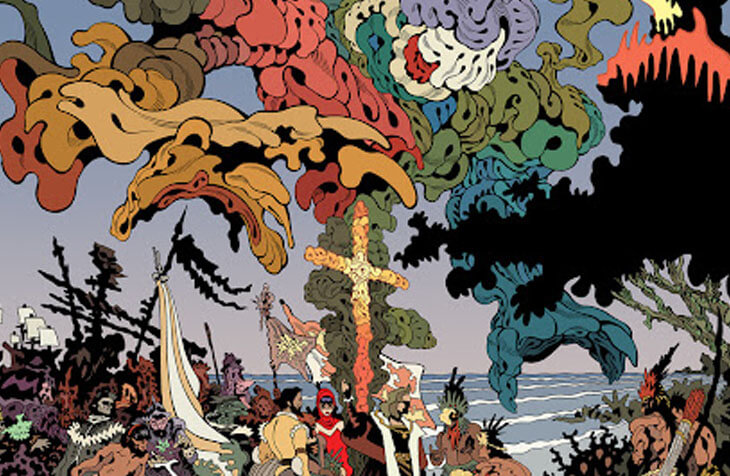
Conspiracy theories, secret histories, and supernatural activity are themes at the center of The Department of Truth, written by horror-thriller mastermind James Tynion IV with its premiere art by Martin Simmonds. Several of its most collectible issues are variant covers, where artists take liberties with the general ideas within the popular comic. Tradd Moore has a particularly thoughtful variant cover for The Department of Truth #4 (December 2020), that is impressive enough at first glance but rewards some deeper consideration. A note from Moore’s Tumblr credited this explosively colorful piece of art as an homage based on two historic paintings, The First Tribute to Columbus by José Garnelo y Alda (1892) and Fireside Angel by Max Ernst (1937).
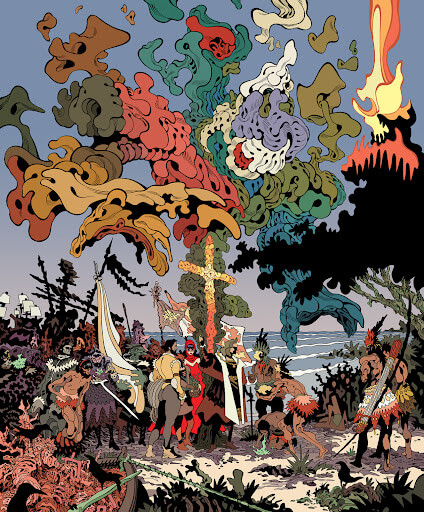
Moore’s scene of the first encounter between Europeans and indigenous Lucayans centers “the woman in red” in front of a burning Christian cross with a massive thought-form emanating from the smoke and clouding the sky. Moore’s scene here serves to extend the historical reach of Tynion’s lore about the exchange and dominance of ideas, while being in itself, a commentary about the inherent malicious nature of religious colonialism being a mode of fascism. More than merely an homage to how the artistic form of surrealism confronts fascism, Moore employs his distinct style, presenting a stunning, memorable, and distinct work of art. Appearing to the public as a variant cover for The Department of Truth, the message encoded within the art can be easily glossed over, or may simply go unseen by many because it gets pushed back in the stack of monthly additions or added to back issue bins, but it begs to be held and reconsidered deeply.
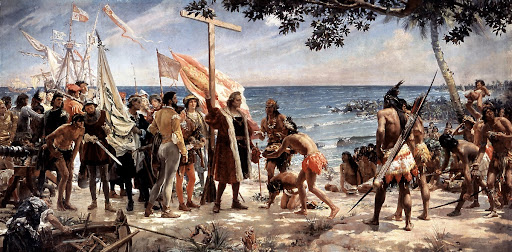
Jose Garnelo y Alda’s The First Tribute to Columbus (1892) depicts the first meeting between Spanish colonists with the Lucayan natives on the island of Guanahani, in the Bahama Archipelago in October 1492, the day Columbus claimed the lands of the “new world” in the name of the Spanish throne. Many details on Moore’s cover speak to the centuries of doom this convergence portends. Centermost is the indigenous man vomiting at Columbus’ feet, he is immediately sickened by the presence of the Spaniards, indicative of the way many Native Americans were subsequently swept into extinction by European pestilence — a bold contrast to the reverently prostrate man in Garnelo’s scene. There are vague, skeletal-like specters hidden amongst the landing party, speaking to the hostile and ghoulish nature with which they historically treated the Lucayans upon arriving. Moore strips away all the grand posturing that Garnelo’s patriotic original assumes, and by including unbelievably fantastic elements, the scene becomes a more honest portrayal of the vibes on the shores Columbus renamed “San Salvador.”
The “woman in red” Moore has added behind Christopher Columbus, is a central figure in the story of The Department of Truth and, though still somewhat mysterious in nature to the story’s context. She seems to at least embody the idea that extraterrestrials have played a vital part in ensuring that the dominant ideas necessary to control our human structures of power are in place, as they currently appear to us to be, and that social narratives flow consistently with those beliefs. Here, the dominant idea being shared by Columbus’ landing party, and chaperoned by this unseen extraterrestrial, is the Christian cross, which Moore has illuminated with the glow of flames, symbolizing the violent nature of Christian evangelizing and also evoking its direct legacy with racial oppression in American history. What is seemingly at first an innocent and nobly rendered meeting between two foreign cultures is also the very moment that sanctioned the commencement of centuries of violent, inhumane treatment in order to convert pagan belief to popular beliefs. By suppressing indigenous cosmologies, outlawing religious ceremonies and dance, destroying cultural artifacts, renaming established locales, demeaning native languages, executing obstinate non-believers, and erasing thousands of years of spoken word folklore, European colonists ensured the dominance of European beliefs and ideals which continue today throughout all the Americas (North, Central, and South).
The popular belief of Christianity, which rippled throughout the Americas, is represented by the colorful thought-form emanating from the glowing cross. Tibetan Buddhist mysticism suggests manifestations of thought, or tulpa, can be created through the spiritual or mental power generated by human belief, which is a device Tynion’s The Department of Truth largely revolves around. Moore’s imposing tulpa dominating the majority of the cover space is interpreted from Max Ernst’s painting Fireside Angel (1937).
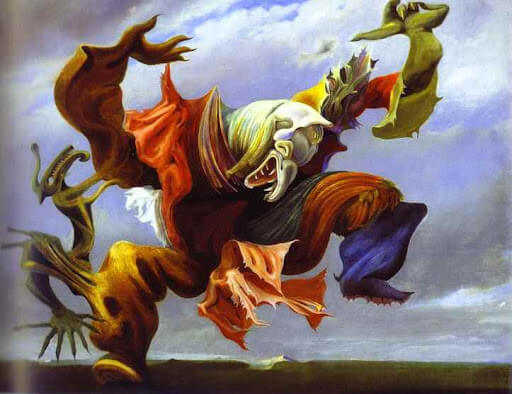
Contrary to the cozy nature evoked by the title, Ernst’s Fireside Angel embodies the chaos and destruction that fascist ideals brought to Europe in the 1930s. The angel is a grotesque, supernatural horror that, while isolated within its frame, threatens to tear itself out of its refined cage. Moore’s “angel” takes on an even more menacing life of its own, reaching its dragon-like claw for the natives onshore, hungry to dominate their thoughts and overwrite their culture. The idea is alive and sentient yet goes unseen, much like the ‘woman in red’ who is present but obviously not perceived by those within the setting. What especially distinguishes this as a unique work of fine art in itself is not simply the fusion of using works of historical fine art to include, validate, and extend the creative license of the mythos being driven in The Department of Truth, but by how Moore’s art significantly impacts a viewer’s perceptions of the original works.
Regarding Garnelo’s original painting The First Tribute to Columbus, it is a challenge to unsee the tulpa or the burning cross, even though the dimensions of the canvas don’t leave room for any skyward depiction. Rather, it is the absence of the surreal angel and the plain nature of the wooden cross that is disturbingly felt. The viewer is forced to subconsciously consider the mundane, unalarming, and unseen nature with which fascism creeps. This further highlights the good faith with which the natives greet their colonizers, as well as the tragic irony that they readily welcomed, sheltered, and fed the same foreigners that destroyed their culture.
Likewise, to look at Ernst’s Fireside Angel is to consider it with greater understanding of the ease with which one becomes familiar with fascism, leading the viewer to question the nature of their own beliefs socially deemed to be “righteous” or “angelic”. Ernst’s painting, first shown in 1937, prophetically predates and predicts the chaos and violence that resulted in Europe by allowing political fascism to spread. Moore’s rendering suggests that fascism isn’t just an idea isolated to the rise of totalitarianism in the 1930s to ‘40s, but that fascism has existed throughout the years, and in other forms, especially evident in the spread of European colonialism and Christian evangelizing throughout the Western hemisphere.
And if fascism can be present within separate ideals, whether enforced by the open malice of Nazi doctrine or proselytized with goodwill by Christian missionaries, then fascism isn’t just an idea, but the blind drive to dominate what others feel, think, and believe. It is an attitude, a mode of operation, carried out blindly by society, and individuals impressed by that society, which has chosen oppression over diversity. Fascism is the spirit of the colonizer, the spirit of complicitness, the spirit of those who benefit in their lives, however briefly, from the disadvantages classism creates from a lower (socially-conquered) class of human.
Ernst’s angel captures both the absurdity and ferocity of this malicious spirit. Intimidating as it is, the message isn’t to despair, but to indulge the consideration: what is the power of an idea? What are we manifesting in our own thoughts? In what way do we actively co-create with our world? Are we subconsciously replicating the violent thought patterns of others because they benefit us? How will the world change if we change our minds, despite the isolating terror of standing against the social norm?
Merging works of fine art from across separate centuries and styles to succinctly capture the essence of The Department of Truth and to extend its reach in a meaningful way is masterful. Especially since this meeting between Columbus’ landing party and Lucayans doesn’t appear as an event anywhere in Tynion’s storyline; it’s a creative and influential episode for Tradd Moore to add to Tynion’s history. The power to impress lies in the details of Moore’s distinct artistic style. Its bright colors and exaggerated perspectives can have the effect of an experimental cartoon, distorted yet familiar, implying cohesive form by focusing on the collection of individual shapes that constitute an object. The colonists and natives in Moore’s scene are equally surreal, the shape of their respective garb incorporated into their form so as to suggest the material of reality is perhaps made up of the same thing as the thought-form looming above them. The admirable details within this setting are countless. Our reality consists of multiple, layered ideas, of the seen and unseen, where factual truth competes and merges with popular belief. This is a powerful statement that confronts fascism and is tolerated by fascists only because, like the surrealism of the 1920s to ’40s, its presentation is too bizarre for unimaginative, fascist minds to comprehend. Those that can see, know the truth.
